OpenAI’s Long Game: The Customer-Growth Flywheel
OpenAI is reducing customer costs, improving model capabilities, and expanding technical engagement.
The competitive results are visible.
According to _The Information_, Replit shifted most of its AI-model spending from Anthropic to OpenAI after receiving a reported discount exceeding 30% on an agreement worth more than $100 million annually.
At Rippling, OpenAI’s share of coding workloads rose from 16% to 52% between May and October 2026. Anthropic’s fell from 57% to 18%. CEO Parker Conrad cited lower costs and model performance.
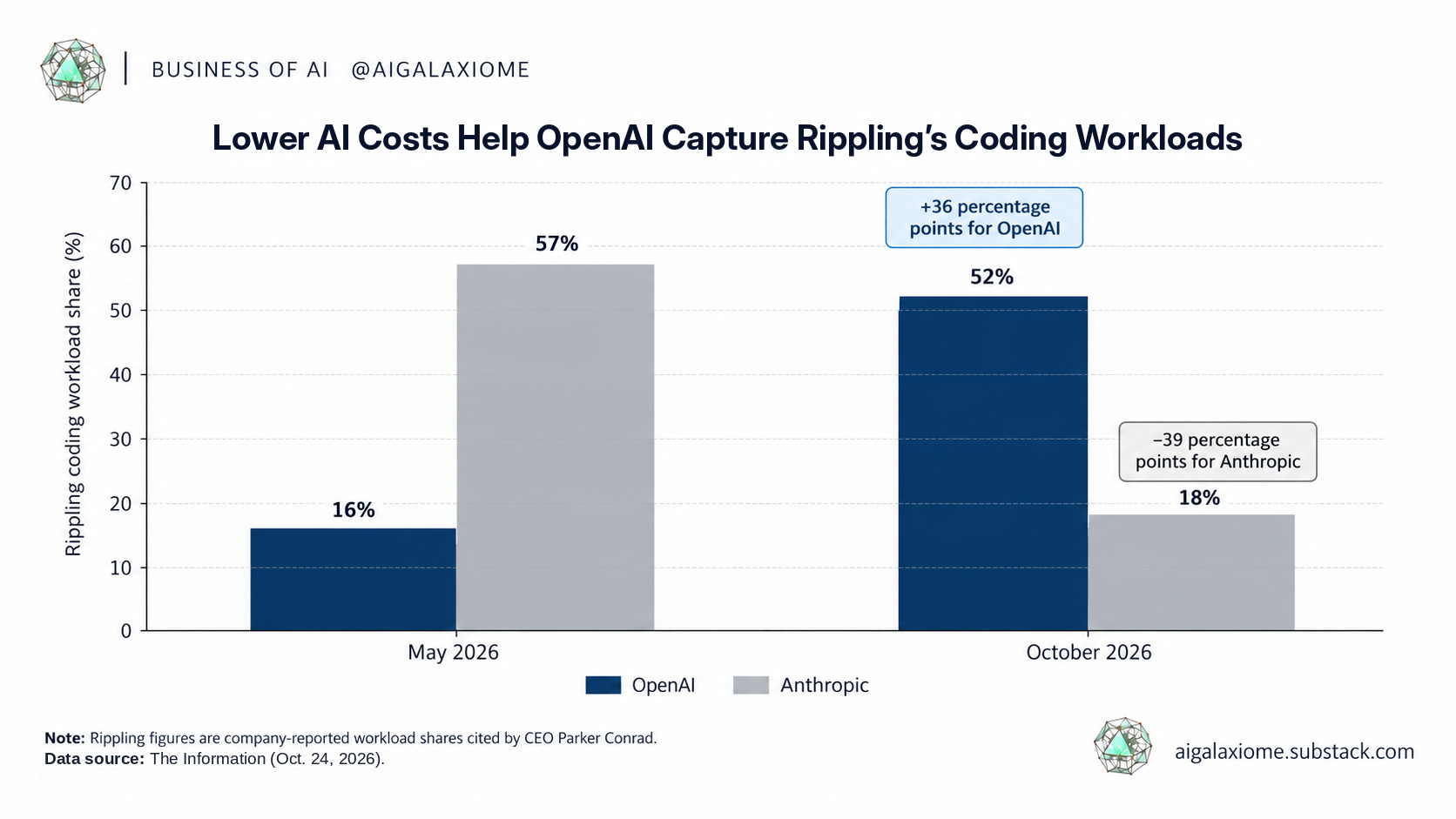

**Figure 1.** Rippling’s AI coding workload allocation, May–October 2026. OpenAI gained 36 percentage points while Anthropic lost 39 percentage points. _Source: The Information, October 24, 2026; figures attributed to Rippling CEO Parker Conrad._
CodeRabbit also moved from Anthropic to OpenAI as its primary model supplier, citing improved model economics and performance.
These migrations raise a broader strategic question.
**Is OpenAI adopting the customer-growth strategy that helped make AWS the dominant cloud provider?**
AWS systematically reduced customers’ infrastructure costs. Customers reinvested the savings, expanded, and consumed more cloud services. Their growth increased AWS’s revenue.
AI presents a comparable opportunity.
Lower inference costs improve application margins, free capital for expansion, and make previously uneconomic applications viable. Growing businesses consume more AI.
The provider benefits from demand its pricing helped create.
The objective is not limited to winning existing workloads. Lower prices can also expand the market.
OpenAI’s recent commercial activity provides several signals.
**Completed migrations.** Rippling, Replit, and CodeRabbit shifted substantial AI workloads toward OpenAI as its models became more economically attractive.
**Prospective adoption.** OpenAI offered DataCamp a 40% discount tied to Codex adoption. CEO Jonathan Cornelissen estimates that proposed changes could reduce AI costs by 80–90%, improving application gross margins. The offer remains under consideration.
**Implemented contract concession.** OpenAI doubled an American bank’s ChatGPT seats without increasing its approximately $40,000 annual contract expenditure.
**Observed pricing elasticity.** OpenAI CFO Sarah Friar reported a tenfold increase in model usage following a price reduction.
**Direct engineering engagement.** Some startup customers have shared communication channels with OpenAI engineers who help resolve technical problems.
OpenAI’s October 26 launch of GPT-6.1 Terra adds a product-level signal. The company cut standard API prices by 50% relative to its predecessor while reporting improved performance and lower cost per completed task.
Higher capability at lower cost expands the range of commercially viable AI applications.
Lower AI costs benefit established businesses and startups differently.
For established companies, lower AI costs improve the economics of new products and business models, including those that disrupt existing revenue streams to sustain competitiveness.
For startups, lower costs extend runway, reduce capital requirements, and make more ideas commercially feasible.
Some will develop products and serve markets that higher AI costs would have made uneconomic.
The platform gains consumption from economic activity that otherwise might not exist.
A provider that improves startup economics attracts more potential disruptors.
Most will remain small or fail. Some will become major businesses. A few will become unicorns or pegasuses.
The provider need not identify future winners. A larger startup customer base increases the probability that future market leaders will emerge from its ecosystem.
As those companies scale, their AI consumption can increase substantially.
The lifetime value of those relationships may exceed the revenue sacrificed through early pricing concessions.
Customer loyalty is strongest when providers demonstrate a sustained commitment to growing customers’ businesses.
That includes favorable economics, technical transparency, direct engineering access, and substantive collaboration.
OpenAI’s October 26 announcement with Fanatics provides an example.
OpenAI and Fanatics engineers developed _Shop the Look_, an AI-powered merchandise recommendation system deployed across Fanatics and major professional sports merchandise sites.
They tested the first 50 products in less than 24 hours, then expanded testing to approximately 30,000 MLB products.
OpenAI reports 10% higher engagement than Fanatics’ previous implementation. Revenue impact remains undisclosed.
Direct technical collaboration helped Fanatics deploy an application with measurable engagement gains.
Successful deployments can generate additional projects, consumption, and adoption across other business functions.
AI is moving toward multi-provider architectures, as cloud computing did.
Customers combine models and inference services across hyperscalers, independent providers, and customer-controlled infrastructure. Hybrid and sovereign deployments add further requirements.
Model performance and price remain essential, but technical advantages can be temporary. Customers can redirect workloads as competing offerings improve.
A provider with a record of improving customer economics has an advantage competitors cannot reproduce through price reductions alone.
That relationship influences model retention, workload allocation, and technology selection for customer-controlled deployments. It also creates opportunities for adjacent products, services, and deployment models.
As models become more interchangeable, established customer relationships become more important to retaining workloads.
These customer wins differ in their immediate commercial significance and potential effect on future demand.
**Replit** reports more than 60 million users, including users at 85% of Fortune 500 companies. Its selection of OpenAI as the default model provider exposes its application-development ecosystem to OpenAI models, potentially influencing downstream adoption.
**CodeRabbit**, valued at $1.5 billion in August, operates an AI-assisted code-review platform used across millions of software repositories. Its decision to use OpenAI as its primary supplier could increase OpenAI consumption as CodeRabbit’s business grows.
**Rippling** represents a different case: a large enterprise software provider reallocating internal engineering workloads based on performance and economics.
These choices can also influence the engineering organizations and developer communities surrounding each company. Technical experience, model preferences, and economic results affect future purchasing decisions.
The commercial significance of these migrations extends beyond current contracts to the additional demand these customers may generate or influence.
OpenAI’s pricing can be interpreted as sacrificing near-term margins to win Anthropic customers.
The evidence also supports a broader interpretation: OpenAI may be pursuing an AWS-style strategy of reducing customer costs to stimulate customer growth and increase future platform consumption.
Its pricing, model improvements, direct engineering engagement, and commercial collaborations are consistent with that approach.
OpenAI has not publicly described this complete strategy. The conclusion is an interpretation of observable behavior, not a confirmed statement of management intent.
Winning existing workloads generates revenue. Enabling new businesses expands the market. Supporting customer growth creates opportunities for additional consumption and longer-term relationships.
The greatest return from reducing customer costs may come not from today’s workload migrations, but from the markets those customers create and the future business OpenAI earns by supporting their growth.
**Provenance & Sources**
**The Information — October 24, 2026.**_Anthropic’s Margin Is OpenAI’s Opportunity._ Reporting on Replit’s agreement, Rippling’s workload migration, DataCamp’s prospective savings, enterprise pricing concessions, and direct technical engagement.
**The Information — September 28, 2026.**_Anthropic Moves to Cut Off Discounts When Customers Hit Their Cap._ Enterprise pricing practices and CodeRabbit’s migration to OpenAI.
**The Information — September 2026.** Reporting on OpenAI CFO Sarah Friar’s remarks concerning model price reductions and increased consumption.
**OpenAI — October 26, 2026.**_Introducing GPT-6.1 Terra._ Model capabilities, pricing, and cost-per-task improvements.
**OpenAI — October 26, 2026.**_How Fanatics and OpenAI Streamline the Fan Experience._ Technical collaboration, product deployment, and reported engagement results.
**Replit — September 2026.** Company disclosures concerning its global user base and Fortune 500 reach.
**CodeRabbit — August 2026.** Company announcements concerning financing, valuation, and product adoption.
Copyright © 2026 AI Galaxiome. All rights reserved. Published by Business of AI @aigalaxiome. AI Strategy | Situational Awareness | Applied AI Research | ROAI