The curious symmetry between quantum error correction and the brain
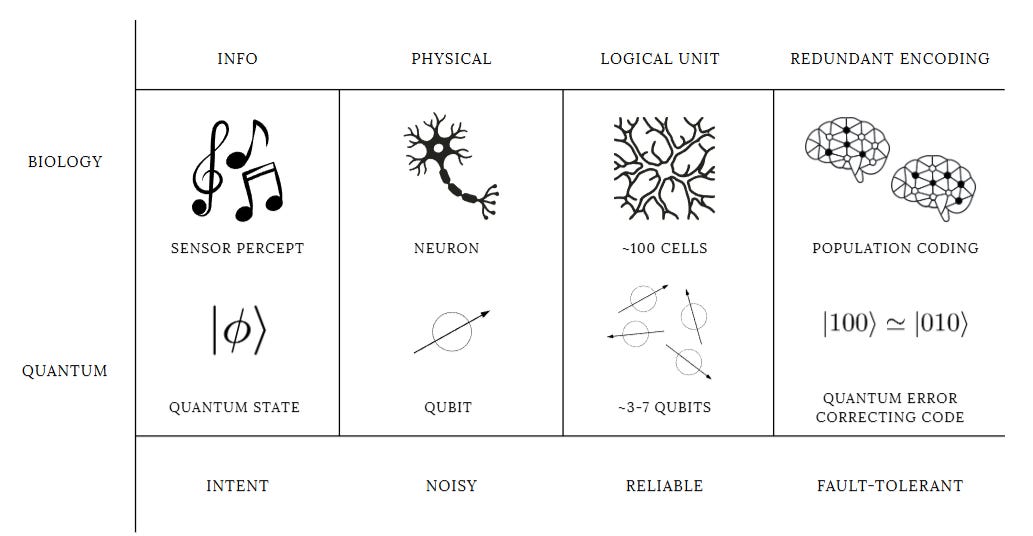

Source: arxiv.org/abs/2607.20534
BACK in the 1950s, the physicist and computer pioneer John von Neumann gave a series of lectures asking how a machine or organism made from unreliable parts could ever compute or behave reliably. His answer has shaped computing ever since. Von Neumann posited that spreading the information across many components and letting them vote to settle disputes would make the whole significantly more dependable than the parts, provided each component failed less often than some threshold rate.
Von Neumann had vacuum tubes and neurons in mind but quantum engineers face a similar problem. Quantum machines are notoriously fragile and noisy and yet still have to process and transmit quantum information reliably. What’s more, quantum information in the form of qubits cannot be inspected without destroying it, which significantly complicates the business of spotting and correcting errors.
That’s why quantum physicists have spent the last 30 years developing quantum error correction techniques that hide logical qubits inside a larger collection of noisy physical qubits. This allows them to repeatedly measure collective constraints, called stabilizer checks, that reveal whether neighbouring qubits agree without revealing what they encode. This allows physicists to correct the inevitable stream of errors that plague quantum machines.
Quantum error correction is a significant feat of mathematical ingenuity. Now Ian Whitehouse and colleagues at the University of Maryland in College Park, ask how this process compares to the way biological systems protect and correct information as it passes through complex networks of neurons. The answer, they conclude, is that both systems employ essentially the same strategy.
That’s important because biological error correction works without the strange quantum properties of entanglement and superposition and runs continuously and adaptively. These are things quantum physicists have struggled to achieve.
“Our structural analogy suggests that new insights into brain-inspired algorithms for collective information processing may inform novel quantum error correction approaches,” say Whitehouse and co.
The team approach the two systems of error correction by translating each object in a stabilizer code into a neural counterpart. Physical qubits map onto individual neurons or small microcircuits. Logical qubits map onto the low-dimensional variables that neural populations encode, such as spatial position or working memory.
The Hilbert codespace where quantum information is encoded maps onto a neural manifold, the set of activity patterns representing valid values of those variables. Quantum stabilizer checks become neural circuit-level constraints such as excitation-inhibition balance; the error-containing quantum measurements become mismatch signals and ancilla qubits become interneurons, oscillatory modes and possibly astrocytes.
Crucially the researchers invoke no quantum weirdness in tissue. “Neurons are treated throughout as noisy classical elements, and no quantum coherence or entanglement is invoked in biological tissue,” they say.
Having mapped the properties of quantum error correction onto their biological equivalents, the researchers test whether they still work using two toy systems to see whether continuous recovery in both systems follows the same mathematical dynamics.
In both cases, the results line up, suggesting some fundamental connection between them. “Quantum error correction and biological error correction in neuronal circuits share a common organizational pattern,” say the team.
However, they are careful to caveat the result. “The correspondence is an analogy of roles, not an identification of mechanisms: neurons are computationally far richer than qubits,” they point out. Even so, the shared vocabulary of action points both ways, offering neuroscientists a measurable notion of code distance and hinting to quantum engineers that the best decoders may be adaptive ones.
Although it has taken some seventy years, Von Neumann would surely be impressed.
Ref: arxiv.org/abs/2607.20534 : Quantum error correction and biological error correction: A structural analogy between qubits and neurons
_INSIGHT_
_This paper’s core contribution is a formal structural mapping that links quantum error correction to how neural circuits keep computation reliable despite noisy neurons. It demonstrates that both systems solve the same problem with mathematically comparable machinery._
_Its value is in what quantum physicists and neuroscientists can learn from this. For quantum engineers the key learning is nature’s ability to adapt. Neural error control is local, continuous, and adjusts on the fly as noise statistics drift. The problem is that quantum error correction typically returns a system to its original codespace, whereas continuous damping recovery in neural circuits does not. Instead, nature trades exactness for adaptivity. So the lesson isn’t to copy biology outright but perhaps to explore a similar kind of trade off in noisy quantum hardware._
_Neuroscientists have long described neural codes using the qualitative notion of as redundancy. Quantum error correction now offers them quantities for formally defining and measuring the robustness of a neural code: codespace, code distance, decoder and so on. Code distance, for example, determines how many physical unit failures can occur before the encoded variable breaks down. This translates into a measurable robustness scale for neural population codes._
_Quantum error correction also relies crucially on additional qubits called ancilla to help correct errors. Something should play a similar role in the brain, but nobody is quite sure what. Potential candidates include interneurons and network oscillations. Whitehouse and co think star-shaped brain cells called astrocytes might also play a crucial role and their goal now is to unravel this mystery._