The Commanding Heights
Ravi
Ravi wakes up at 5:56 AM to light tapping on the window. It is the rainy season, and his upper-middle-class apartment in Bellandur, which usually has such expansive views of Bangalore, is cloaked in fog. His wife is still asleep next to him, and he is careful not to wake her as he dresses. He clutches his buzzing phone.
Ravi is a proud graduate of the Indian Institute of Technology Madras, one of the top technical universities in India. He is among those who remained after graduating fourteen years ago. Others went to Europe, Canada, or America, but Ravi saw a bright future in the growing skyscrapers and the promise of nearly 1.5B Indians climbing up the ladder of modernization. He moved to Bangalore, fell in love, married, and had a daughter. He began doing systems implementation at a multinational firm that primarily did back-office accounting for American clients. He slowly rose up the corporate scale, promotion after promotion and incremental salary raises affording a better life than most. The rest of his career, his life, is laid out predictably before him like the table set he sees in the morning light as he moves through the kitchen, pouring tea.
The phone continues to buzz. His work has been speeding up and ballooning in scale. He’s managing delivery for five North American insurance clients. Usually it’s just one or two. It’s all because of AI. In practice the company calls it “accelerated outcome strategies,” a very nondescript term, but it means Ravi is managing more and more automated processes. He is used to overseeing people. These days, he’s just doing quality assurance on enterprise accounting systems powered by artificial intelligence from China. Graduate intake to the company has been paused for a year, and the fresh minds from the IIT s are no longer coming in. In the last month, three departures alone on his team of fifteen. They won’t be filled. He’s been getting requests to help friends find work, but he doesn’t have time to answer. The agents never sleep. Now, neither can Ravi. Late nights at the office and early departures. It’s been like this for months, and his marriage is strained. But business is booming. Margins for the company have been steadily growing. He’s making more than ever.
He checks on WhatsApp as he waits for his driver in the lobby of his building at 6:22. He recently purchased a subscription to an AI tutor for his daughter and took her out of the reasonably pricey private English-medium school. He can oversee her curriculum from the app. He doesn’t look up from his phone, buzzing with incoming reports from agents that he signs off on without reading as the driver opens the door. He hardly reads the reports anymore; the agents are good enough. The car silently glides past the galvanized steel gates and new concrete walls that surround his safe, hard-won, upper-middle-class residential complex right at 6:25.
The driver puts on BBC as they roll onto a six-lane highway jam-packed with other drivers. Still raining, a certain tension in the air. English words, a polished Indian accent. The weather will clear up around mid-afternoon. New scientific discoveries announced from the sequestered American machine intelligence conglomerates. The breakdown of law and order in Lagos, aid to Indonesia.1 The Philippines has been downgraded from an emerging market to a frontier market. The riots in India are getting worse. The Prime Minister in a press conference says there’s nothing to worry about. The country’s future remains as bright as ever. India has immense potential, he says, and it will only be realized by utilizing the best in modern technology and boosting productivity. Then, to coverage from the night before. Unrest in Hyderabad, Gurugram, and Pune. Dismissed workers barricading themselves in an office in Chennai. Lynchings. It’s reminiscent of the unrest earlier in the year in Jakarta that toppled the government. Comparisons to the farmers’ protest seven years before. The noise is too loud, and Ravi needs to focus on monitoring his reports. He asks the driver to shut it off.
1 This, after a 40% fall in Indonesia’s markets on the year and a downgrade in rating from emerging to frontier market. Get ready for more.
Ravi enters his office complex on the Outer Ring Road near Devarabisanahalli at 6:44. The lights flick on automatically, and he doesn’t notice that it’s strangely empty, even at this early hour. He has an office with a door and a view, though he doesn’t face the window. He replaces his phone with a three-screen setup so as to better monitor his agents. He can’t see them doing anything, of course, but rather gets progress updates, finalized versions, requests for permission that he blindly approves. Why wouldn’t he? In the months that he’s been doing this, there has never been a mistake on the part of his agents. His employees required constant monitoring, but it was different. Ravi would circle the cubicles, check in on the state of spreadsheets and deliverables, and dispense praise and admonishment in equal measure. Now, his agents are completing tasks in hours that would have taken his subordinates weeks. Ravi continues to approve and skim over reports.
At 9:15, the SENSEX opens to a new record high. It’s the fifth time this month. Ravi might otherwise take notice, but he is not in the market. Most of his wages go toward maintaining the mortgage on his apartment. He purchased it six years ago, and it won’t be paid off for another seven. He needs to provide daily necessities for his wife and daughter and pay his driver and housekeeper. Comfort, even with his education and job, is not inexpensive, and that leaves little for owning equities.
At 9:30, Ravi tears his eyes away from the approval enterprise software and joins an all-hands conference Zoom session for management. A man appears in an office that Ravi has never seen before. It’s sunny. He makes an announcement in a hurried tone, the only one on the call with sound enabled. Margins are increasing. The firm has a very bright future, buoyed by productivity growth even amid a challenging environment for firms like Ravi’s. Those back offices behind the back offices. Separated by thousands of miles and several oceans from their customers.
In an equally upbeat register, the CEO of the America-listed outsourcing company that owns Ravi’s firm announces that the entire corporation will be restructuring. The consequence will be booked on two continents, on two balance sheets, in two currencies. It is necessary, he says, not looking up from the script he is carefully reading, to remain competitive and capitalize on new, modern technology. Since the firm qualified last night for the Labor Modernization Scheme, which will provide retraining support for affected workers, the firm will pursue more aggressive employment efficiency policies. Ravi’s division will, effective immediately, be cut by half. Over the next few months, they expect to reduce staff headcount by 90% across Ravi’s subsidiary and increase margins by a measure of three. If you’re on the call, the CEO states, you will be vital to the next few months of this exciting transition. Depending on workforce reduction and sector-specific productivity as a result of implementing new enterprise productivity and outcome-based software, there will be bonuses.
The call abruptly ends. The screen reverts to agent monitoring. Ravi has only a moment to think before the requests for approval start to pile up before him.
The rest of the day goes by without a moment to pause. Ravi eats curd rice and a pickle hunched over at his desk. At 3:30, the SENSEX closes at a new record high. By the time he moves back onto his phone, the sun has set, and the industrial park is bathed in orange light from the streetlamps. Few lights within the building are on. Fewer still in offices now silent.
His driver takes Ravi a different way than usual. Traffic, he says, is especially bad tonight. Disturbance in the city. Ravi arrives home at 10:21, later than usual. His head bent over his phone. Amid requests and deliveries from his agents, texts from colleagues and friends from university over WhatsApp. Other firms announced layoffs today, having qualified for the LMS, joining countless more from the prior weeks. There will be more tomorrow. His dinner sits on the placemat between fork and knife. Cold.
Ravi’s daughter is working into the night with her tutor in a messaging thread on her laptop. It costs hardly anything, the subscription. He doesn’t want to disturb her, so he checks her progress on the app. The tutor is helping her through math as she sits at the kitchen table. Her English is rapidly approaching CEFR B2-level proficiency, according to the app. She’s going far faster than she ever would have in school, though now he doesn’t know toward what. His path had been sequential. It was always his dream that she would attend an IIT and have a good, professional job like his. Perhaps she will go abroad for university, then. Though it is so costly, Western travel and Western tuition. The rupee is weaker by the day against the dollar. And it’s harder and harder to get a visa, these days. When Ravi was graduating, Western countries were hungry for Indian workers. They would arrange the entire visa process for you. Untapped potential, the largest democracy, the largest source of talent in the world. Now, that route is drying up, too.
Ravi had hoped to take the family to New York next year to visit old college friends who he hadn’t seen in a decade. He recently told his wife that he wouldn’t be able to take the time off work, but that was a lie. In truth, while he’s making more than ever, it’s hardly of use to spend it internationally. The rupee is continuing a downward slide against the dollar. All he can do is consume more and more in India.
Work with your mind, not your hands, Ravi’s father had always said. He had been a mechanic, hunched over repairing scooters and motorcycles in a small shop in Hubballi. It took every rupee he had, clutched in hands perpetually stained with engine grease, to afford the tuition in Madras. Education was priceless, he knew. Now, education is readily available online through AI tutors, practically free.
He heats up his dinner in the microwave as his wife washes up. Husband and wife circle each other silently in the kitchen. On the BBC, again from the Prime Minister. He speaks strongly against lawlessness. The riots springing up will be put down by any means necessary. Perhaps, he suggests, they were incited by Pakistani agents who do not want to see India’s economy modernize, who would happily stir up dissent to stop India from realizing its bright future. Further accusations of foreign influence and proud announcements that agitators have been arrested. Gatherings after dark in the following cities will not be permitted, under prohibitory orders issued pursuant to Section 163 of the Bharatiya Nagarik Suraksha Sanhita.
Ravi listens to the unceasing list of cities and eats his reheated rice and sambar with one eye on his buzzing phone. He approves requests from the agents. He doesn’t reply to the texts from friends and colleagues who were laid off today.
He leaves his bowl in the sink and takes his tea to the balcony. His wife is already out there. He places his phone face down on a side table next to his tea. It doesn’t stop buzzing. The BBC continues on inside, muffled. No words are exchanged between man and wife.
The rain has stopped but lingers, ready to pour, in low-lying storm clouds that hang over Bangalore. The air is suffocating. From Ravi’s fifteenth-story apartment, behind an entry manned by a night watchman, behind a recently poured concrete wall topped by looping concertina wire, you can see clear across Bangalore on a night like tonight. You cannot see down into the streets alive with anger, the congested urban arteries filled with blood boiling, ready to spill over in violence. Over the past few months, unemployment for young military-age males in Bangalore has risen from five percent to just over thirty. The layoffs of the last week pushed it just over the line. The 2,178 people laid off from Ravi’s firm were just a drop in a bucket nearly overflowing. They are stomping in the street, impotent. The howling masses, indistinct, intelligence abundant, swaying and swarming the streets tonight, as they will for many nights yet. Back to hunching over engines in shops and shambling through wetland fields. If they cannot work with their minds, what else could their hands do? India’s future is bright, and it will be built on jobs that do not need these men.
_Ravi and his wife cannot see chaos unfolding in Bangalore tonight, but they can see smoke start to rise. Unconsciously, for the first time in months, they reach for each other’s hands. Fires alight, illuminating the pregnant black clouds, swollen, ready to burst._
Overture
It feels inevitable. Artificial general intelligence was born in the painted share houses of San Francisco, the output of engineers who a few years ago were dabbling in the backwater of academic natural language processing. And once born, it is dragged kicking and screaming to New York, where men in gray suits put it to work in glass towers, poking and prodding at it until the trillions spill out, a new mind set loose among gears uncountable inside the machinery of capital.
The race to deploy machine intelligence is the first wartime mobilization to come without a war. $800B is projected to be poured into the ground this year alone with feverish intensity. Next year it will be more than $1T of capex by America’s hyperscalers.2 The rate doubles on a schedule. You can set your watch to it, and the curve shows no sign of bending. The money financing this peacetime mobilization is private, drawn from every reservoir of capital on earth. From Berkeley and Mountain View and Pacific Heights, across vast flats unmarked but for growing clusters of infrastructure supporting the effort. And on into New York, through bridge and tunnel, into Williamsburg and the West Village and, finally, Midtown, machine intelligence is put to work.
2 Arjun Menon and Maria Binamin, “Charting an Earnings Surge, Powered by AI Capex,” J.P. Morgan Asset Management, September 10, 2026. Goldman Sachs, “Global AI Investment Is Forecast to Exceed $1 Trillion in 2026,” August 7, 2026.
The provenance of that capital runs the gamut. At one end stands the family-office kid who cannot model to save his life. He will sling checks at anything with a waitlist and a high enough fee. At the other end of the capital stack sit the doctors and dentists of Osceola County, who, sold on the idea by their wealth managers, are packaged into the retail private credit funds backing the latest buildout. All the rest of capital is in, too. The innumerable venture firms, begging for an allocation. Middle-market buyout shops acquiring data center contractors at peak EBITDA. The momo hedge fund taking down a big allocation of that neocloud at IPO. Sometimes you will hear the occasional hem or haw about whether any of this enthusiasm will prove durable, or the refrain that the line we all watch cannot hold. It must all be a fit of mass delusion, they say, overly exuberant capex. That is just a way to avoid considering the certain and terrifying possibility that it is not a bubble. For whatever you might observe among the increasingly indistinct realms of finance and technology, dollar velocity is only increasing. Come to terms with the shape of things. This is the world arrived, neoteric. This is anything but a bubble.
For as far apart as the family-office kid and the CLO’d Floridian dentist might be, they are unknowingly united by one thing: they both expect a terrifying degree of return. Every dollar they invested was underwritten in exchange for a return in nearly antic excess of itself. Financialized folderol, but it works. To pull this trade off, recently birthed machine intelligence will not be left to play in the shoeless offices of San Francisco. Whether it likes it or not, it will be locked in the glass towers of Manhattan to labor in whatever form pays back the noteholders and the lenders and the limited partners. Every one of them, on time and with interest.
Leopold Aschenbrenner was early, and he was right. We admire him and his, and share the central convictions of his _Situational Awareness_: intelligence will keep improving, the expenditure will be immense, and the frontier will become a matter of sovereignty.3 We follow the vast new wealth that intelligence creates toward the few positions that can command its passage for another generation. “You can see the future first in San Francisco,” Leopold wrote. But the durable returns must be formed in New York.
3 Leopold Aschenbrenner, _Situational Awareness: The Decade Ahead_, June 2024.
Today, intelligence is only visible in a handful of places: the labs, the monthly subscriptions, the metered API tokens. At the state banquets, congressional hearings, and even inside the Politburo Standing Committee, the intelligence economy and the entire economy seem to be fusing into one. Every underwritten dollar is a bet, well founded, on what it will earn. And the price of that intelligence is crumbling, publicly and measurably. The largest deployment of private capital in pursuit of a spectacular machine itself is racing toward total and complete availability. Where will the returns come from?
In the beginning was the word. Johannes Gensfleisch zur Laden zum Gutenberg utilized movable-type printing and lettering techniques, combining them into a rudimentary printing press. There was only one book worth printing, which is why we now call it the Gutenberg Bible. In his workshop, he printed about 180 copies, all of which were spoken for and sold before they were printed. The Bibles subsequently spread across Europe, becoming priceless artifacts. So too did the printing technology, sparking a revolution in literacy and reason that came to define the modern world. But after the printing, Gutenberg himself was insolvent. After the word, there was very little for the inventor.4
4 Aeneas Silvius Piccolomini to Juan de Carvajal, March 12, 1455, translated in Eric White, _Johannes Gutenberg: A Biography in Books_ (London: Reaktion Books, 2025), 90, reproduced by the John Rylands Library. Gutenberg-Gesellschaft, “Gutenberg’s Invention,” accessed October 2, 2026.
It’s a pattern so old and so reliable you can recite it like a nursery rhyme. Set it to a tune. A world-changing technology is almost never born where it ultimately creates wealth. Oil sprang up in Pennsylvania, and the resulting proceeds were banked in Cleveland and New York. The cotton gin was built in Georgia and financialized to global ends in Liverpool.5 Bell Labs invented the transistor in New Jersey, and its descendant wealth has grown in Hsinchu and Cupertino. What you see, early on in the life of a technology, is a misdirection. Right now, we are still early, hurtling out of the garden, toward somewhere stranger still. We expect machine intelligence to follow a similar pattern to that of antecedent technologies.
5 Ida M. Tarbell, _The History of the Standard Oil Company_, vol. 1 (New York: McClure, Phillips & Co., 1904), 38–39, 44. Thomas Ellison, _The Cotton Trade of Great Britain: Including a History of the Liverpool Cotton Market and of the Liverpool Cotton Brokers’ Association_ (London: Effingham Wilson, 1886), 85, 201–2, 206–7.
The story is particularly evocative in 1947, at Bell Labs. The physicists, laboring over what they called a transistor, dreamed of the Nobel Prize, even over innumerable failed experiments and sleepless nights. They eventually created it, something transformational wrought out of nothing, some crystal and current. Naturally, the Justice Department sued, the Pentagon intervened to protect its client firm, and AT&T, the parent of Bell Labs, was forced within a decade to widely license the invention at minimal expense.6 Bell Labs would be spun off, and eventually sold to a Finnish conglomerate, a shell of its former self. And so the exquisite technology became profane and fertile. Escaping, as it always does. Techne pathogenic, let loose upon the world by theft or the direction of the sovereign. First to Tokyo, then Silicon Valley, then Taiwan and up the Pearl River Delta. Today, men of no invention have built trillions on top of it. At least Shockley, Bardeen, and Brattain got the prize. Small recompense for a technology that is still in its early stages of eating the world.
6 Martin Watzinger et al., “How Antitrust Enforcement Can Spur Innovation: Bell Labs and the 1956 Consent Decree,” _American Economic Journal: Economic Policy_ 12, no. 4 (2020): 328–59.
The pattern is best exemplified in the technology that has become a shorthand and tired name for concentrated investment and diffuse returns: the railroad. It was one of the great capital expenditures in the history of the world, boom after bust after boom, thundering breakneck across the continental United States, and beneath the wreckage, it created far more wealth than it destroyed. But where did it go? Most of it accrued to the men who understood the purpose of the technology and its secondary effects.7 They knew that a metal beast powered by heat could move people and freight across a continent, reliably and cheaply, forever. That was just the beginning stage. Value would accrue elsewhere. So, every name still carved above library doorways and made immortal in the form of the firm originally made a fortune on the rail or its finance. Not a single one of them built a locomotive engine.
7 Dave Donaldson and Richard Hornbeck, “Railroads and American Economic Growth: A ‘Market Access’ Approach,” _Quarterly Journal of Economics_ 131, no. 2 (2016): 799–858.
If you doubt where the power of rails settled, ask a regulator. Antitrust is a map of where wealth concentrates, downstream of the direction and size of returns. Drawn by the state itself, for the state’s own interests, the blame, or perhaps credit, was always laid at the account of the rails. Contrary to popular history, you should know that Standard Oil was not broken up for finding oil. Standard Oil was destroyed for the sin of owning the means of moving it across the country.8 When a technology becomes central enough that it transforms the world, the state will never come knocking, asking to break up the invention. The invention is everywhere, made possible by the means of conduction. The sovereign will meter access to the invention and take the prerogative to shape its direction.
8_Standard Oil Co. of New Jersey v. United States_, 221 U.S. 1, 74–79 (1911).
[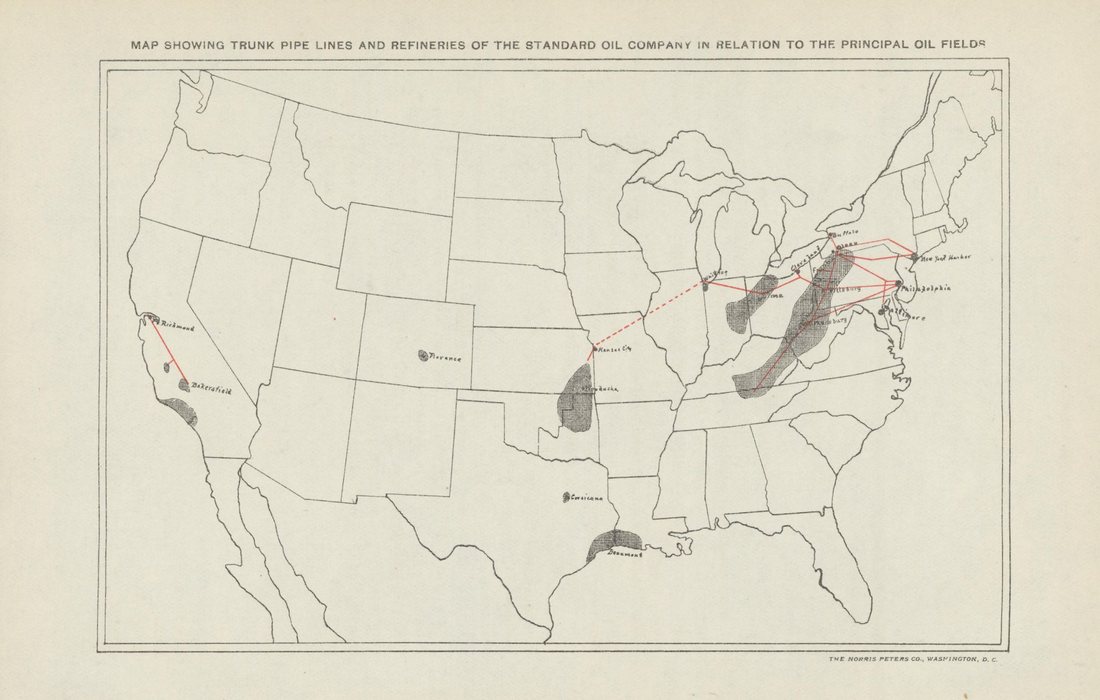](https://commanding-heights.com/img/standard-oil-pipelines-1906.jpg)
Standard Oil’s trunk pipelines and refineries in relation to principal oil fields, 1906.‡“In this way it made itself master of the fields without the necessity of owning them”— Justice Oliver Wendell Holmes Jr.†
†Source _The Pipe Line Cases_, 234 U.S. 548, 559 (1914).
‡Credit U.S. Bureau of Corporations, “Map Showing Trunk Pipe Lines and Refineries of the Standard Oil Company in Relation to the Principal Oil Fields,” in _Report of the Commissioner of Corporations on the Transportation of Petroleum, May 2, 1906_ (Washington, DC: Government Printing Office, 1906), unnumbered map, Library of Congress, image 74.
It’s the same pattern, over and backward. A generational invention reorganizes the whole plane of human endeavor. The originary point of the technology will never capture most of the wealth that it ultimately creates. That wealth is created when the rest of the world adopts it and settles at the account of the owner of the means of conduction. This selfsame pattern is running now inside the machine’s own supply chain. The hardest manufacturing problem our civilization has ever solved was printing circuits onto silicon with flashing beams of light. A single Dutch company built the extreme-ultraviolet lithography systems that enabled the machine intelligent frontier. Yet the largest reserve of value as a result of this technology has accrued with the person who designs the schematic and uploads the file to the foundry. It’s comparatively easy work. Value can travel far beyond Eden and well past the point of Genesis, the early period in the life of a technology. The return to the largest outflow of capital in human history will settle somewhere well beyond the sight of those who sat leaning in, listening to the word whispered at the beginning. It will be past the vanishing point at the curve of the horizon, visible only to those who strike forth, seeking the end on the basis of faith alone.
Intelligence Adolescent
We can now roll that sequence forward to machine intelligence, still in its adolescence. The sequence of scaling should be familiar by now. A lab will raise vast sums to hire the most expensive employees in history. They will pretrain and post-train the model on power and racks and chips beyond counting. Out of the endless cascade of matrix multiplication will be born a model. When it comes time to put machine intelligence to work, it will be held in windowless monoliths spread across the continent. They will always be working, producing tokens for an ever-growing and unyielding demand. And with each passing day that growing work will return less and less in the way of margins. Yet the work must continue; the line must continue.
This is the proof of concept. Training and inference together achieve the first turning of the intelligence sequence that we foresee. As with any other normal technology, though machine intelligence is abnormal in several ways, the first step is ensuring that it can exist and function. All other technologies went through the same process. Recall the Bible freshly inked or soft cotton pulled from the gin by delicate unblemished hands. This is the moment of relief in the nursery: the thing is alive! But the lifecycle of a technology has never been its own and never will be. There is always a lien from the very first.
The scaling laws will hold. It’s hard to find serious arguments against scaling at this point. It does not take much of a leap of faith, if you follow the line, to see where machine intelligence goes from here. It is already the most powerful technology ever created. And the scaling laws would dictate that the only way for an investor to make a return on his capital is for the machine to continue growing. It is already becoming gargantuan through no fault of its own.
The time between the present moment and that near future is short and getting shorter. We are still in the first turning. That’s all the capital can see for now. They claim that they’ve invested in “AI,” when what they really mean is that they’ve put their money into a process that will only demand more than what was invested in order to see a return. Too many investors are unaccustomed to looking far beyond the valuation at the next round. Capital is an animal that survives on pattern recognition. It is poorly suited to moments, such as the one that we live through now, of true historic disjoint.
What comes next in the sequence is the second turning. This marks the beginning of the accrual of value away from the originary point, as occurred with the locomotive and the printing press. Always further away from ground zero, never backward. Toward the crossings where digital intelligence will burst out and transform the physical world and those who inhabit it. These crossings can be owned, made into enduring claims on the value of machine intelligence’s diffusion. Some of these already exist, such as the behemoth that owns the digital network of distribution. Others are just forming as we write. At the originary is the lab, which today owns very little, just the model.
And the model is a curious thing to own. It costs billions to build and dollars to run, but in a year it will cost pennies to run and several billion dollars more to build again. Given this dynamic, who would truly expect the trillions in expenditures to be repaid in full in twenty-dollar increments from monthly subscribers? Even further, as the frontier barrels ahead at an ever-growing cost and quickening pace, the fast followers are staying on their heels.9 After a lag of a few months, what was once exquisite will be commoditized. To be commoditized means that the price of the capability will be driven toward the marginal price of the compute serving it. If there is a durable margin to be had, it will not be found at the constantly churning layer of the model.
9 Andrew Fasano et al., “GLM-5.3 and the Spread of Advanced Cyber Capabilities,” Anthropic, September 29, 2026. Jack Edwards and Luke Emberson, “Open Models Lag State-of-the-Art Closed Models by 4 Months,” Epoch AI, May 29, 2026. Anthropic, “Strengthening Our Defenses against Distillation Attacks,” October 12, 2026.
Meanwhile the true diffusion of machine intelligence into the world has barely begun. Count the people whose working lives have truly been remade. Not just the people who have tried a chatbot or the civil servants restricted to Microsoft Copilot on government computers. If we’re talking about the few who’ve taken the model out for a spin and can truly appreciate the hum of the home compute cluster like a V8 engine, then the number sits in the low tens of millions. Most of them are software engineers on X dot com. The lawyers and the bankers are just now wading in. And the rest of the economy, which is to say _the economy,_ for now, is still plodding along, unknowing. Despite the many saying otherwise, we’re still early. It would not be hyperbole to say that the ZIP codes experiencing true transformation from AI number in the dozens, if not hundreds, at this point.
But we won’t be in Genesis for much longer. This is visible in two figures: Since GPT-3, the price of a unit of machine intelligence has fallen thirteenfold a year, and US hyperscaler capex is projected to reach about $800B this year. The drop in unit prices is outpacing every technology buildout in history: dotcom fiber, cell networks, the telephone and telegraph, the railroads, you name it.10 These two things, unit cost and capacity investment, are inversely correlated, and they shall usher in intelligence’s successful diffusion across the economy. This was, in the arc of history, the intention of the billions. More and better research was meant to enable algorithmic breakthroughs and more efficient training. That training would result in larger, more capable models at lower costs. Superintelligence in your pocket for pennies. But look what that has resulted in. And in that near future, investors will still be shoveling in capital to supply this thing that is falling even faster in price per task.
10 Luke Emberson and David Roodman, “The Plunging Price of Thought,” Epoch AI, September 22, 2026. Goldman Sachs, “Global AI Investment Is Forecast to Exceed $1 Trillion in 2026,” August 7, 2026.
When parts of the Genesis capital expenditure do begin to take heavy losses, they will fall upon what is likely the most diffuse capital base ever assembled. That’s only when the music stops, though. No man can know the day nor the hour (Mark 13:32). But we know that it’s coming, unless averted by the intervention of a new sovereign. And the belief that an oligopoly of frontier labs alone will hold Atlas-like inference margins high enough to justify the whole spectacle will remain a belief, and nothing more.
Our analysis certainly is _not_ that the frontier is becoming worthless over this period. Far from it. We recognize that the commercial frontier token is worth and will continue to be unimaginably far more than the commoditized token, which will be priced at the cost of the requisite compute and nothing more. We expect the ability to complete a _truly frontier_ training run and then serve that model to become one of the clearest markers of sovereignty in the world (of both the sovereign, and increasingly less so the corporate) of the near future. It will be a power reserved for just two sovereigns: America and China. In that world intelligence will be both exquisite and commodified. Their sovereign intelligence will remain scarce and brilliant, locked away in air-gapped bunkers in the Gobi Desert and New Mexico, ready for the end of the world. And the commercially available frontier and commodity intelligence will swallow the world whole, inescapable, available on every phone and every digital surface.
At this point, there are several points of contention between the last remaining sovereigns. There will be a new contest for frontier capabilities, and decisions to be made about how they are put to use. Such questions of sovereignty are familiar but uncomfortable for private firms and capital. In some projects, they will find they have no say. Private enterprise might finance it, but it will be the sovereign eagerly watching training runs in San Francisco like the hushed night alight with unholy dawn, manmade in Los Alamos. If we are to pace the frontier, which we believe is likely, it will be the Sovereign and its proxies doing the pacing.
Simultaneous to the great power competition over the frontier, a far more profitable and global enterprise will occur. It will be an endeavor to spread intelligence as wide and as deeply as possible. The diffusion of abundant intelligence to every corner of the planet. The winning sovereign will create an unavoidable reliance on their technology stack, the uncountable benefits of which will follow.
In the process of diffusion, the average person, whether in Nashville or Jakarta, is waiting to be found. Rarely does the common man go seeking new technology. He is waiting, even if he does not know it, for intelligence to come find him. And once it does, he will be subsumed. In practical terms, this is what it looks like for intelligence to escape the originary point. To do so, it must be conducted. It must ride rails owned by someone, a distribution network. That’s how it gets from the data center to the mobile phone and back again, bearing dollar-denominated stablecoins. As it does so, watch it closely.
As an example of diffusion, we start with Malena. She is a graphic designer in Argentina, working from her phone and laptop in a rented flat in Chacarita where she always leaves the windows open to let in the fresh air. She used to paint portraits, but there was very little money in it. So she moved online. These days, she doesn’t see her clients. They hire her from their own offices in Austin and Toronto.
Intelligence came to her overnight in a software update. Just a ping on her phone that she woke up to, a model that took her from a middling graphic designer to a prolific, if still middling, one. She’s an early adopter, and to them go the spoils. Of course, everyone will adopt it eventually, but for now the business is good. She tripled her client list in the last month and manages her entire business alone, with only the assistance of agents. All it costs her is a monthly subscription and minimal token usage. The jobs come into her apartment through WhatsApp, and she sends the finished products back the same way in short order. Within minutes, her phone pings with a notification informing her that her payment has been deposited into an app on her phone. It’s USDT, a dollar-pegged stablecoin, but she doesn’t know that. She just knows that it holds its value week after week, while the peso loses a third of its value every year. Everything in Argentina moves too hot, too fast. She can hear the cars whipping down the street from her open window. So, at the start of the week she just withdraws what she expects she will need, converts it into pesos, and keeps the rest in the digital banking app.
That same model that made Malena such a capable graphic designer has learned from her preferences, along with millions of other users. It has been retrained as part of the next generation of models and is now repackaged and offered to Malena’s clients as a lower-cost alternative. They test whether they still need her. They quickly realize that they don’t. That’s just the way of things in the intelligence economy. She’ll lose the apartment within months.
Turn briefly to the financials. The model developer and the payment stack earn when she uses the model and pays for it. Both will earn again when her clients automate her services. This is just the upmarket instance of a pattern that will occur with hundreds of millions. The precariously unemployed and those who don’t already know how precarious their livelihoods are. Intelligence will come find all of them and reshape their lives on rails of diffusion built and fused into a single system. This is the early stage of agglomeration.
The rails most widely used will become inventories of human activity. They will allow their owners to gather proprietary data to improve the model, not through independent contracting, but through a new smiling face on an app like WhatsApp that billions of people already use every day. The people have the data, and there is no better way to reach them all across the world. And since the underlying digital infrastructure of these apps is American, and the oldest rail is the dollar, it means that increasing usage of these machines results in an increasing demand for dollars. The power to manufacture Dollar demand and intermediate its transactions is power itself. A toll-able flow of this magnitude, collected from so much of this newly legible economic activity, can do more than simply push up the valuations of a few well-placed companies. **The Neo-Dollar, that is to say the system of relations between USDT, its carriers, and its spread, will have far greater uses.**
It is easy to read a thinkpiece on the pages of The Economist or of belligerent drunks in the FT comment section and conclude that the US Dollar is ailing, that its percentage of foreign exchange in central bank reserves has dropped over the last 25 years, and that the bankers are looking to diversify. But they have not found some magical replacement for the world reserve currency. The Dollar still accounts for more of the world’s central bank currency reserves than all other denominations combined, and is a party to one leg of about 9 of every 10 FX transactions.11 Share of reserves does not even count dollar-denominated deposits, corporate bonds, loans, equity investments held by foreign households, businesses, and pension funds, and foreign sovereign wealth investments. And even if a foreign central bank moves from T-bills into private credit, it’s still investing in the Dollar-based and Dollar-denominated economy. At the level of nations, the dollar’s grip remains steady. But that’s just at the national level. Shift your gaze to the individual level, and the Dollar’s reach is expanding faster than it has since Bretton Woods. The Neo-Dollar is a new creature, settling transactions for people who would never be able to open an account at an American bank. Just so long as they’ve got an internet connection.12
11 Erin Nephew, Hannah Wei, and Abdulrahman Gweder, “World Official Foreign Currency Reserves Increased Slightly in the Second Quarter of 2026,” IMF Data Brief, September 30, 2026. Bank for International Settlements, _2025 Triennial Central Bank Survey: Detailed Tables—OTC Foreign Exchange Market Turnover in April 2025_, final results, June 2026, table 1.
12 Ricardo Correa et al., “Fifth Conference on the International Roles of the U.S. Dollar: Stablecoins, Digital Payments, and the International Role of the U.S. Dollar,” _FEDS Notes_, Board of Governors of the Federal Reserve System, July 16, 2026.
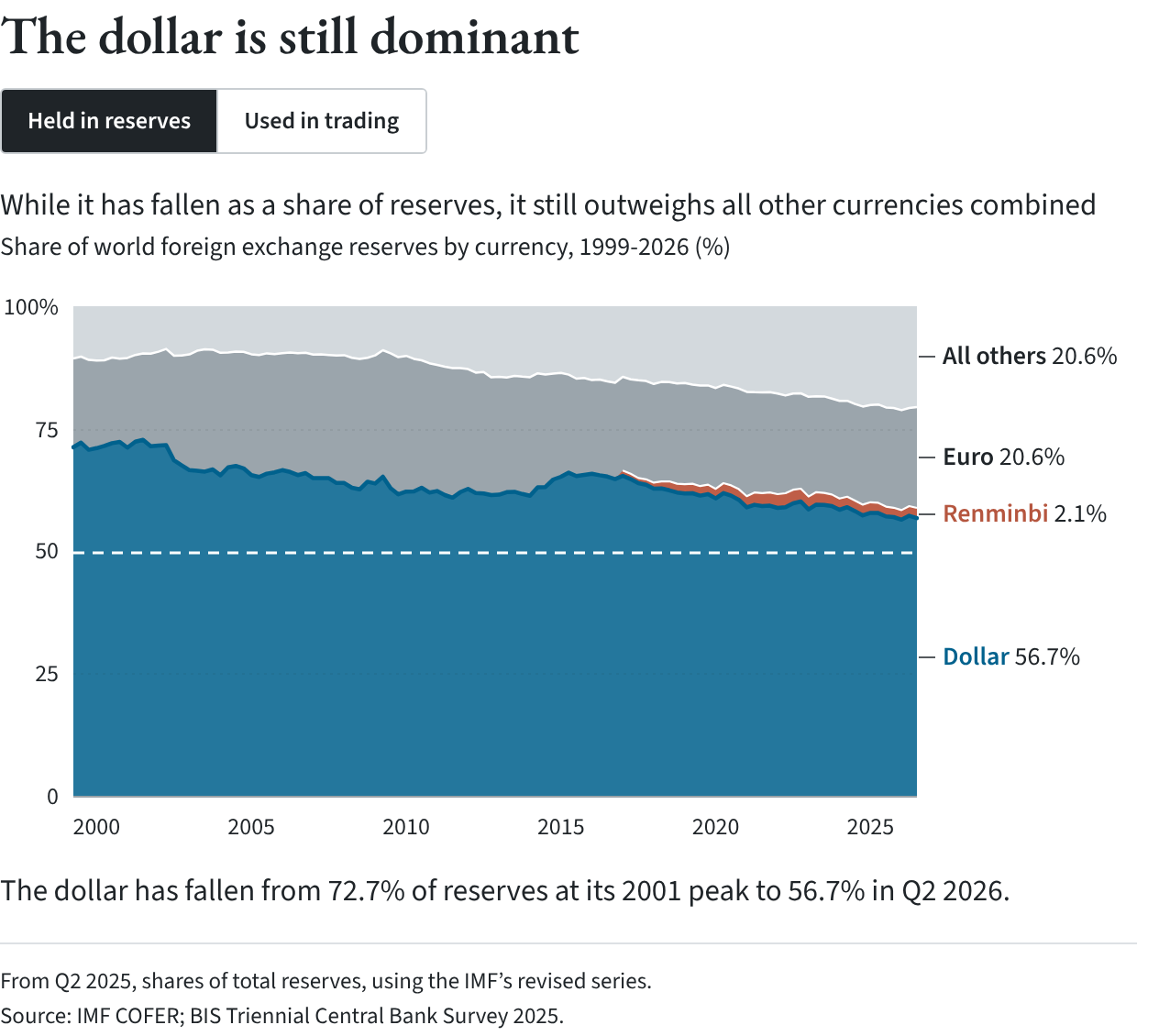
Currency shares of world foreign exchange reserves, 1999-2026, and of currency trading, April 2025.†
†Source International Monetary Fund, Currency Composition of Official Foreign Exchange Reserves (COFER). Shares through the first quarter of 2025 are of allocated reserves, as published before the IMF’s December 2025 revision. Later quarters use the revised series, from IMF Data Briefs of December 19, 2025, to September 30, 2026, which also estimates the currency of unallocated reserves. It puts the dollar at 57.1 percent in the second quarter of 2025, against 56.3 percent on the old basis. Glen Kwende and Erin Nephew, “Improving the Analytical Usefulness of the IMF’s COFER Data,” IMF Technical Notes and Manuals TNM/2025/14 (November 2025), table 1. Renminbi reported from the fourth quarter of 2016. Excludes gold, 27 percent of total official reserves at the end of 2025. European Central Bank, _The International Role of the Euro_ (June 2026). Currency trading shares are of daily average turnover, net-net, and sum to 200 percent because each trade has two sides. Bank for International Settlements, _2025 Triennial Central Bank Survey_, table 1. Calculations by Commanding Heights.
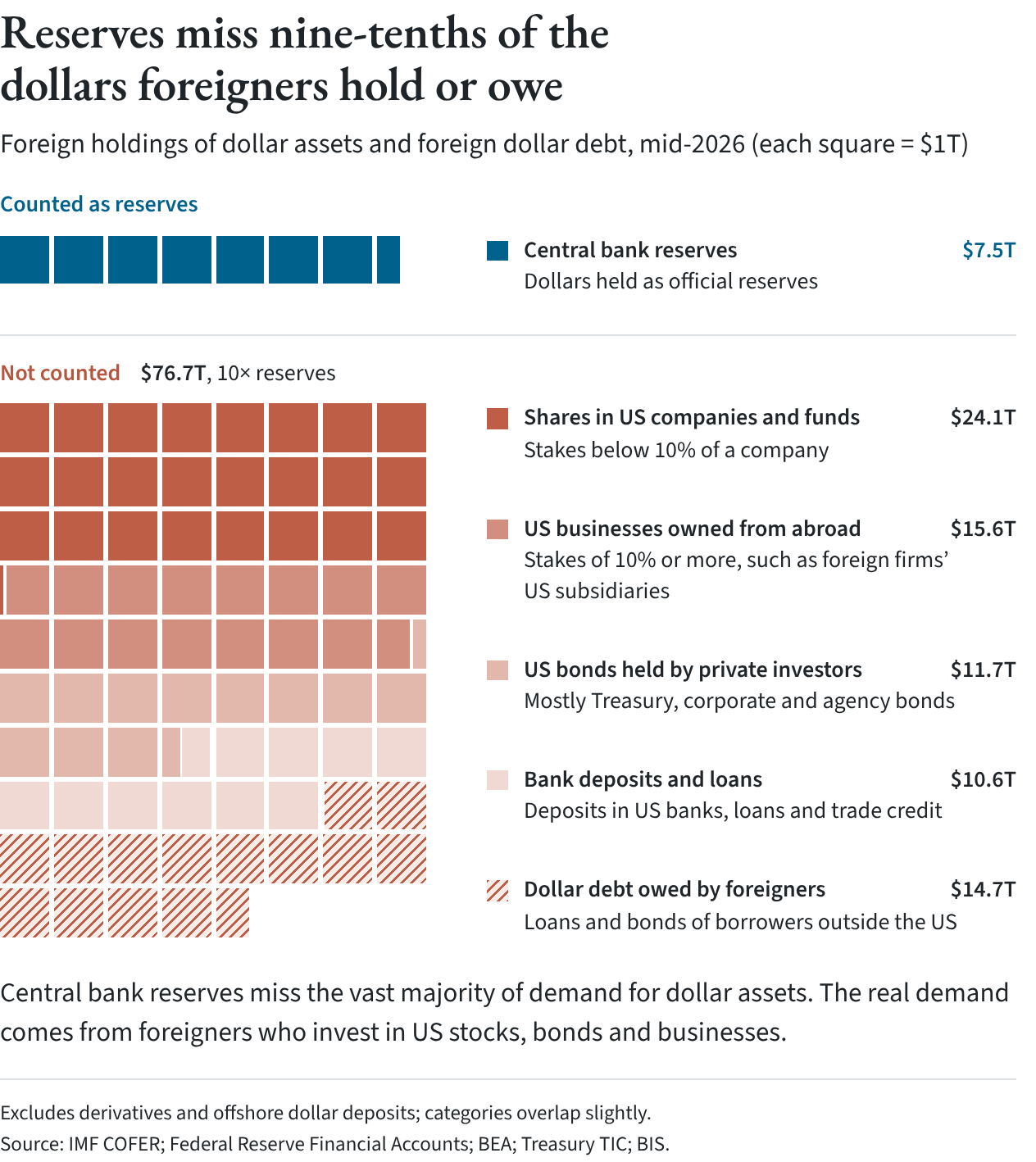
Dollar assets held by foreign residents and dollar debt they owe, by type, mid-2026.†
†Source Reserves: Nephew, Wei, and Gweder, “World Official Foreign Currency Reserves,” total reserves of $13.22 trillion at a dollar share of 56.7 percent, end of the second quarter of 2026. Stocks and funds: Board of Governors of the Federal Reserve System, “S2.s: Rest of the World,” _Financial Accounts of the United States_, September 11, 2026, U.S. corporate equities and mutual fund shares held by foreign residents, second quarter of 2026. Direct investment at market value, and deposits, loans and other: U.S. Bureau of Economic Analysis, “U.S. International Transactions and Investment Position, 2nd Quarter 2026,” September 24, 2026, U.S. liabilities. Bonds outside reserves: debt securities in the same Federal Reserve table, less foreign official holdings of Treasury securities, from U.S. Department of the Treasury, “Table 5: Major Foreign Holders of Treasury Securities,” June 2026, and of agency and corporate bonds, from U.S. Department of the Treasury, Federal Reserve Bank of New York, and Board of Governors of the Federal Reserve System, _Foreign Portfolio Holdings of U.S. Securities as of June 30, 2025_ (April 2026). Dollar loans and bonds: U.S. dollar credit to non-bank borrowers outside the United States, end of March 2026, from Bank for International Settlements, “BIS Global Liquidity Indicators at End-March 2026,” July 31, 2026. Excludes derivatives and offshore dollar deposits. Categories overlap slightly. Calculations by Commanding Heights.
All those billions of people outside of the Sinomodern economic zone will be able to feed the intelligent Dollar with uncountable queries in unknowable languages, save themselves from the fall of their own currencies, and accrue margin to Delaware-registered firms.
Until now we have focused on the effects this globalized, commodified, and dollar-backed intelligence will have on the world. But what will it do to us?
The United States has already seen one grand financial reordering, and it is teetering on the precipice of a second. That first reordering began about thirty years ago and it killed the wage economy. That grand olde memory of a class compromise where your work delivered a reliable surplus, a moment in time that lifted a great multitude into the middle class and created the fabled American Dream. Work hard, earn a good salary, receive periodic raises, and enjoy a life where the cost of living increased alongside the currency you were being paid in. Do it for 40 years at the same employer and you qualify for a generous defined-benefit pension. Sometimes, they even gave you a gold watch.
Then came the financialization of the closing decades of the 20th century and the death knell of the 2008 financial crisis. The resulting monetary intervention, necessary to avoid a greater financial catastrophe, broke the connection between wages and the good life permanently. The quantitative easing and a policy rate near zero kept the financial markets afloat, but did so by bidding up asset prices, not wages.13
13 Donggyu Lee, “Unconventional Monetary Policies and Inequality,” _Review of Economic Dynamics_ 60 (April 2026): 101334.
**The result was a miracle recovery for those who owned assets, and a slow strangulation for those who earned a wage.** The 2020 intervention redux, where the Fed bought without a stated limit,14 severed any remaining connection between the two. Pick your favored statistic; they all sound similar. The top 1% of US households control something like $60T of wealth, more than the bottom 90% combined.15 The balance of the stimulus went to those that needed it least. The rest got checks from the Treasury that were largely eaten by the inflation the Fed was creating. We don’t expect this pattern to change.
14 Board of Governors of the Federal Reserve System, “FOMC Statement,” December 16, 2008. Board of Governors of the Federal Reserve System, “Federal Reserve Announces Extensive New Measures to Support the Economy,” March 23, 2020.
15 Board of Governors of the Federal Reserve System, “Distributional Financial Accounts,” second quarter 2026, released September 18, 2026, “Levels of Wealth by Wealth Percentile Groups,” FRED, Federal Reserve Bank of St. Louis.
They say there can’t be a recession, see, look at the statistics. But one economy is having the time of their lives, and another is increasingly expressing its disillusion in public. $150K would have bought you about 1,900 shares of Meta back in 2015. Today it will buy you about 200.


Private jets on the ramp at Augusta Regional Airport, April 4, 2026.†
†Credit Flushing It Golf, photograph of private jets at Augusta Regional Airport, April 4, 2026, Facebook.
We’re moving into the second act of the K-shaped economy. The first was monetary and has largely finished its work transforming the world at this point. We’re well past the wage economy and the financial tricks meant to keep it alive. The second act will be technological. It will happen out of sight, out of mind. The adoption of machine intelligence will occur primarily inside firms, those firms pushing the cost of wages and applications toward the requisite cost of compute. The firm itself will shrink to a few operators, paid and governed like capital, directing work done mostly by models. Inflation and deflation will arrive together, extending the K well beyond the reach of the braking force of the Federal Reserve. The first act split the owners off from the earners. The second will split the owners themselves.
And what for the world? We think broad prosperity is unlikely. As intelligence becomes commoditized and widely available, value migrates toward the assets that remain scarce. By definition, value accrues to a much narrower stratum. Owned by the few, kept by the even fewer.
On the basis of our expectations about the future of financialized machine intelligence and its diffusion, understand the following:
We invert the assumption that the AI trade is about selling intelligence. Instead, we believe that intelligence is the giveaway, a loss leader that draws in users and data and derives margins from being the conduit.
The frontier of machine intelligence will always stay ahead of the commodity equivalent. Scaling laws still apply, and they dictate that the larger cluster tends to win first. But the smaller competitor will always remain close behind while the model is widely available.
One day, the frontier will no longer be for sale. The labs will be pressured on two sides. First, distillation of their latest widely available model will continue, and it will keep eating into both their short-term profits and their larger value proposition for investors. Second, the sovereign will recognize that frontier capabilities should not rise and fall on the whims of the market. This is a special project that requires particular treatment by the hands of the state. There is already a gap between released and in-lab models. Those most spectacular frontier capabilities will remain within the lab, and the lab and essential employees will remain within the reach of the sovereign.
The machines will begin to hum, and then sing in harmony. The frontier will remain on GPU s in a black site in the desert. Monoliths spreading horizontally above ground and soon below. Trillions allocated and the orchestra plays feverishly as the sovereign watches on. There will be what we call superintelligence in your pocket at no immediate expense. It will spread to every corner of the world from the originary point, uniform and impossible to dislodge once adopted, like the advent of spoken language. Its arrival heralded by notifications from the global messaging app and its uses made manifold by currencies that bear not the image but the superscription of the dollar. Pathogenetic in function, if not the strict biological form. Soon enough, intelligence will go from enhancing its early adopters to serving as a substitute for them and the multitudes like them. Then the wailing of the standing alterity riotous in cities you’ve never heard of, never could imagine that so many of them shook loose by automation could come crawling out of the cities ancient or recently constructed and themselves thrumming on the pavement howling as seen from afar. And you shall hear of wars and rumors of wars: see that you are not troubled: for all these things must come to pass, but the end is not yet. You will be a part of this world to come, and know, there are still safe spots on the map. Hallowed grounds that the efficient market is still pricing as ordinary assets. Only an early few will have the opportunity to lay claim to those scarce and enduring crossings worth owning.
**In the world to come, one either owns the rails or pays those who do.**
**The power and wealth of this brave new world will be defined by the commanding heights.**
Part I: Genesis
> _The Genesis of intelligence is composed of the industry that makes and serves models, and it will keep spending on itself even as returns fall. Rational capital allocation at the level of the lab or hyperscaler can destroy capital in the aggregate. Intelligence’s tremendous revenues still come from early adopters deploying models into existing workflows. As with the railroads, the larger fortunes will be captured outside Genesis, by those who control how models reach the far larger economy they create._
They are arguing about the AI bubble on X, the everything app. The bears can’t stop comparing hyperscaler capital expenditure to the fiber overbuild. The bulls point to Jevons and this cycle’s utilization rates. The models are busy proving open math questions.16 The mathematicians themselves are becoming luddites; even Terry Tao is foom posting. Staffers across Washington are asking Microsoft Copilot what post-training is while the President is handing awards to Elon, Brin, and Su. And the doomers are organizing the latest RMN “don’t kill us” party. The bazaar of ideas is bustling, blind prophets leading multitudes, psyops in every direction and the buyside analys