Fata Morgana (mirage)


A Fata Morgana seen over the Baltic Sea, 2016. The mirage consists of multiple upright and inverted images over the original object.


A Fata Morgana of a container ship seen off the coast of [Oceanside, California](https://en.wikipedia.org/wiki/Oceanside,_California "Oceanside, California")
A Fata Morgana changing the shape of a distant boat
A **Fata Morgana** (Italian:[[ˈfaːta morˈɡaːna]](https://en.wikipedia.org/wiki/Help:IPA/Italian "Help:IPA/Italian")) is a complex form of [mirage](https://en.wikipedia.org/wiki/Mirage#Superior_mirage "Mirage") visible in a narrow band right above the horizon. The term _Fata Morgana_ is the Italian translation of [Morgan le Fay](https://en.wikipedia.org/wiki/Morgan_le_Fay "Morgan le Fay") of Arthurian legend. These mirages are often seen in the Italian [Strait of Messina](https://en.wikipedia.org/wiki/Strait_of_Messina "Strait of Messina"), and were described as fairy castles in the air or false land conjured by her magic.
Fata Morgana mirages significantly distort the object or objects on which they are based, often such that the object is completely unrecognizable. A Fata Morgana may be seen at sea or on land, in polar regions, or in deserts. It may involve almost any kind of distant object, including boats, islands, and the coastline. Often, a Fata Morgana changes rapidly. The mirage comprises several inverted (upside down) and upright images stacked on top of one another. Fata Morgana mirages also show alternating compressed and stretched zones.[[1]](https://en.wikipedia.org/wiki/Fata_Morgana_(mirage)#cite_note-An_Introduction_to_Mirages-1)
The [optical phenomenon](https://en.wikipedia.org/wiki/Optical_phenomenon "Optical phenomenon") occurs because rays of light bend when they pass through air layers of different temperatures in a steep [thermal inversion](https://en.wikipedia.org/wiki/Temperature_inversion "Temperature inversion") where an [atmospheric duct](https://en.wikipedia.org/wiki/Atmospheric_duct "Atmospheric duct") has formed.[[1]](https://en.wikipedia.org/wiki/Fata_Morgana_(mirage)#cite_note-An_Introduction_to_Mirages-1) In calm weather, a layer of significantly warmer air may rest over colder dense air, forming an atmospheric duct that acts like a refracting lens "Lens (optics)"), producing a series of both inverted and erect images. A Fata Morgana requires a duct to be present; thermal inversion alone is not enough to produce this kind of mirage. While a thermal inversion often takes place without there being an atmospheric duct, an atmospheric duct cannot exist without there first being a thermal inversion.
Observing a Fata Morgana
[edit&action=edit§ion=1 "Edit section: Observing a Fata Morgana")]


Schematic diagram explaining the Fata Morgana mirage
A Fata Morgana is commonly seen in [polar regions](https://en.wikipedia.org/wiki/Polar_region "Polar region"), where it may be known as an [iceblink](https://en.wikipedia.org/wiki/Iceblink "Iceblink"), especially over large sheets of ice that have a uniform low temperature. It may, however, be observed in almost any area. In polar regions the Fata Morgana phenomenon is observed on relatively hot days. In Antarctica, over oceans, and over lakes, a Fata Morgana may be observed on cold days or can be seen in mist and fog.
To generate the Fata Morgana phenomenon, the [thermal inversion](https://en.wikipedia.org/wiki/Temperature_inversion "Temperature inversion") has to be strong enough that the curvature of the light rays within the inversion layer is stronger than the curvature of the [Earth](https://en.wikipedia.org/wiki/Earth "Earth").[[1]](https://en.wikipedia.org/wiki/Fata_Morgana_(mirage)#cite_note-An_Introduction_to_Mirages-1) Under these conditions, the rays bend and create arcs "Arc (geometry)"). An observer needs to be within or below an [atmospheric duct](https://en.wikipedia.org/wiki/Atmospheric_duct "Atmospheric duct") in order to be able to see a Fata Morgana.[[2]](https://en.wikipedia.org/wiki/Fata_Morgana_(mirage)#cite_note-Atmospheric_Optics_Glossary-2) Fata Morgana may be observed from any altitude within the [Earth's atmosphere](https://en.wikipedia.org/wiki/Earth%27s_atmosphere "Earth's atmosphere"), from sea level up to mountaintops, and even including the view from airplanes.[[3]](https://en.wikipedia.org/wiki/Fata_Morgana_(mirage)#cite_note-SUPERIOR_MIRAGE_of_cumulus_cloudtop_from_airplane-3)[[4]](https://en.wikipedia.org/wiki/Fata_Morgana_(mirage)#cite_note-Annotated_bibliography_of_mirages,_green_flashes,_atmospheric_refraction,_etc.-4)


A sequence of a Fata Morgana of the [Farallon Islands](https://en.wikipedia.org/wiki/Farallon_Islands "Farallon Islands") as seen from San Francisco

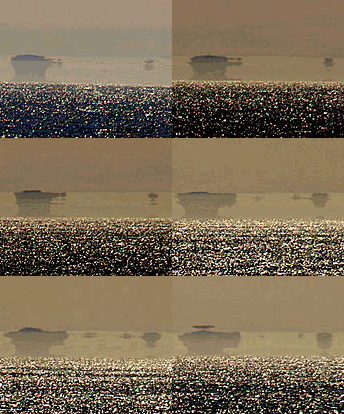
The above sequence as an animation
A Fata Morgana may be described as a very complex superior [mirage](https://en.wikipedia.org/wiki/Mirage "Mirage") with more than three distorted erect and inverted images.[[1]](https://en.wikipedia.org/wiki/Fata_Morgana_(mirage)#cite_note-An_Introduction_to_Mirages-1) Because of the constantly changing conditions of the atmosphere, a Fata Morgana may change in various ways within just a few seconds of time, including changing to become a straightforward superior mirage. The sequential image [here](https://en.wikipedia.org/wiki/File:Farallons_islands_miragep.jpg "File:Farallons islands miragep.jpg") shows sixteen photographic frames of a mirage of the [Farallon Islands](https://en.wikipedia.org/wiki/Farallon_Islands "Farallon Islands") as seen from San Francisco; the images were all taken on the same day. In the first fourteen frames, elements of the Fata Morgana mirage display alternations of compressed and stretched zones.[[1]](https://en.wikipedia.org/wiki/Fata_Morgana_(mirage)#cite_note-An_Introduction_to_Mirages-1) The last two frames were photographed a few hours later, around sunset time. At that point in time, the air was cooler while the ocean was probably a little bit warmer, which caused the [thermal inversion](https://en.wikipedia.org/wiki/Temperature_inversion "Temperature inversion") to be not as extreme as it was few hours before. A mirage was still present at that point, but it was not so complex as a few hours before sunset: the mirage was no longer a Fata Morgana, but instead had become a simple superior mirage.
Fata Morgana mirages are visible to the naked eye, but in order to be able to see the detail within them, it is best to view them through [binoculars](https://en.wikipedia.org/wiki/Binoculars "Binoculars"), a [telescope](https://en.wikipedia.org/wiki/Telescope "Telescope"), or as is the case in the images here, through a [telephoto lens](https://en.wikipedia.org/wiki/Telephoto_lens "Telephoto lens"). [Gabriel Gruber](https://en.wikipedia.org/wiki/Gabriel_Gruber "Gabriel Gruber") (1740–1805) and [Tobias Gruber](https://en.wikipedia.org/w/index.php?title=Tobias_Gruber&action=edit&redlink=1 "Tobias Gruber (page does not exist)")[[sl](https://sl.wikipedia.org/wiki/Tobija_Gruber "sl:Tobija Gruber")] (1744–1806), who observed Fata Morgana above [Lake Cerknica](https://en.wikipedia.org/wiki/Lake_Cerknica "Lake Cerknica"), were the first to study it in a laboratory setting.
La Fata Morgana ("The Fairy Morgana") is the Italian name of [Morgan le Fay](https://en.wikipedia.org/wiki/Morgan_le_Fay "Morgan le Fay"), also known as Morgana and other variants, who was described as a powerful sorceress in [Arthurian legend](https://en.wikipedia.org/wiki/Arthurian_legend "Arthurian legend"). As her name indicates, the figure of Morgan appears to have been originally a [fairy](https://en.wikipedia.org/wiki/Fairy "Fairy") figure rather than a human woman. The early works featuring Morgan do not elaborate on her nature, other than describing her role as that of a fairy or magician. Later, she was described as King Arthur's half-sister and an enchantress.[[5]](https://en.wikipedia.org/wiki/Fata_Morgana_(mirage)#cite_note-5) After King Arthur's final [battle at Camlann](https://en.wikipedia.org/wiki/Battle_of_Camlann "Battle of Camlann"), Morgan takes her half-brother Arthur to [Avalon](https://en.wikipedia.org/wiki/Avalon "Avalon").[[6]](https://en.wikipedia.org/wiki/Fata_Morgana_(mirage)#cite_note-6) In medieval times, suggestions for the location of Avalon included the other side of the Earth at the [antipodes](https://en.wikipedia.org/wiki/Antipodes "Antipodes"), [Sicily](https://en.wikipedia.org/wiki/Sicily "Sicily"), and other locations in the [Mediterranean](https://en.wikipedia.org/wiki/Mediterranean "Mediterranean").[[7]](https://en.wikipedia.org/wiki/Fata_Morgana_(mirage)#cite_note-Lacy-7)[_[page needed](https://en.wikipedia.org/wiki/Wikipedia:Citing\_sources "Wikipedia:Citing sources")_] Legends claimed that sirens "Siren (mythology)") in the waters around Sicily lured the unwary to their death. Morgan is associated not only with Sicily's [Mount Etna](https://en.wikipedia.org/wiki/Mount_Etna "Mount Etna") (the supposedly hollow mountain locally identified as Avalon since the 12th century[[8]](https://en.wikipedia.org/wiki/Fata_Morgana_(mirage)#cite_note-8)), but also with sirens. In a medieval French Arthurian romance of the 13th century, _Floriant et Florete_, she is called "mistress of the fairies of the salt sea" (_La mestresse [des] fées de la mer salée_).[[9]](https://en.wikipedia.org/wiki/Fata_Morgana_(mirage)#cite_note-Vanishing_Tricks_of_a_Goddess-9) Ever since that time, Fata Morgana has been associated with Sicily in the Italian folklore and literature.[[10]](https://en.wikipedia.org/wiki/Fata_Morgana_(mirage)#cite_note-The_Sea-side_Companion,_Or,_Marine_Natural_History-10) For example, a local legend connects Morgan and her magical mirages with [Roger I of Sicily](https://en.wikipedia.org/wiki/Roger_I_of_Sicily "Roger I of Sicily") and the Norman conquest of the island from the Arabs.[[11]](https://en.wikipedia.org/wiki/Fata_Morgana_(mirage)#cite_note-11)[[12]](https://en.wikipedia.org/wiki/Fata_Morgana_(mirage)#cite_note-12)


An 1844 drawing entitled _The Fata Morgana, As Observed in the Harbour of Messina_
[Walter Charleton](https://en.wikipedia.org/wiki/Walter_Charleton "Walter Charleton"), in his 1654 treatise "Physiologia Epicuro-Gassendo-Charltoniana", devotes several pages to the description of the Morgana of Rhegium, in the Strait of Messina (Book III, Chap. II, Sect. II). He records that a similar phenomenon was reported in Africa by [Diodorus Siculus](https://en.wikipedia.org/wiki/Diodorus_Siculus "Diodorus Siculus"), a Greek historian writing in the first century BC, and that the Rhegium Fata Morgana was described by [Damascius](https://en.wikipedia.org/wiki/Damascius "Damascius"), a Greek philosopher of the sixth century AD. In addition, Charleton tells us that [Athanasius Kircher](https://en.wikipedia.org/wiki/Athanasius_Kircher "Athanasius Kircher") described the Rhegium mirage in his book of travels.
An early mention of the term _Fata Morgana_ in English, in 1818, referred to such a mirage noticed in the [Strait of Messina](https://en.wikipedia.org/wiki/Strait_of_Messina "Strait of Messina"), between [Calabria](https://en.wikipedia.org/wiki/Calabria "Calabria") and Sicily.[[13]](https://en.wikipedia.org/wiki/Fata_Morgana_(mirage)#cite_note-The_Stanford_Dictionary_of_Anglicised_Words_and_Phrases-13)
> * Fata Morgana, phr.: It.: a peculiar mirage occasionally seen on the coasts of the Straits of Messina, locally attributed to a fay Morgana. Hence, metaph. any illusory appearance. 1818 In mountainous regions, deceptions of sight, Fata Morgana, &c., are more common: In E. Burl's Lett. N. Scotl., Vol. II. p. in (1818).
Famous legends and observations
[edit&action=edit§ion=3 "Edit section: Famous legends and observations")]
The _Flying Dutchman_
[edit&action=edit§ion=4 "Edit section: The Flying Dutchman")]
The _[Flying Dutchman](https://en.wikipedia.org/wiki/Flying\_Dutchman "Flying Dutchman")_, according to [folklore](https://en.wikipedia.org/wiki/Folklore "Folklore"), is a [ghost ship](https://en.wikipedia.org/wiki/List_of_ghost_ships "List of ghost ships") that can never go home, and is doomed to sail the [seven seas](https://en.wikipedia.org/wiki/Seven_seas "Seven seas") forever. The _Flying Dutchman_ is usually spotted from afar, sometimes seen to be glowing with ghostly light. One of the possible explanations of the origin of the _Flying Dutchman_ legend is a Fata Morgana mirage seen at sea.[[14]](https://en.wikipedia.org/wiki/Fata_Morgana_(mirage)#cite_note-14)


A nineteenth-century book illustration, showing enlarged superior mirages; mirages can never be so far above the horizon, and a superior mirage can never increase the length of an object as shown on the right.
A Fata Morgana superior mirage of a ship can take many different forms. Even when the boat in the mirage does not seem to be suspended in the air, it still looks ghostly, and unusual, and what is even more important, it is ever-changing in its appearance. Sometimes a Fata Morgana causes a ship to appear to float inside the waves, at other times an inverted ship appears to sail above its real companion.
In fact, with a Fata Morgana it can be hard to say which individual segment of the mirage is real and which is not real: when a real ship is out of sight because it is below the horizon line, a Fata Morgana can cause the image of it to be elevated, and then everything which is seen by the observer is a mirage. On the other hand, if the real ship is still above the horizon, the image of it can be duplicated many times and elaborately distorted by a Fata Morgana.
- [](https://en.wikipedia.org/wiki/File:Fata_morgana_of_the_ships.jpg "The appearance of two ships changing owing to the Fata Morgana phenomenon: the four frames in the first column are of ship No. 1, and the four frames in the second column are of ship No. 2.")
The appearance of two ships changing owing to the Fata Morgana phenomenon: the four frames in the first column "Column (typography)") are of ship No. 1, and the four frames in the second column are of ship No. 2.
- [](https://en.wikipedia.org/wiki/File:Superior_mirage_of_a_small_boat.jpg "In this mirage, at least three separate images of a boat are visible. The real one at the bottom and the uppermost one are in the upright position, whereas the one in the middle is inverted.")
In this mirage, at least three separate images of a boat are visible. The real one at the bottom and the uppermost one are in the upright position, whereas the one in the middle is inverted.
- [](https://en.wikipedia.org/wiki/File:Fata_Morgana_of_a_boat.jpg "Superimposed detail from six frames of a view showing how the miraged image of a ship changes from one moment to the next")
Superimposed detail from six frames of a view showing how the miraged image of a ship changes from one moment to the next


A Fata Morgana of the sea surface and [sun glitter](https://en.wikipedia.org/wiki/Sun_glitter "Sun glitter"), with a boat at the left hand side of the image
In the 19th and early 20th centuries, Fata Morgana mirages may have played a role in a number of unrelated "discoveries" of [arctic](https://en.wikipedia.org/wiki/Arctic "Arctic") and [antarctic](https://en.wikipedia.org/wiki/Antarctic "Antarctic") land masses which were later shown not to exist. [Icebergs](https://en.wikipedia.org/wiki/Iceberg "Iceberg") frozen into the [pack ice](https://en.wikipedia.org/wiki/Sea_ice "Sea ice"), or the uneven surface of the ice itself, may have contributed to the illusion of distant land features.
[Yakov Sannikov](https://en.wikipedia.org/wiki/Yakov_Sannikov "Yakov Sannikov") and [Matvei Gedenschtrom](https://en.wikipedia.org/wiki/Matvei_Gedenschtrom "Matvei Gedenschtrom") claimed to have seen a land mass north of [Kotelny Island](https://en.wikipedia.org/wiki/Kotelny_Island "Kotelny Island") during their 1809–1810 cartographic expedition to the [New Siberian Islands](https://en.wikipedia.org/wiki/New_Siberian_Islands "New Siberian Islands"). Sannikov reported this sighting of a "new land" in 1811, and the supposed island was named after him.[[15]](https://en.wikipedia.org/wiki/Fata_Morgana_(mirage)#cite_note-Mills1-15) Three-quarters of a century later, in 1886, Baron [Eduard Toll](https://en.wikipedia.org/wiki/Eduard_Toll "Eduard Toll"), a [Baltic German](https://en.wikipedia.org/wiki/Baltic_German "Baltic German") explorer in Russian service, reported observing Sannikov Land during another expedition to the New Siberian Islands. In 1900, he would lead [still another expedition to the region](https://en.wikipedia.org/wiki/Russian_polar_expedition_of_1900%E2%80%931902 "Russian polar expedition of 1900–1902"), which had among its objectives the location and exploration of Sannikov Land.[[16]](https://en.wikipedia.org/wiki/Fata_Morgana_(mirage)#cite_note-16) The expedition was unsuccessful in this respect.[[17]](https://en.wikipedia.org/wiki/Fata_Morgana_(mirage)#cite_note-17) Toll and three others were lost after they departed their ship, which was stuck in ice for the winter, and embarked on a risky expedition by dog sled.[[18]](https://en.wikipedia.org/wiki/Fata_Morgana_(mirage)#cite_note-18) In 1937, the Soviet icebreaker _Sadko_ "Sadko (1913 icebreaker)") also tried and failed to find Sannikov Land.[[19]](https://en.wikipedia.org/wiki/Fata_Morgana_(mirage)#cite_note-19) Some historians and geographers[_[which?](https://en.wikipedia.org/wiki/Wikipedia:Avoid\_weasel\_words "Wikipedia:Avoid weasel words")_] have theorised that the land mass that Sannikov and Toll saw was actually Fata Morganas of [Bennett Island](https://en.wikipedia.org/wiki/Bennett_Island "Bennett Island").[[15]](https://en.wikipedia.org/wiki/Fata_Morgana_(mirage)#cite_note-Mills1-15)
In 1818, Sir John Ross "John Ross (Royal Navy officer)") led an expedition to discover the long-sought-after [Northwest Passage](https://en.wikipedia.org/wiki/Northwest_Passage "Northwest Passage"). When he reached [Lancaster Sound](https://en.wikipedia.org/wiki/Lancaster_Sound "Lancaster Sound") in Canada, he sighted, in the distance, a land mass with mountains, directly ahead in the ship's course. He named the mountain range the Croker Mountains,[[20]](https://en.wikipedia.org/wiki/Fata_Morgana_(mirage)#cite_note-20) after First [Secretary to the Admiralty](https://en.wikipedia.org/wiki/Secretary_to_the_Admiralty "Secretary to the Admiralty")[John Wilson Croker](https://en.wikipedia.org/wiki/John_Wilson_Croker "John Wilson Croker"), and ordered the ship to turn around and return to England. Several of his officers protested, including First Mate [William Edward Parry](https://en.wikipedia.org/wiki/William_Edward_Parry "William Edward Parry") and [Edward Sabine](https://en.wikipedia.org/wiki/Edward_Sabine "Edward Sabine"), but they could not dissuade him.[[21]](https://en.wikipedia.org/wiki/Fata_Morgana_(mirage)#cite_note-21) The account of Ross's voyage, published a year later, brought to light this disagreement, and the ensuing controversy over the existence of the Croker Mountains ruined Ross's reputation. The year after Ross's expedition, in 1819, Parry was given command of his own Arctic expedition, and proved Ross wrong by continuing west beyond where Ross had turned back, and sailing through the supposed location of the Croker Mountains. The mountain range that had caused Ross to abandon his mission had been a mirage.
Ross made two errors. First, he refused to listen to the counsel of his officers, who may have been more familiar with mirages than he was. Second, his attempt to honour Croker by naming a mountain range after him backfired when the mountains turned out to be non-existent. Ross could not obtain ships, or funds, from the government for his subsequent expeditions, and was forced to rely on private backers instead.[[22]](https://en.wikipedia.org/wiki/Fata_Morgana_(mirage)#cite_note-22)
#### New South Greenland
[edit&action=edit§ion=8 "Edit section: New South Greenland")]
[Benjamin Morrell](https://en.wikipedia.org/wiki/Benjamin_Morrell "Benjamin Morrell") reported that, in March 1823, while on a voyage to the Antarctic and southern Pacific Ocean, he had explored what he thought was the east coast of New South Greenland.[[23]](https://en.wikipedia.org/wiki/Fata_Morgana_(mirage)#cite_note-23) The west coast of New South Greenland had been explored two years earlier by Robert Johnson, who had given the land its name.[[24]](https://en.wikipedia.org/wiki/Fata_Morgana_(mirage)#cite_note-24) This name was not adopted, however, and the area, which is the northern part of the Antarctic Peninsula, is now known as [Graham Land](https://en.wikipedia.org/wiki/Graham_Land "Graham Land").[[25]](https://en.wikipedia.org/wiki/Fata_Morgana_(mirage)#cite_note-25) Morrell's reported position was actually far to the east of Graham Land.[[26]](https://en.wikipedia.org/wiki/Fata_Morgana_(mirage)#cite_note-26) Searches for the land that Morrell claimed to have explored would continue into the early 20th century before New South Greenland's existence was conclusively disproven. Why Morrell reported exploring a non-existent land is unclear, but one possibility is that he mistook a Fata Morgana for actual land.[[27]](https://en.wikipedia.org/wiki/Fata_Morgana_(mirage)#cite_note-27)
[Robert Peary](https://en.wikipedia.org/wiki/Robert_Peary "Robert Peary") claimed to have seen, while on a 1906 Arctic expedition, a land mass in the distance. He said that it was north-west from the highest point of [Cape Thomas Hubbard](https://en.wikipedia.org/wiki/Cape_Thomas_Hubbard "Cape Thomas Hubbard"), which is situated in what is now the northern Canadian territory of [Nunavut](https://en.wikipedia.org/wiki/Nunavut "Nunavut"), and he estimated it to be 210 km (130 miles) away, at about 83 degrees N, longitude 100 degrees W. He named it Crocker Land, after George Crocker of the Peary Arctic Club.[[28]](https://en.wikipedia.org/wiki/Fata_Morgana_(mirage)#cite_note-28) As Peary's diary contradicts his public claim that he had sighted land,[[29]](https://en.wikipedia.org/wiki/Fata_Morgana_(mirage)#cite_note-29) it is now believed that Crocker Land was a fraudulent invention of Peary,[[30]](https://en.wikipedia.org/wiki/Fata_Morgana_(mirage)#cite_note-30) created in an unsuccessful attempt to secure further funding from Crocker.
In 1913, unaware that Crocker Land was merely an invention, [Donald Baxter MacMillan](https://en.wikipedia.org/wiki/Donald_Baxter_MacMillan "Donald Baxter MacMillan") organised the Crocker Land Expedition, which set out to reach and explore the supposed land mass. On 21 April, the members of the expedition did, in fact, see what appeared to be a huge island on the north-western horizon. As MacMillan later said, "Hills, valleys, snow-capped peaks extending through at least one hundred and twenty degrees of the horizon". Piugaattoq, a member of the expedition and an [Inuk](https://en.wikipedia.org/wiki/Inuit "Inuit") hunter with 20 years of experience of the area, explained that it was just an illusion. He called it _poo-jok_, which means '[mist](https://en.wikipedia.org/wiki/Mist "Mist")'. However, MacMillan insisted that they press on, even though it was late in the season and the sea ice was breaking up. For five days they went on, following the mirage. Finally, on 27 April, after they had covered some 200 km (125 miles) of dangerous sea ice, MacMillan was forced to admit that Piugaattoq was right—the land that they had sighted was in fact a mirage (probably a Fata Morgana). Later, MacMillan wrote:
from _Four Years in the White North_[[31]](https://en.wikipedia.org/wiki/Fata_Morgana_(mirage)#cite_note-Four_Years_in_the_White_North-31)
> The day was exceptionally clear, not a cloud or trace of mist; if land could be seen, now was our time. Yes, there it was! It could even be seen without a glass, extending from southwest true to north-northeast. Our powerful glasses, however, brought out more clearly the dark background in contrast with the white, the whole resembling hills, valleys and snow-capped peaks to such a degree that, had we not been out on the frozen sea for 150 miles [240 km], we would have staked our lives upon its reality. Our judgment then, as now, is that this was a mirage or loom of the sea ice.
The expedition collected interesting samples, but is still considered to be a failure and a very expensive mistake. The final cost was $100,000 (equivalent to $2.3 million in 2024).[[32]](https://en.wikipedia.org/wiki/Fata_Morgana_(mirage)#cite_note-Mirages_in_the_Sky-32)
Hy Brasil "Brasil (mythical island)") is an island that was said to appear once every few years off the coast of [County Kerry](https://en.wikipedia.org/wiki/County_Kerry "County Kerry"), Ireland. Hy Brasil has been drawn on ancient maps as a perfectly circular island with a river running directly through it.


Fata Morgana on Lake Ontario in [Ajax](https://en.wikipedia.org/wiki/Ajax,_Ontario "Ajax, Ontario"). Top image shows a regular view and the bottom shows the mirage effect, causing visual distortion to the distant shoreline.
Lake Ontario is said to be famous for mirages, with opposite shorelines becoming clearly visible during the events.[[33]](https://en.wikipedia.org/wiki/Fata_Morgana_(mirage)#cite_note-Pearson_1909-33)
In July 1866, mirages of boats and islands were seen from [Kingston, Ontario](https://en.wikipedia.org/wiki/Kingston,_Ontario "Kingston, Ontario").[[34]](https://en.wikipedia.org/wiki/Fata_Morgana_(mirage)#cite_note-Mirage-34)
> A Mirage – The atmospheric phenomenon known as "mirage" might have been observed on Sunday evening between 6 and 7 o'clock, by looking towards the lake. The line beyond which this phenomenon was observable seemed to strike from about the middle portion of Amherst Island across to the southeast, for while the lower half of the island presented its usual appearance, the upper half was unnaturally distorted and thrown upward in columnar shape with an apparent height of two to three hundred feet. The upper line or cloud from this elevation stretched southward, upon which was thrown the image of objects. A barque sailing in front of this cloud presented a double appearance. While she appeared slightly distorted on the surface of the water, her image was inverted upon the background of the cloud referred to, and both blending together produced a curious sight. At the same time the ship and its shadow were again repeated in a more shadowy form, but distinct, in the foreground, the base being a line of smooth water. Another bark whose hull was entirely below the horizon, the topsails alone being visible, had its hull shadowed on this foreground, but no inversion in this case could be observed. It may be added that these optical phenomena in regard to the vessels could only be seen with the aid of a telescope, for the nearest vessel was at the time fully sixteen miles [26 km] distant. The phenomena lasted over an hour, the illusion changing every moment in its character.
Here the described mirages of vessels "could only be seen with the aid of a [telescope](https://en.wikipedia.org/wiki/Telescope "Telescope")". It is often the case when observing a Fata Morgana that one needs to use a [telescope](https://en.wikipedia.org/wiki/Telescope "Telescope") or [binoculars](https://en.wikipedia.org/wiki/Binoculars "Binoculars") to really make out the mirage. The "cloud" that the article mentions a few times probably refers to a [duct](https://en.wikipedia.org/wiki/Atmospheric_duct "Atmospheric duct").
On 25 August 1894, _[Scientific American](https://en.wikipedia.org/wiki/Scientific\_American "Scientific American")_ described a "remarkable mirage" seen by the citizens of [Buffalo, New York](https://en.wikipedia.org/wiki/Buffalo,_New_York "Buffalo, New York").[[35]](https://en.wikipedia.org/wiki/Fata_Morgana_(mirage)#cite_note-SciAm_1894-35)[[36]](https://en.wikipedia.org/wiki/Fata_Morgana_(mirage)#cite_note-A_MIRAGE_SEEN_AT_BUFFALO-36)


Mirage of the Canadian coast as seen from [Rochester, New York](https://en.wikipedia.org/wiki/Rochester,_New_York "Rochester, New York") on 16 April 1871
> The people of Buffalo, N.Y., were treated to a remarkable mirage, between ten and eleven o'clock, on the morning of 16 August, [1894]. It was the city of Toronto with its harbor and small island to the south of the city. Toronto is fifty-six miles [90 km] from Buffalo, but the church spires could be counted with the greatest ease. The mirage took in the whole breadth of Lake Ontario, Charlotte, the suburbs of Rochester, being recognized as a projection east of Toronto. A side-wheel steamer could be seen traveling in a line from Charlotte to Toronto Bay. Two dark objects were at last found to be the steamers of the New York Central plying between Lewiston and Toronto. A sail-boat was also visible and disappeared suddenly. Slowly the mirage began to fade away, to the disappointment of thousands who crowded the roofs of houses and office buildings. A bank of clouds was the cause of the disappearance of the mirage. A close examination of the map showed the mirage did not cause the slightest distortion, the gradual rise of the city from the water being rendered perfectly. It is estimated that at least 20,000 spectators saw the novel spectacle. > > > This mirage is what is known as that of the third order; that is, the object looms up far above the level and not inverted, as with mirages of the first and second orders, but appearing like a perfect landscape far away in the sky.
— _Scientific American_, 25 August 1894
This description might refer to [looming](https://en.wikipedia.org/wiki/Looming,_Towering,_Stooping,_and_Sinking "Looming, Towering, Stooping, and Sinking") owing to inversion "Inversion (meteorology)") rather than to an actual mirage.
McMurdo Sound and Antarctica
[edit&action=edit§ion=13 "Edit section: McMurdo Sound and Antarctica")]
From [McMurdo Station](https://en.wikipedia.org/wiki/McMurdo_Station "McMurdo Station") in Antarctica, Fata Morganas are often seen during the Antarctic spring and summer, across [McMurdo Sound](https://en.wikipedia.org/wiki/McMurdo_Sound "McMurdo Sound").[[37]](https://en.wikipedia.org/wiki/Fata_Morgana_(mirage)#cite_note-Perinson_1966-37)[[38]](https://en.wikipedia.org/wiki/Fata_Morgana_(mirage)#cite_note-El_Paso_1973-38)[[39]](https://en.wikipedia.org/wiki/Fata_Morgana_(mirage)#cite_note-39) An Antarctic Fata Morgana, seen from a [C-47 transport](https://en.wikipedia.org/wiki/Douglas_C-47_Skytrain "Douglas C-47 Skytrain") flight, was recounted:
> We were going along smoothly and all of a sudden a mountain peak seemed to rise up out of nowhere up ahead. We looked again and it was gone. A couple of minutes later it popped up again rising some 300 feet higher than our altitude. We never seemed to get any closer to it. The peak just kept popping up and down, getting higher and higher and higher every time it reappeared.
— Rear Adm. [Fred E. Bakutis](https://en.wikipedia.org/wiki/Frederick_E._Bakutis "Frederick E. Bakutis"), commanding the Antarctic Navy Support Activities[[37]](https://en.wikipedia.org/wiki/Fata_Morgana_(mirage)#cite_note-Perinson_1966-37)


A Fata Morgana distorting the images of distant boats beyond recognition
Fata Morgana mirages may continue to trick some observers and are still sometimes mistaken for [otherworldly](https://en.wikipedia.org/wiki/Otherworld "Otherworld") objects such as UFOs.[[40]](https://en.wikipedia.org/wiki/Fata_Morgana_(mirage)#cite_note-40) A Fata Morgana can display an object that is located below the astronomical [horizon](https://en.wikipedia.org/wiki/Horizon "Horizon") as an apparent object hovering in the sky. A Fata Morgana can also magnify such an object vertically and make it look absolutely unrecognizable.
Some UFOs which are seen on [radar](https://en.wikipedia.org/wiki/Radar "Radar") may also be due to Fata Morgana mirages. Official UFO investigations in France indicate:
> As is well known, atmospheric ducting is the explanation for certain optical mirages, and in particular the arctic illusion called "fata morgana" where distant ocean or surface ice, which is essentially flat, appears to the viewer in the form of vertical columns and spires, or "castles in the air". > >
> People often assume that mirages occur only rarely. This may be true of optical mirages, but conditions for radar mirages are more common, due to the role played by water vapor which strongly affects the atmospheric refractivity in relation to radio waves. Since clouds are closely associated with high levels of water vapor, optical mirages due to water vapor are often rendered undetectable by the accompanying opaque cloud. On the other hand, radar propagation is essentially unaffected by the water droplets of the cloud so that changes in water vapor content with altitude are very effective in producing atmospheric ducting and radar mirages.[[41]](https://en.wikipedia.org/wiki/Fata_Morgana_(mirage)#cite_note-Official_UFO_Investigations_in_France:_the_GEPAN/SEPRA_Project-41)
Fata Morgana mirages could explain the mysterious Australian [Min Min light](https://en.wikipedia.org/wiki/Min_Min_light "Min Min light") phenomenon.[[42]](https://en.wikipedia.org/wiki/Fata_Morgana_(mirage)#cite_note-perrigrew1-42) This would also explain the way in which the legend has changed over time: The first reports were of a stationary light, which in a Fata Morgana effect would be an image of a campfire. In more recent reports this has changed to moving lights, which in an inversion reflection such as Fata Morgana would be headlights over the horizon being reflected by the inversion.
[Fata Morgana Land](https://en.wikipedia.org/wiki/Fata_Morgana_Land "Fata Morgana Land") is a [phantom island](https://en.wikipedia.org/wiki/Phantom_island "Phantom island") in the [Arctic](https://en.wikipedia.org/wiki/Arctic "Arctic"), reported first in 1907. After an unfruitful search, it was deemed to be [Tobias Island](https://en.wikipedia.org/wiki/Tobias_Island "Tobias Island").[[43]](https://en.wikipedia.org/wiki/Fata_Morgana_(mirage)#cite_note-cat-43)
A Fata Morgana is usually associated with something mysterious, something that never could be approached.[[44]](https://en.wikipedia.org/wiki/Fata_Morgana_(mirage)#cite_note-Fata_Morgan-44)


An unrealistic 1886 drawing of a "Fata Morgana" mirage in a [desert](https://en.wikipedia.org/wiki/Desert "Desert")
> O sweet illusions of song > > That tempt me everywhere, > > In the lonely fields, and the throng > > Of the crowded thoroughfare! > > > I approach and ye vanish away, > > I grasp you, and ye are gone; > > But ever by night and by day, > > The melody soundeth on. > > > As the weary traveler sees > > In desert or prairie vast, > > Blue lakes, overhung with trees > > That a pleasant shadow cast; > > > Fair towns with turrets high, > > And shining roofs of gold, > > That vanish as he draws nigh, > > Like mists together rolled— > > > So I wander and wander along, > > And forever before me gleams > > The shining city of song, > > In the beautiful land of dreams. > > > But when I would enter the gate > > Of that golden atmosphere, > > It is gone, and I wonder and wait > > For the vision to reappear.
In the lines, "the weary traveller sees / In desert or prairie vast, / Blue lakes, overhung with trees / That a pleasant shadow cast", because of the mention of blue lakes, it is clear that the author is actually describing not a Fata Morgana, but rather a common inferior or [desert](https://en.wikipedia.org/wiki/Desert "Desert") mirage. The 1886 drawing shown here of a "Fata Morgana" in a desert might have been an imaginative illustration for the poem, but in reality no mirage ever looks like this. Andy Young writes, "They're always confined to a narrow strip of sky—less than a finger's width at arm's length—at the horizon."[[1]](https://en.wikipedia.org/wiki/Fata_Morgana_(mirage)#cite_note-An_Introduction_to_Mirages-1)
The 18th-century poet [Christoph Martin Wieland](https://en.wikipedia.org/wiki/Christoph_Martin_Wieland "Christoph Martin Wieland") wrote about "Fata Morgana's castles in the air". The idea of castles in the air was probably so irresistible that many languages still use the phrase Fata Morgana to describe a mirage.[[9]](https://en.wikipedia.org/wiki/Fata_Morgana_(mirage)#cite_note-Vanishing_Tricks_of_a_Goddess-9)
In the book _Thunder Below!_ about the submarine USS _Barb_ "USS Barb (SS-220)"), the crew sees a Fata Morgana (called an "arctic mirage" in the book) of four ships trapped in the ice. As they try to approach the ships the mirage vanishes.[[46]](https://en.wikipedia.org/wiki/Fata_Morgana_(mirage)#cite_note-46)
The Fata Morgana is briefly mentioned in the 1936 [H. P. Lovecraft](https://en.wikipedia.org/wiki/H._P._Lovecraft "H. P. Lovecraft") horror novel _[At the Mountains of Madness](https://en.wikipedia.org/wiki/At\_the\_Mountains\_of\_Madness "At the Mountains of Madness")_, in which the narrator states: "On many occasions the curious atmospheric effects enchanted me vastly; these including a strikingly vivid mirage—the first I had ever seen—in which distant bergs became the battlements of unimaginable cosmic castles."
It is vividly described in the 1954 novel [Lord of the Flies](https://en.wikipedia.org/wiki/Lord_of_the_Flies "Lord of the Flies") by [William Golding](https://en.wikipedia.org/wiki/William_Golding "William Golding"):
> Strange things happened at midday. The glittering sea rose up, moved apart in planes of blatant impossibility; the coral reef and the few stunted palms that clung to the more elevated parts would float up into the sky, would quiver, be plucked apart, run like raindrops on a wire or be repeated as in an odd succession of mirrors. Sometimes land loomed where there was no land and flicked out like a bubble as the children watched. Piggy discounted all this learnedly as a “mirage”...
- [Atmospheric optics](https://en.wikipedia.org/wiki/Atmospheric_optics "Atmospheric optics")
- [Brocken spectre](https://en.wikipedia.org/wiki/Brocken_spectre "Brocken spectre")
- _Fata Morgana_ (1971 film) "Fata Morgana (1971 film)")
- [Green flash](https://en.wikipedia.org/wiki/Green_flash "Green flash")
- [Looming and similar refraction phenomena](https://en.wikipedia.org/wiki/Looming_and_similar_refraction_phenomena "Looming and similar refraction phenomena")
- [Mirage of astronomical objects](https://en.wikipedia.org/wiki/Mirage_of_astronomical_objects "Mirage of astronomical objects")
- [The House in Fata Morgana](https://en.wikipedia.org/wiki/The_House_in_Fata_Morgana "The House in Fata Morgana")
- _Summerland_ (2020 film) "Summerland (2020 film)")
- Fata Morgana (Efteling) "Fata Morgana (Efteling)")
1. ^ _**a**_#cite_ref-An_Introduction_to_Mirages_1-0)_**b**_#cite_ref-An_Introduction_to_Mirages_1-1)_**c**_#cite_ref-An_Introduction_to_Mirages_1-2)_**d**_#cite_ref-An_Introduction_to_Mirages_1-3)_**e**_#cite_ref-An_Introduction_to_Mirages_1-4)_**f**_#cite_ref-An_Introduction_to_Mirages_1-5)An Introduction to Mirages by Andy Young 2. **^#cite_ref-Atmospheric_Optics_Glossary_2-0)**Atmospheric Optics Glossary by Andy Young 3. **^#cite_ref-SUPERIOR_MIRAGE_of_cumulus_cloudtop_from_airplane_3-0)**Durst and Bull (1956). _Met. Mag. 85_. pp.237–42.
4. **^#cite_ref-Annotated_bibliography_of_mirages,_green_flashes,_atmospheric_refraction,_etc._4-0)**Young, Andrew. _Annotated bibliography of mirages, green flashes, atmospheric refraction, etc_.
5. **^#cite_ref-5)**Briggs, Katharine (12 August 1978). "Morgan le Fay". _Encyclopedia of Fairies: Hobgoblins, Brownies, Boogies, and Other Supernatural Creatures_. New York, NY, USA: Pantheon. p.303. ISBN "ISBN (identifier)")[978-0394734675](https://en.wikipedia.org/wiki/Special:BookSources/978-0394734675 "Special:BookSources/978-0394734675").
6. **^#cite_ref-6)**Bromwich, Rachel (2014). _Trioedd Ynys Prydein: The Triads of the Island of Britain_ (1st ed.). Cardiff: University of Wales Press. pp.274–275. ISBN "ISBN (identifier)")[978-1783161478](https://en.wikipedia.org/wiki/Special:BookSources/978-1783161478 "Special:BookSources/978-1783161478").
7. **^#cite_ref-Lacy_7-0)**Lacy, Norris J. (1987). "Avalon". _The Arthurian encyclopedia_. New York: Peter Bedrick Books. ISBN "ISBN (identifier)")[9780872261648](https://en.wikipedia.org/wiki/Special:BookSources/9780872261648 "Special:BookSources/9780872261648"). 8. **^#cite_ref-8)**"Fata Morgana".
9. ^ _**a**_#cite_ref-Vanishing_Tricks_of_a_Goddess_9-0)_**b**_#cite_ref-Vanishing_Tricks_of_a_Goddess_9-1)[Imogen Rhia Herrad](https://en.wikipedia.org/wiki/Imogen_Rhia_Herrad "Imogen Rhia Herrad"), "Vanishing Tricks of a Goddess"
10. **^#cite_ref-The_Sea-side_Companion,_Or,_Marine_Natural_History_10-0)**Roberts, Mary (1835). _The Sea-side Companion; or, Marine Natural History_. Londan, England: Whittaker & Co. p.33. Retrieved 15 August 2025. The sun had just surmounted the hill behind Reggio fata morgana. 11. **^#cite_ref-11)**"The Fata Morgana, Elusive Phenomenon in the Strait of Messina". 28 December 2020. 12. **^#cite_ref-12)**"The Count Roger and the Fata Morgana". 9 May 2012.
13. **^#cite_ref-The_Stanford_Dictionary_of_Anglicised_Words_and_Phrases_13-0)**Augustus, Charles Maude Fennell; Stanford, Charles Augustus (1892). _The Stanford Dictionary of Anglicised Words and Phrases_. Cambridge University Press. p.388.
14. **^#cite_ref-14)**Eyers, Jonathan (2011). _Don't Shoot the Albatross!: Nautical Myths and Superstitions_. A&C Black, London, UK. ISBN "ISBN (identifier)")[978-1-4081-3131-2](https://en.wikipedia.org/wiki/Special:BookSources/978-1-4081-3131-2 "Special:BookSources/978-1-4081-3131-2").
15. ^ _**a**_#cite_ref-Mills1_15-0)_**b**_#cite_ref-Mills1_15-1)Mills, W. J., 2003, _Exploring polar frontiers: a historical encyclopedia._ ABC CLIO Publishers, Oxford, United Kingdom.
16. **^#cite_ref-16)**Zyryanov, P. N. (2012). _Адмирал Колчак, верховный правитель России_ [_Admiral Kolchak, the supreme ruler of Russia_]. Vol.1356 (4th ed.). Moscow: Molodaya Guardia. pp.41–42. ISBN "ISBN (identifier)")[978-5-235-03375-7](https://en.wikipedia.org/wiki/Special:BookSources/978-5-235-03375-7 "Special:BookSources/978-5-235-03375-7").
17. **^#cite_ref-17)**Zyryanov, P. N. (2012). _Адмирал Колчак, верховный правитель России_ [_Admiral Kolchak, the supreme ruler of Russia_]. Vol.1356 (4th ed.). Moscow: Molodaya Guardia. p.60. ISBN "ISBN (identifier)")[978-5-235-03375-7](https://en.wikipedia.org/wiki/Special:BookSources/978-5-235-03375-7 "Special:BookSources/978-5-235-03375-7").
18. **^#cite_ref-18)**Zyryanov, P. N. (2012). _Адмирал Колчак, верховный правитель России_ [_Admiral Kolchak, the supreme ruler of Russia_]. Vol.1356 (4th ed.). Moscow: Molodaya Guardia. pp.77–78. ISBN "ISBN (identifier)")[978-5-235-03375-7](https://en.wikipedia.org/wiki/Special:BookSources/978-5-235-03375-7 "Special:BookSources/978-5-235-03375-7").
19. **^#cite_ref-19)**White, Calvin S. (16 May 1937). "U.S.S.R. Opens Far North". _The New York Times_. Retrieved 4 November 2011. 20. **^#cite_ref-20)**"Croker Mountains". Retrieved 14 April 2016.
21. **^#cite_ref-21)**"John Ross – The Arctic and More – 19th century – Pathfinders and Passageways". Archived from the original on 14 December 2008. 22. **^#cite_ref-22)**"Superior Mirage". Retrieved 14 April 2016.
23. **^#cite_ref-23)**Morrell, Benjamin (1832). _A Narrative of Four Voyages ... etc_. New York: J & J Harper. pp.69–70. ISBN "ISBN (identifier)")[9781927279137](https://en.wikipedia.org/wiki/Special:BookSources/9781927279137 "Special:BookSources/9781927279137").
24. **^#cite_ref-24)**Mills, William James (2003). _Exploring Polar Frontiers_. Santa Barbara: ABC-CLIO. pp.434–435. ISBN "ISBN (identifier)")[978-1-57607-422-0](https://en.wikipedia.org/wiki/Special:BookSources/978-1-57607-422-0 "Special:BookSources/978-1-57607-422-0").
25. **^#cite_ref-25)**[Mill, Hugh Robert](https://en.wikipedia.org/wiki/Hugh_Robert_Mill "Hugh Robert Mill") (1905). _The Siege of the South Pole_. London: [Alston Rivers](https://en.wikipedia.org/wiki/Alston_Rivers "Alston Rivers"). pp.161–162.
26. **^#cite_ref-26)**[Mill, Hugh Robert](https://en.wikipedia.org/wiki/Hugh_Robert_Mill "Hugh Robert Mill") (1905). _The Siege of the South Pole_. London: [Alston Rivers](https://en.wikipedia.org/wiki/Alston_Rivers "Alston Rivers"). p.109.
27. **^#cite_ref-27)**Simpson-Housley, Paul (1992). _Antarctica: Exploration, Perception and Metaphor_. New York: [Routledge](https://en.wikipedia.org/wiki/Routledge "Routledge"). pp.57–69. ISBN "ISBN (identifier)")[978-0-415-08225-9](https://en.wikipedia.org/wiki/Special:BookSources/978-0-415-08225-9 "Special:BookSources/978-0-415-08225-9").
28. **^#cite_ref-28)**"UI Alumni Association – Welcome". Alumni & Friends!. Archived from the original on 4 December 2008. Retrieved 14 April 2016. 29. **^#cite_ref-29)**Rawlins, Dennis. "Contributions". Retrieved 18 December 2012. 30. **^#cite_ref-30)**Welky, David (2017). _A Wretched and Precarious Situation: In Search of the Last Arctic Frontier_.
31. **^#cite_ref-Four_Years_in_the_White_North_31-0)**MacMillan, Donald Baxter; Ekblaw, Walter Elmer (1918). _Four Years in the White North_. Harper & Brothers. pp.87–88.