ICML Invited Talk What will be left for us to work on?
Skip to yearly menu barSkip to main content
Main Navigation


- ICML
- Help/FAQ
- * *
- * *
- * *
- * *
- * *
- Press
- * *
- * *
- Careers
- * *
- * *
- * *
- My Stuff
- 2026
- * *
- 2025
- * *
- 2024
- * *
- 2023
- * *
- 2022
- * *
- 2021
- * *
- 2020
- * *
- 2019
- * *
- 2018
- * *
- 2017
- * *
- 2016
- * *
- 2015
- * *
- 2014
- * *
- 2013
- * *
- 2012
- * *
- 2011
- * *
- 2010
- * *
- 2009
- * *
- 2008
- * *
- 2007
- * *
- 2006
- * *
- 2005
- * *
- 2004
- * *
- 2002
- * *
- 1996
- * *
- Schedule
- * *
- Orals
- * *
- Awards
- * *
- * *
- Papers
- * *
- * *
- * *
- Socials
- Expo Talks, Demos, and Workshops
- [](https://icml.cc/virtual/2026/search)
- HelpDesk
Invited Talk Wed, Jul 8, 2026 • 9:30 PM – 10:30 PM PDT HALL C
What will be left for us to work on?
Arvind Narayanan
Abstract
Given rapid advances in AI, how should researchers and developers shift how we allocate our time? What new skills should we build so that we’re not obsolete in the future? I argue that there will be plenty for us to work on, grounded in the “AI as normal technology” thesis, which holds that there are many bottlenecks between AI capability improvements and automation of tasks or jobs. The evidence suggests that AI is better seen as an augmentation than an automation technology. The balance of human effort will shift towards tasks that are less verifiable — from developing models to scaffolds, and from building towards evaluation and monitoring. Over the long term, as purely technical skills are devalued, both researchers and developers will have to adapt. In research, human effort will migrate from problem solving to question asking and conceptual progress; in industry, relational skills, domain knowledge, aesthetic and normative judgment will gain in importance.
Show more
Speaker
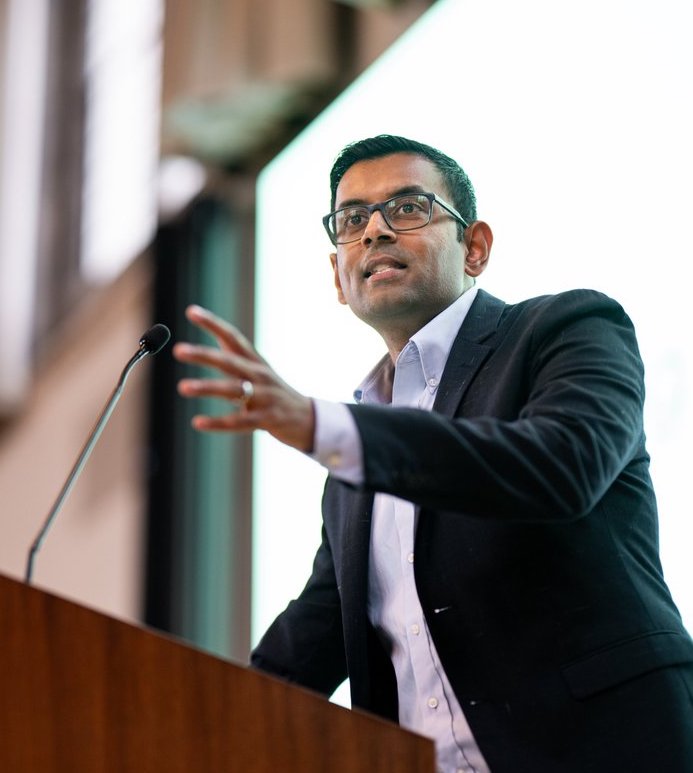
#### Arvind Narayanan
Arvind Narayanan is a professor of computer science at Princeton University and the director of the Center for Information Technology Policy. He is a co-author of the book *AI Snake Oil*, the essay *AI as Normal Technology*, and a newsletter of the same name which is read by over 75,000 researchers, policy makers, journalists, and AI enthusiasts. He previously co-authored two widely used computer science textbooks: *Bitcoin and Cryptocurrency Technologies* and *Fairness in Machine Learning*. Narayanan led the Princeton Web Transparency and Accountability Project to uncover how companies collect and use our personal information. His work was among the first to show how machine learning reflects cultural stereotypes. Narayanan was one of TIME's inaugural list of 100 most influential people in AI. He is a recipient of the Presidential Early Career Award for Scientists and Engineers (PECASE).
Video
Chat is not available.
Successful Page Load
ICML uses cookies for essential functions only. We do not sell your personal information. Our Privacy Policy »Accept
###### !Image 3: ICML logo

The ICML Logo above may be used on presentations. Right-click and choose download. It is a vector graphic and may be used at any scale.
###### Useful links
###### Contact
1269 Law Street, San Diego CA 92109