The Butcher, Now Dead
The name of Ratko Mladić, who just died in prison aged 84, will probably be totally obscure to younger readers. He was a Bosnian Serb general who besieged and bombed Sarajevo in the 1990s, and - much later, in 2011 - got arrested and extradited to The Hague, where he was sentenced to life imprisonment for genocide and crimes against humanity. His most infamous crime was the massacre of Srebrenica, where eight thousand people lost their lives.
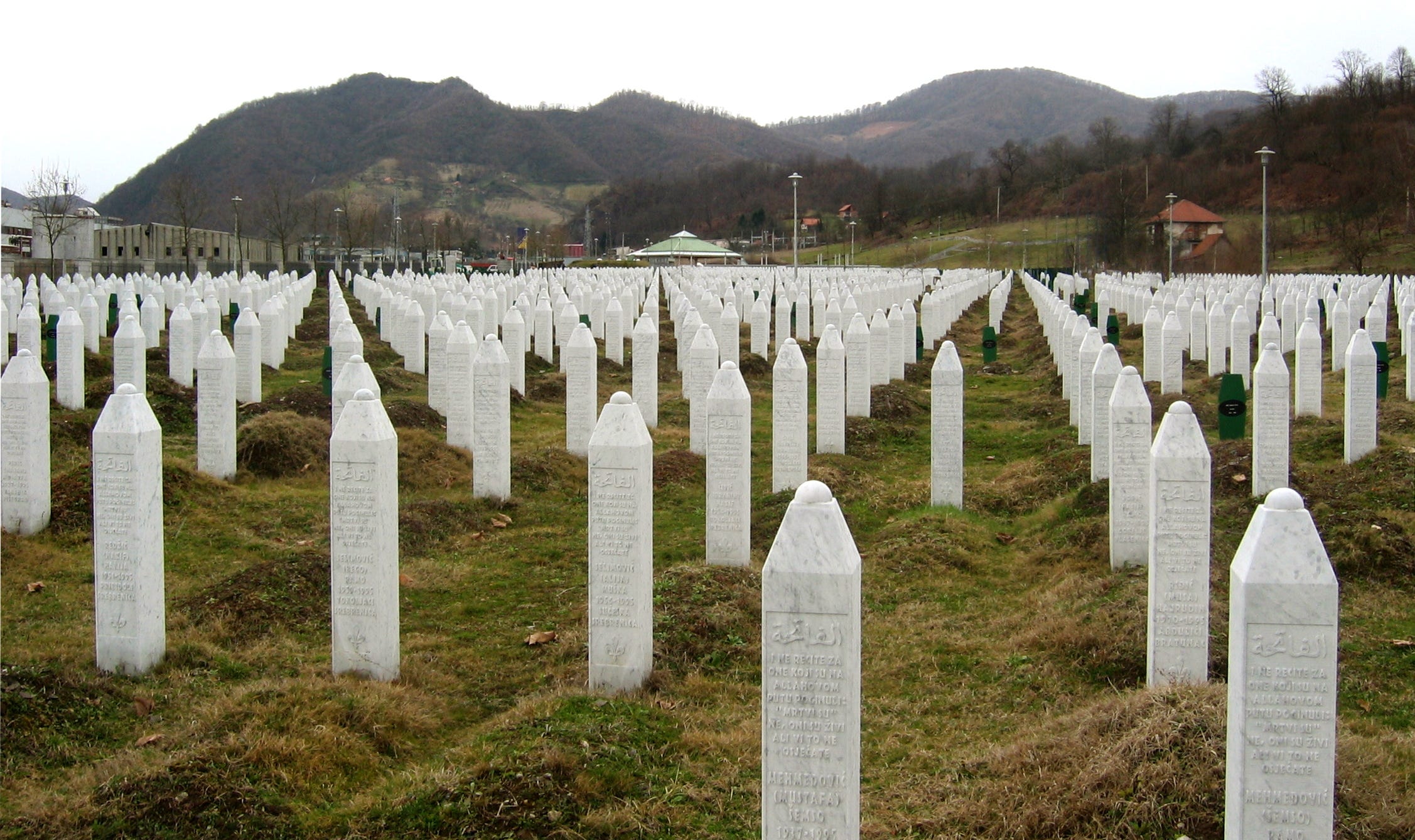

By Michael Büker - Own work, CC BY-SA 3.0, Wikipedia.
Serbian nationalists still love him, because he was _their_ bastard, even though he didn’t achieve anything in particular. Unlike the Napoleons, Genghis Khans and Guderians of the past, Mladić was, from the purely military point of view, a mediocre commander in a war that barely made any sense. There wasn’t that much to gain in Bosnia, for anyone involved, and a lot to lose.
The Balkan peninsula is known for its religious and ethnic complexity. The word _balkanization_ was once used to describe precisely this patchwork of religions and languages that made any attempt at governance thoroughly complicated. In democracies, politicians would campaign on their identity instead of their ideas; in autocracies, rulers would be tempted to favor one nation or religion at the cost of the others, with catastrophic consequences down the line.
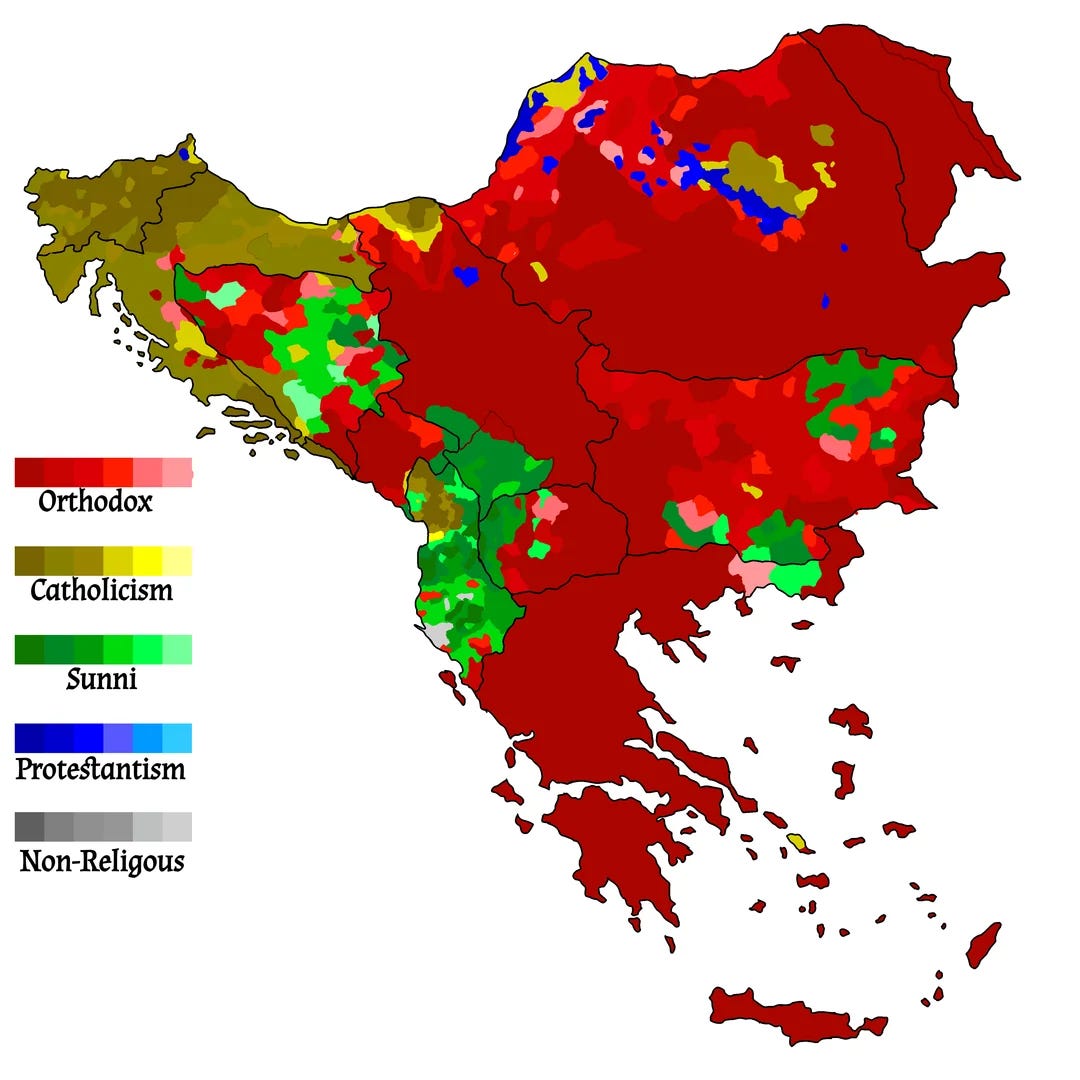

Bosnia is the wild patch in the upper left quadrant of the map, even more complex than the rest of the Balkans. It was one of the regions where the Ottomans had considerable success converting the natives to Islam. A popular, though contested theory says that they used to be Bogomils before, and thus considered deplorable heretics by the rest of Christendom. Bogomilism is long dead now, and the only two things that remained from its era are their medieval cemeteries with eerily beautiful headstones, and also the English word _buggery_1_._ Given the meaning of _buggery_, I would rather show you the tombs:
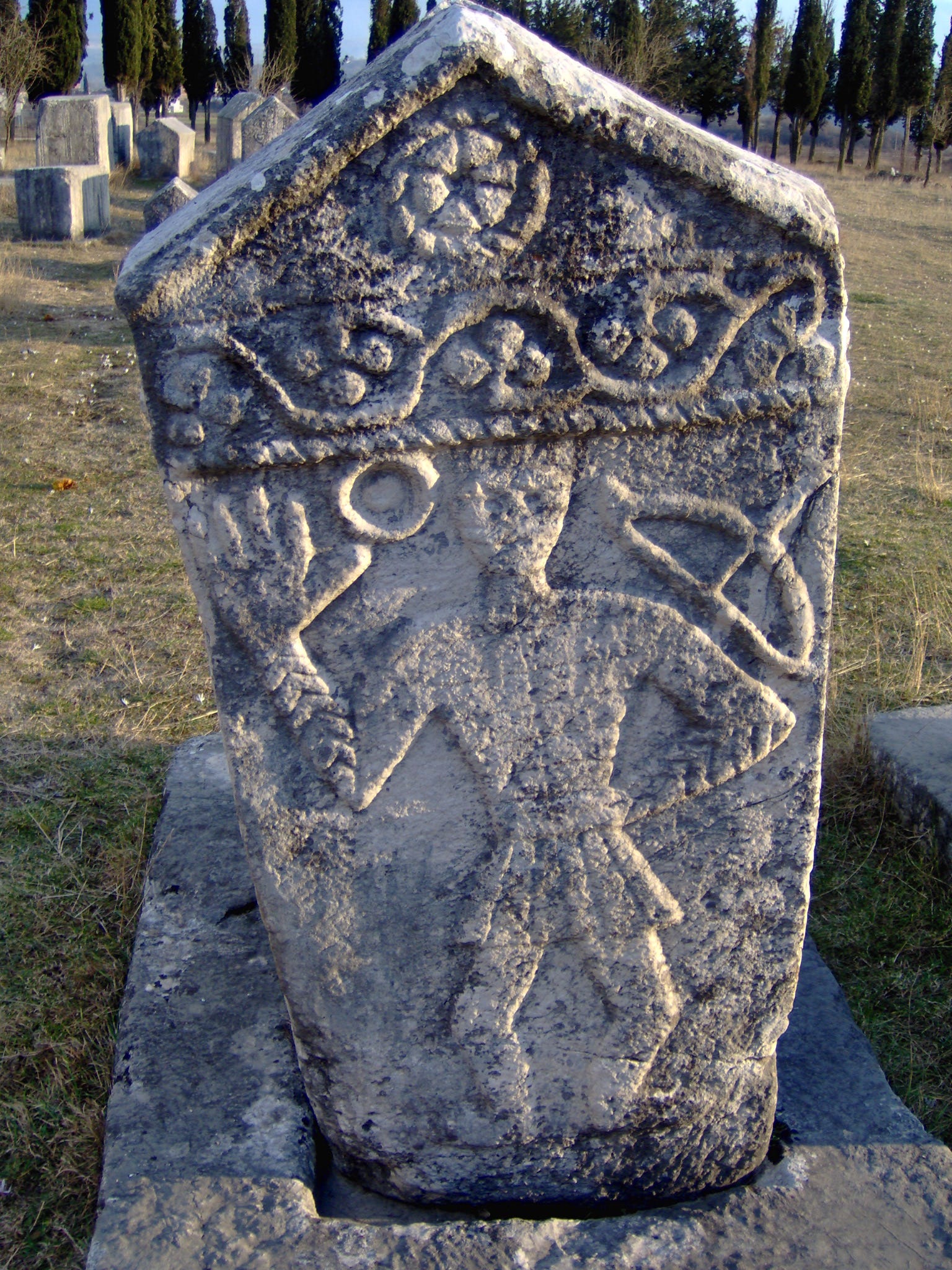

By Litany - Jag har tagit bilden själv, CC BY-SA 3.0, Wikipedia
Bosnia is also a land of harsh, unforgiving terrain, where every valley can have its own religion and its own dialect. Hence the wild ethno-religious map. The same sort of terrain is uniquely unsuitable for mechanized warfare, and even during the Second World War, the Germans were unable to take firm control of the territory against Tito’s partisans.
From any rational point of view, Bosnia is a country where building an ethnically pure nation-state makes no sense and waging a large-scale war does not make sense either.
So, people being what they are, they obviously tried both.
I wasn’t there, I just observed the events from afar, met the refugees up close, then saw some of the consequences many years later, when the worst damage was already fixed.
The war was extremely brutal, with neighbors killing neighbors and cities being shelled from the surrounding hills. Sarajevo and Mostar, the two most beautiful cities of Bosnia, were besieged, but neither was conquered. Sieges of cities fail quite often. It is hard to completely encircle and isolate them from allies, the people themselves are a lot more resilient against misery than the attackers tend to believe, and all the ruins that you create by indiscriminate bombardment become good hiding places for the defenders. The siege of Sarajevo lasted for 1425 days - a year and a half longer than the Nazi siege of Leningrad. Two thirds of the city were destroyed, and yet Karadžić’s and Mladić’s forces were never able to take it. There is a suspicion that some foreigners paid for special “human safari” trips, joining the snipers to shoot at the people below. Last November, Italian authorities reopened their investigation into this, though there are no results yet.
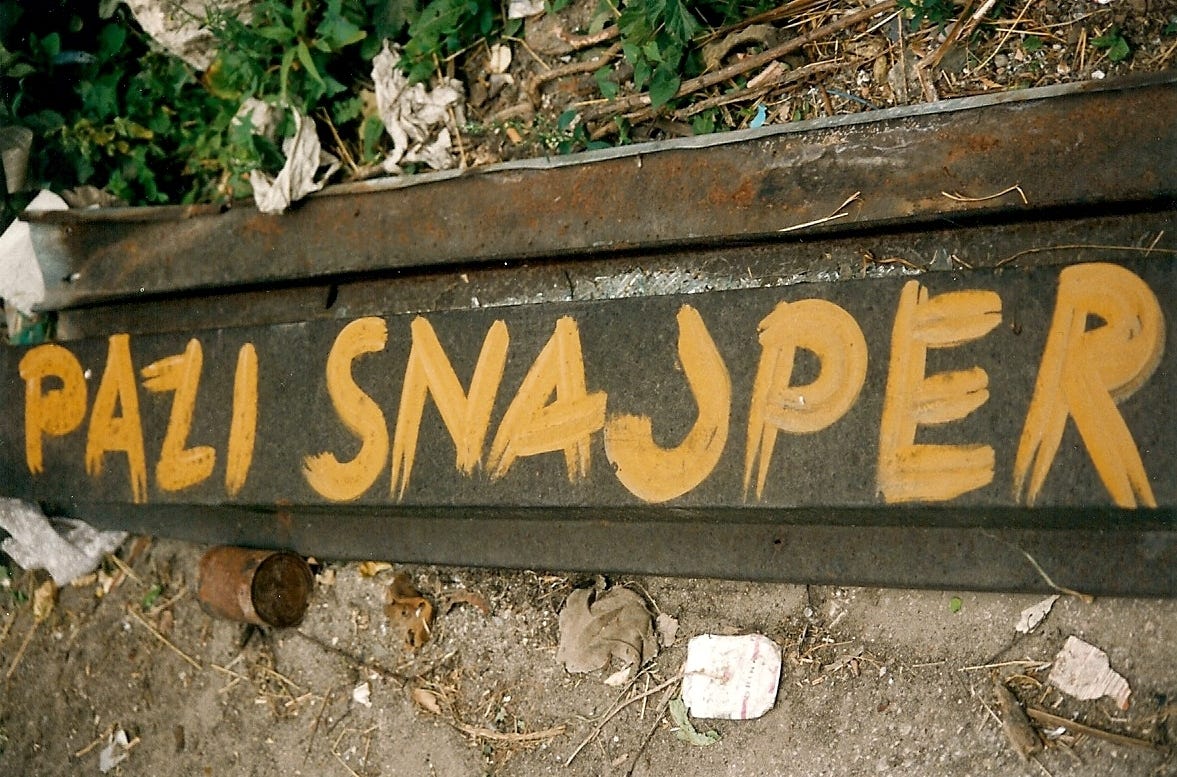

“Beware of the sniper”, a warning sign from the siege. Snipers were very active in the hills above the city. By Paalso - Own work, CC BY-SA 3.0, Wikipedia
Ultimately, in late 1995, even the Serbs came to the conclusion that the war simply could not be won, and agreed to split Bosnia into a bizarre federation of two entities whose internal border looks like something drawn by a drunkard. The red parts are Serb-controlled, the blue parts are Croat-Bosniak-controlled and the yellow part is the district of Brčko, a _sui generis_ entity functioning under separate rules, which came to be somewhat later2.
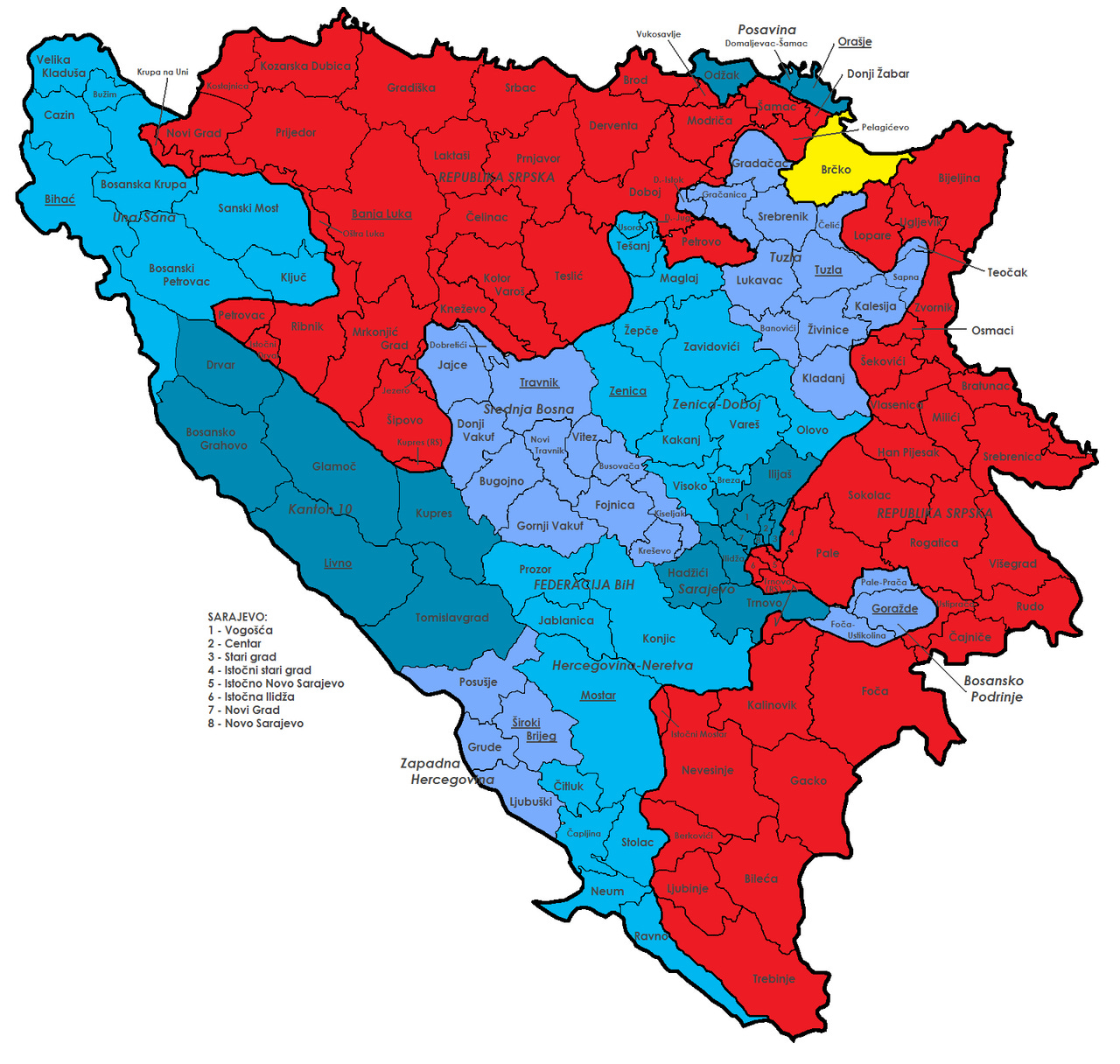

This could have been done in 1992 and without all the killing in the meantime. The country, never particularly affluent, was thoroughly destroyed by the fighting. The death toll reached at least a hundred thousand. Many more fled; about a third of the entire population ended up abroad and does not have any reason to return. City centers of Sarajevo and Mostar had to be rebuilt from the ruins.
The Western powers keep peace in the country through a generous system of grants, which nevertheless hollows out local governance. A country of three million has way too many paid political offices, usually duplicated on the Serbian and Bosniak side, just to placate some important families and get them invested in peace rather than a renewed war. For many years after the war, the Bosnian police had a reputation for being basically an extortionist gang, and although the situation is improving, the improvement is slow.
You can take a wonderful trip through the Bosnian countryside, and you won’t be disappointed. But in some places, you shouldn’t leave the well-trodden path and collect the blueberries, however inviting they seem.
There might still be landmines left.
_The extent of AI use in this article: 13 grammatical errors and bad word choices corrected. Two factual mistakes corrected. No editing._
Bogomilism came from Bulgaria and _buggery_ is a corruption of the word Bulgar.
Brčko is a micro-Bosnia of sorts, with very mixed population. Both parties were unable to agree on its division, and so it exists as a separate entity.