Whole-body Human Musculoskeletal Modeling and Control
OverviewModel ArchitectureDemonstrationResearch Papers
MS-Human-700
Whole-body **Human****M**usculo**S**keletal Modeling and Control
Project Overview
The MS-Human-700 project encompasses a comprehensive series of research initiatives focused on advancing human musculoskeletal modeling and control. By integrating high-fidelity physiological simulations with cutting-edge reinforcement learning and control theory, this model could help research and applications in brain-body interaction, embodied intelligence, medicine, robotics, sports, etc.
Our research is structured around several key pillars, providing a holistic framework for digital human simulation:
- **Musculoskeletal Modeling:**MS-Human-700 establishes the foundation with a full-body model featuring 90 segments, 206 joints, and 700 muscles.
- **Efficient Learning:**DynSyn leverages dynamical synergies to enable efficient policy learning in high-dimensional, overactuated systems.
- **Model-Based Control:**MPC2 implements hierarchical model predictive control for robust, zero-shot motion planning and execution.
- **Contact Modeling:**SoftFoot integrates deformable contact dynamics to enhance the physiological realism of locomotion interactions.
- **Scalable Exploration:**QFlex utilizes value-guided flow to solve exploration challenges in high-dimensional continuous control spaces.
- **Embodied VLM Learning:**MoVLR explores vision-language model guidance for intuitive musculoskeletal control and reward specification.
Model Architecture
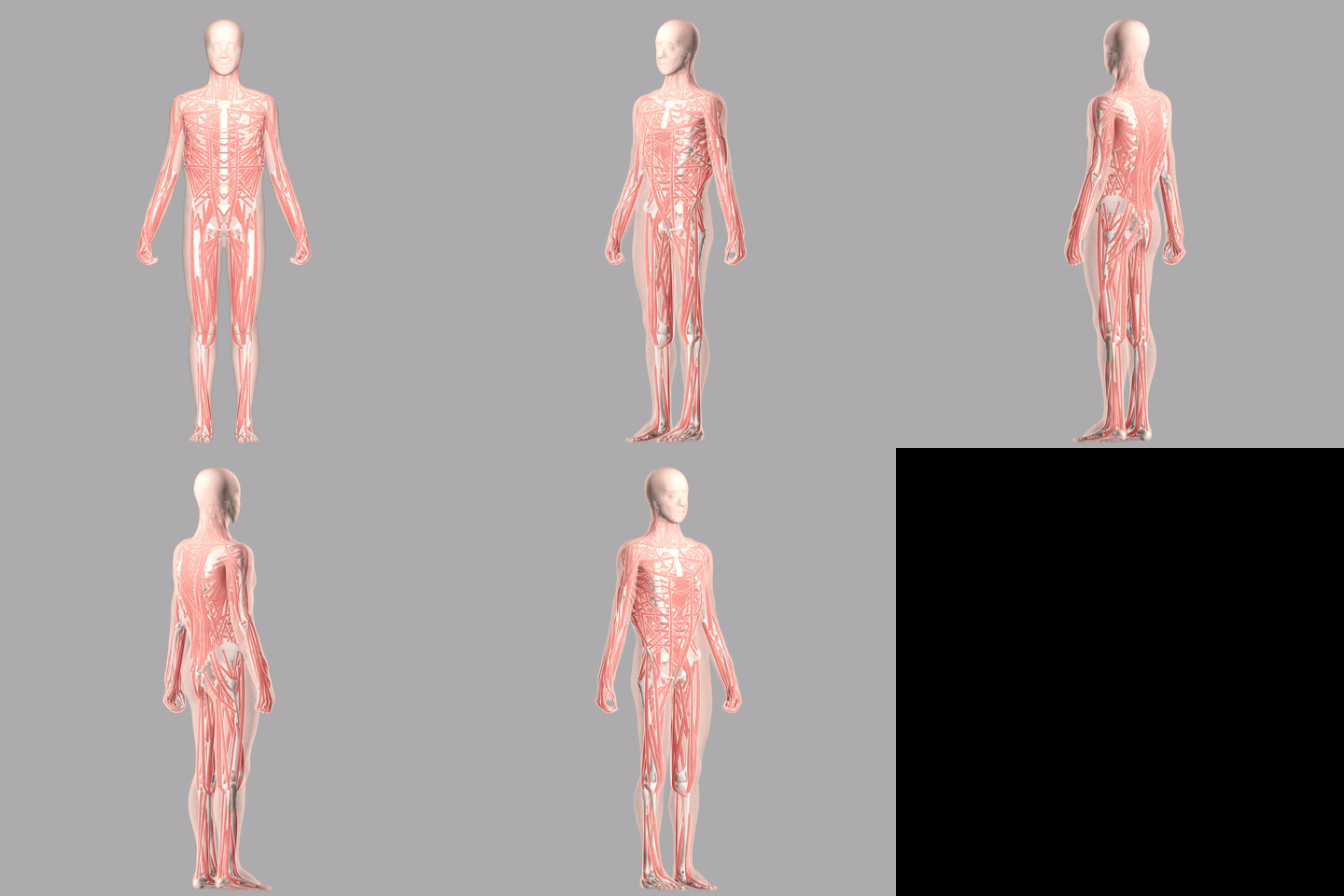
The MS-Human-700 model represents a whole-body human musculoskeletal system, featuring:
- **90 body segments**
- **206 joints**
- **700 muscle-tendon units**
- **Anatomically plausible parameters**
- **MuJoCo integration**
The model enables simulation of full-body dynamics and interaction with various devices, making it suitable for research in embodied intelligence, robotics, and biomechanics.
!Image 1: MS-Human-700 Model Visualization
Demonstration
Two-Stage Hierarchical Training Control Results
DynSyn Control Results
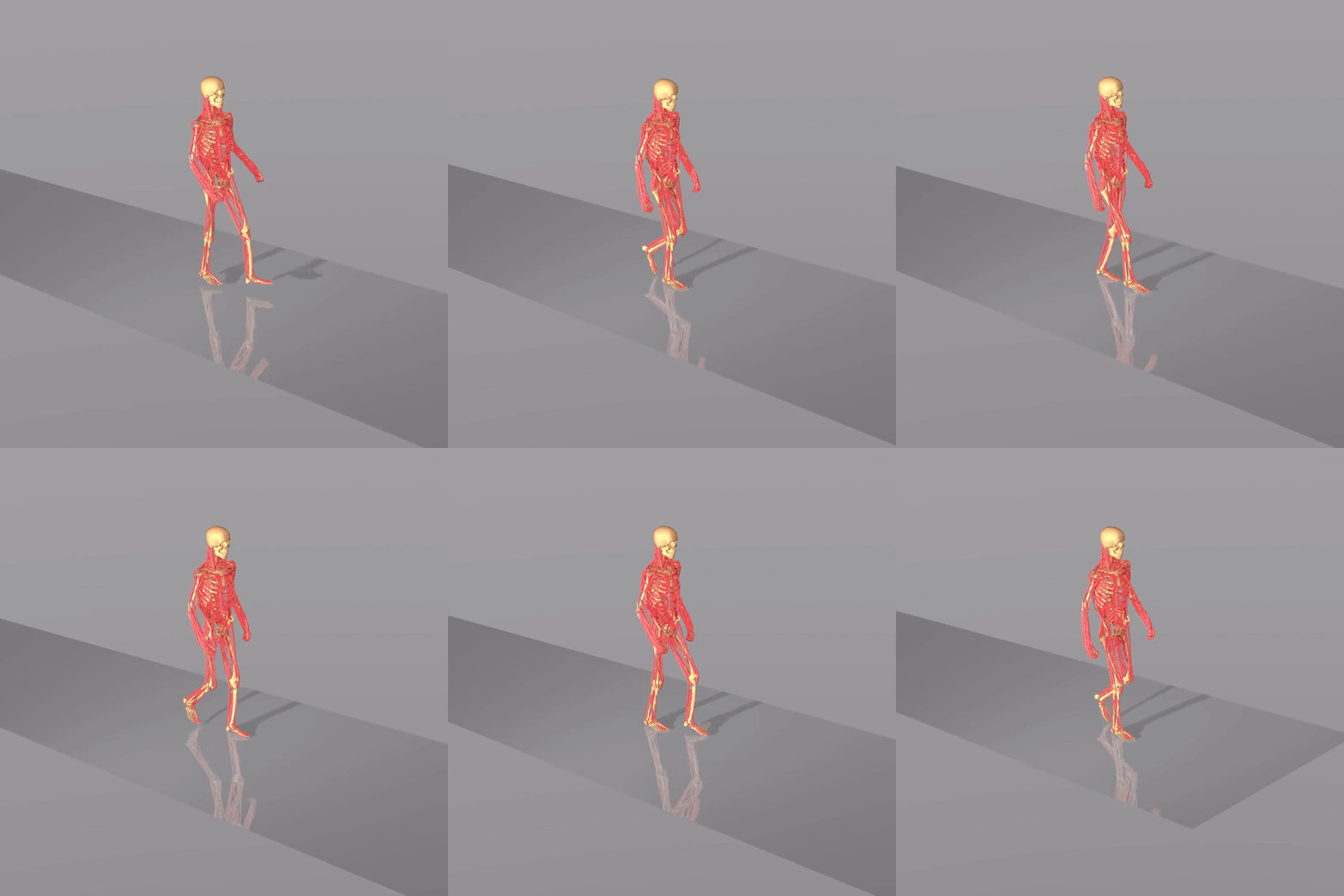
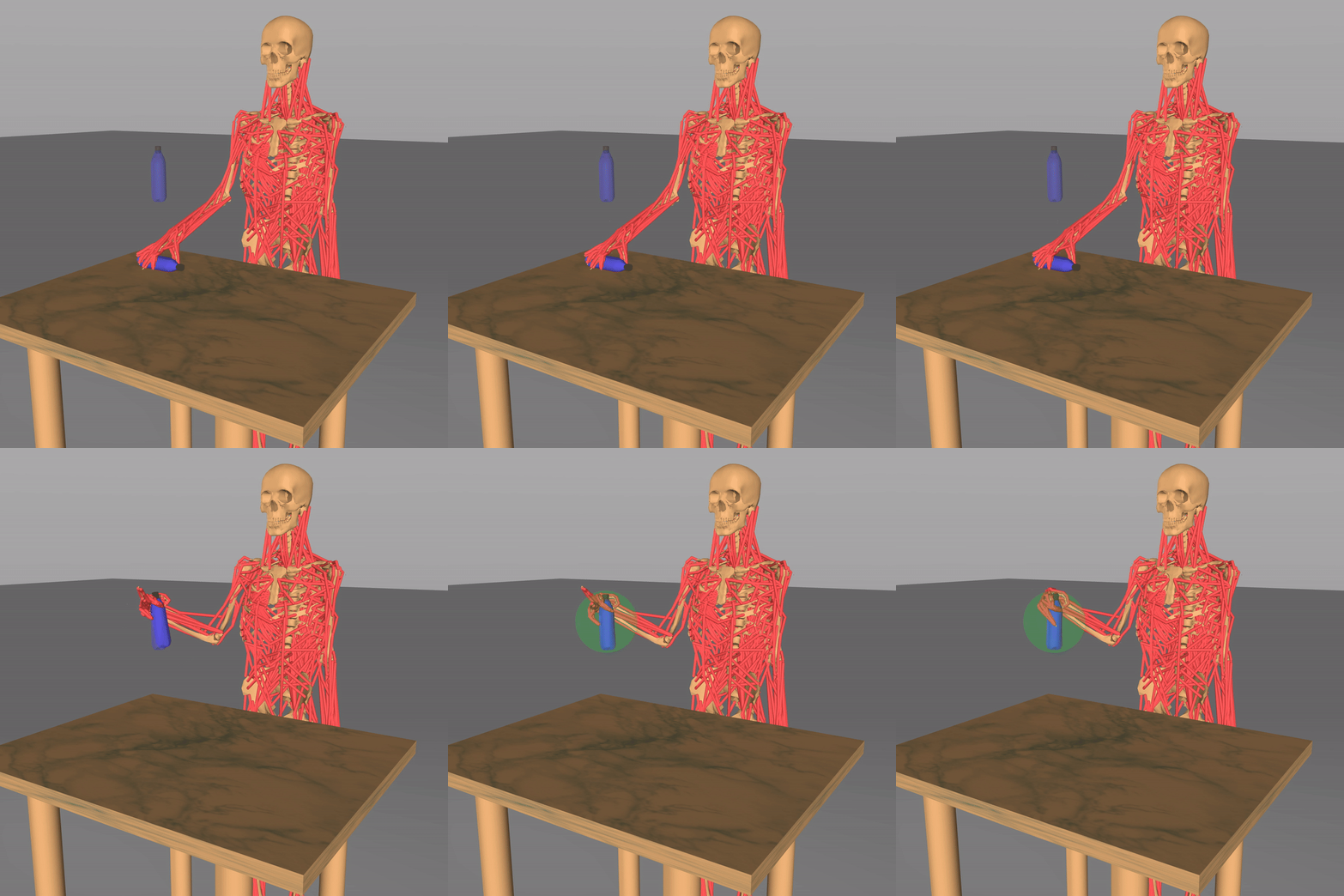
The MS-Human-700 model controlled by the DynSyn algorithm demonstrates remarkable capabilities in both locomotion and manipulation tasks.
#### Locomotion Control
!Image 2: MS-Human-700 Locomotion Control with DynSyn
#### Manipulation Control
!Image 3: MS-Human-700 Manipulation Control with DynSyn
MPC2 Control Results
The MS-Human-700 model controlled by the MPC2 algorithm demonstrates strong generalization to model changes and perturbations.
#### Soccer Motion Control
#### Adaptation Control to Model Changes
#### Adaptation to Sudden Perturbation
QFlex Control Results
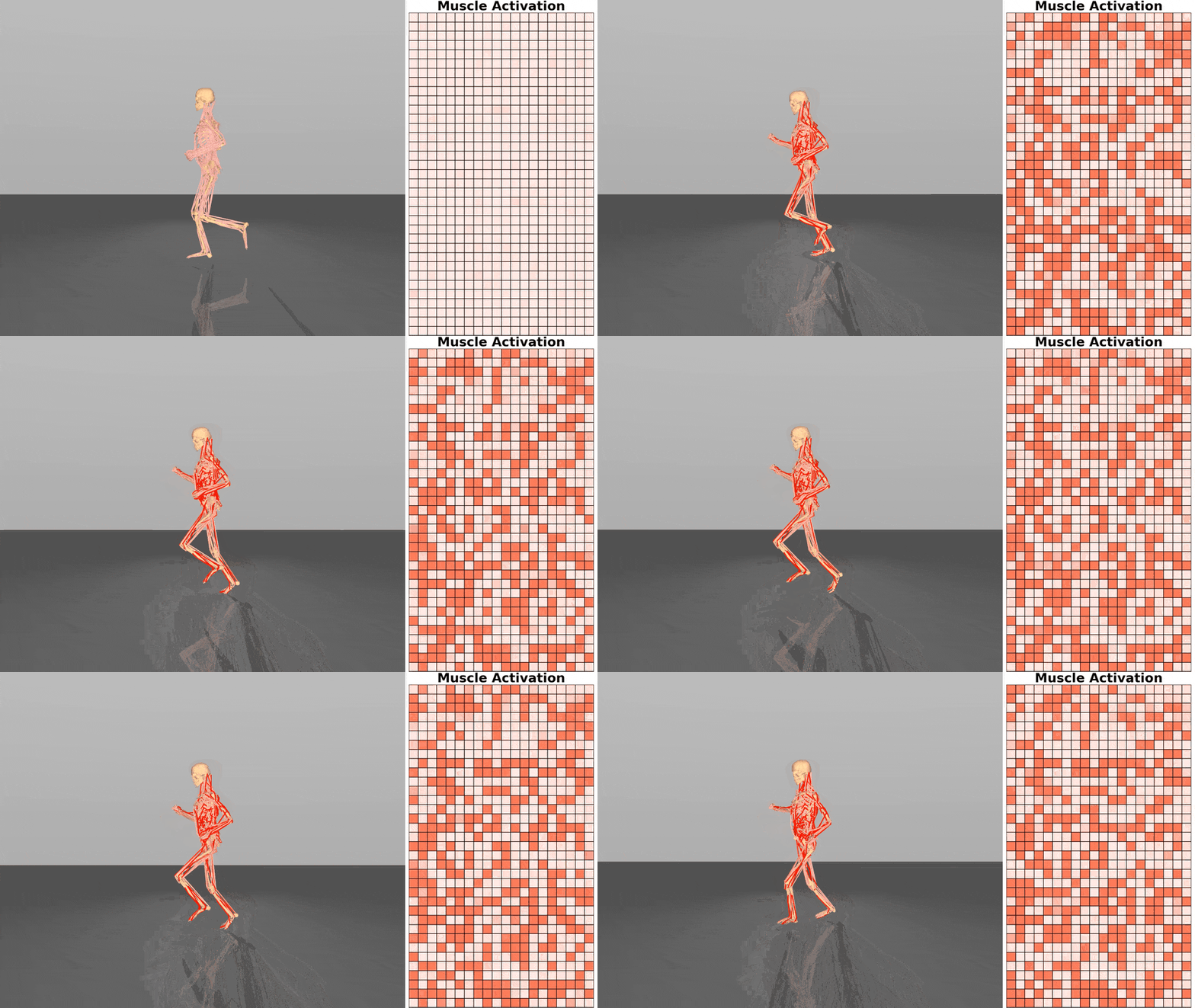
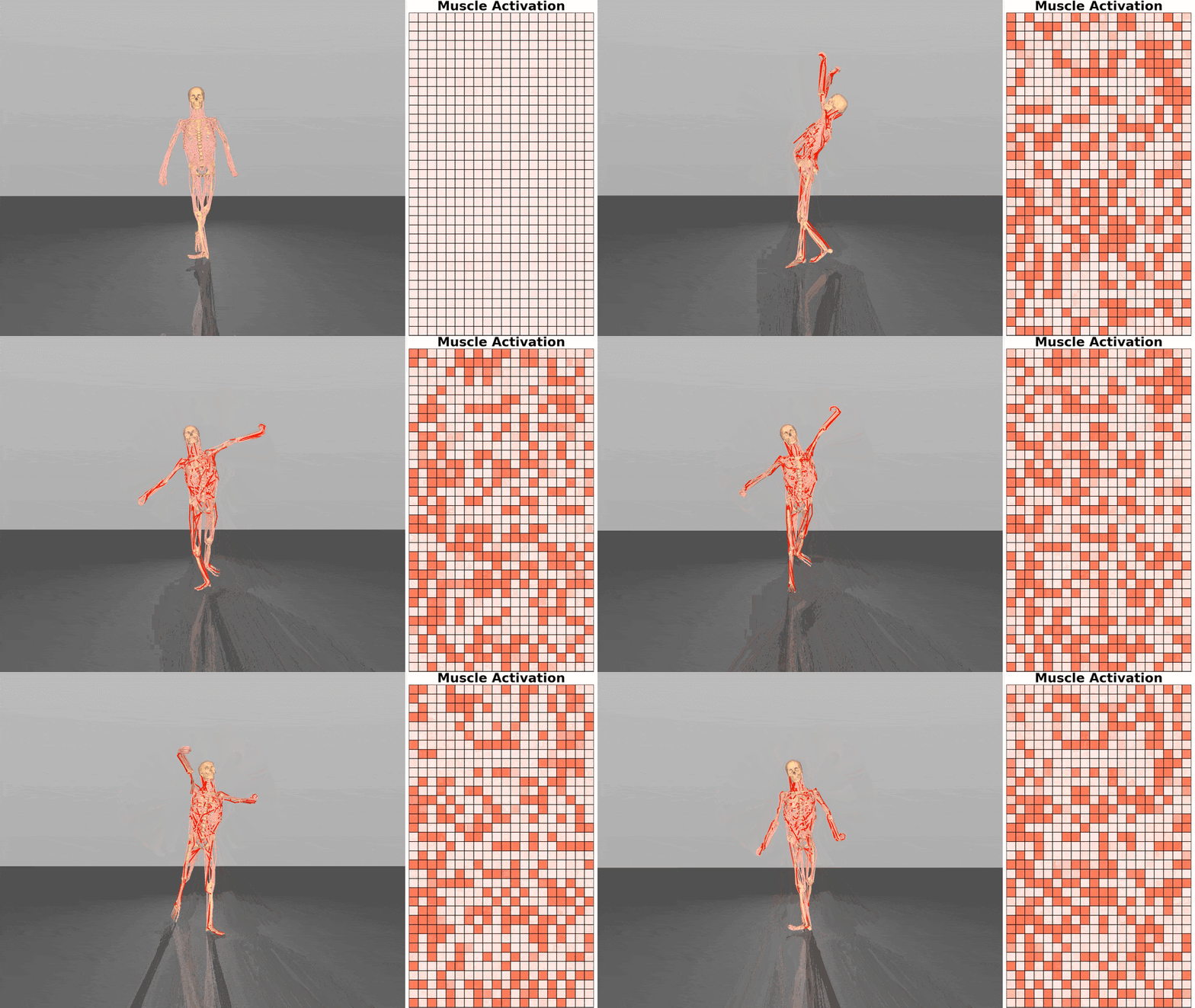
The MS-Human-700 model controlled by the QFlex algorithm demonstrates scalable exploration and agile whole-body control in high-dimensional settings.
#### Whole-body Running
!Image 4: MS-Human-700 running control with QFlex
#### Ballet Motion Control
!Image 5: MS-Human-700 ballet control with QFlex
High-Fidelity Motion Tracking
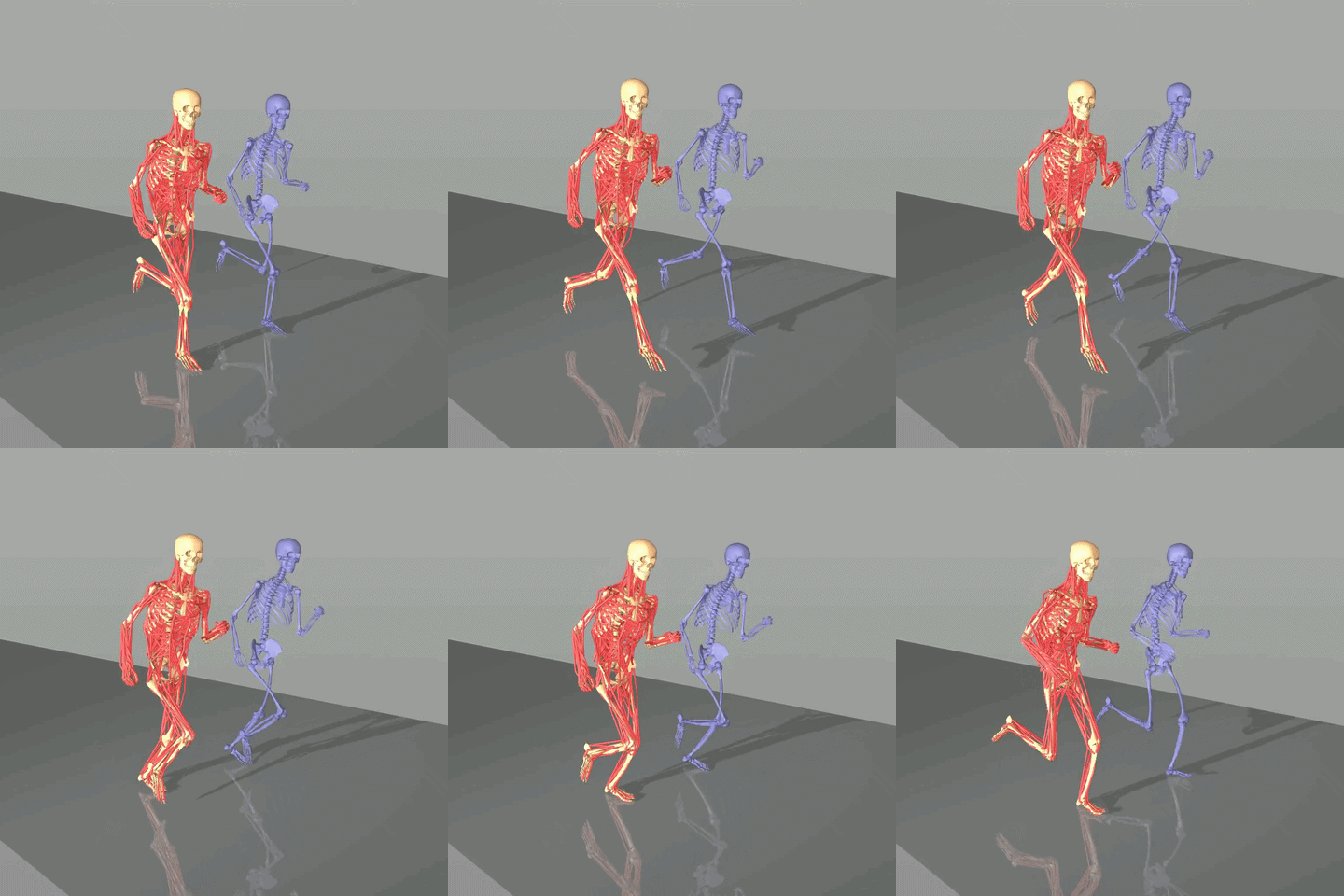
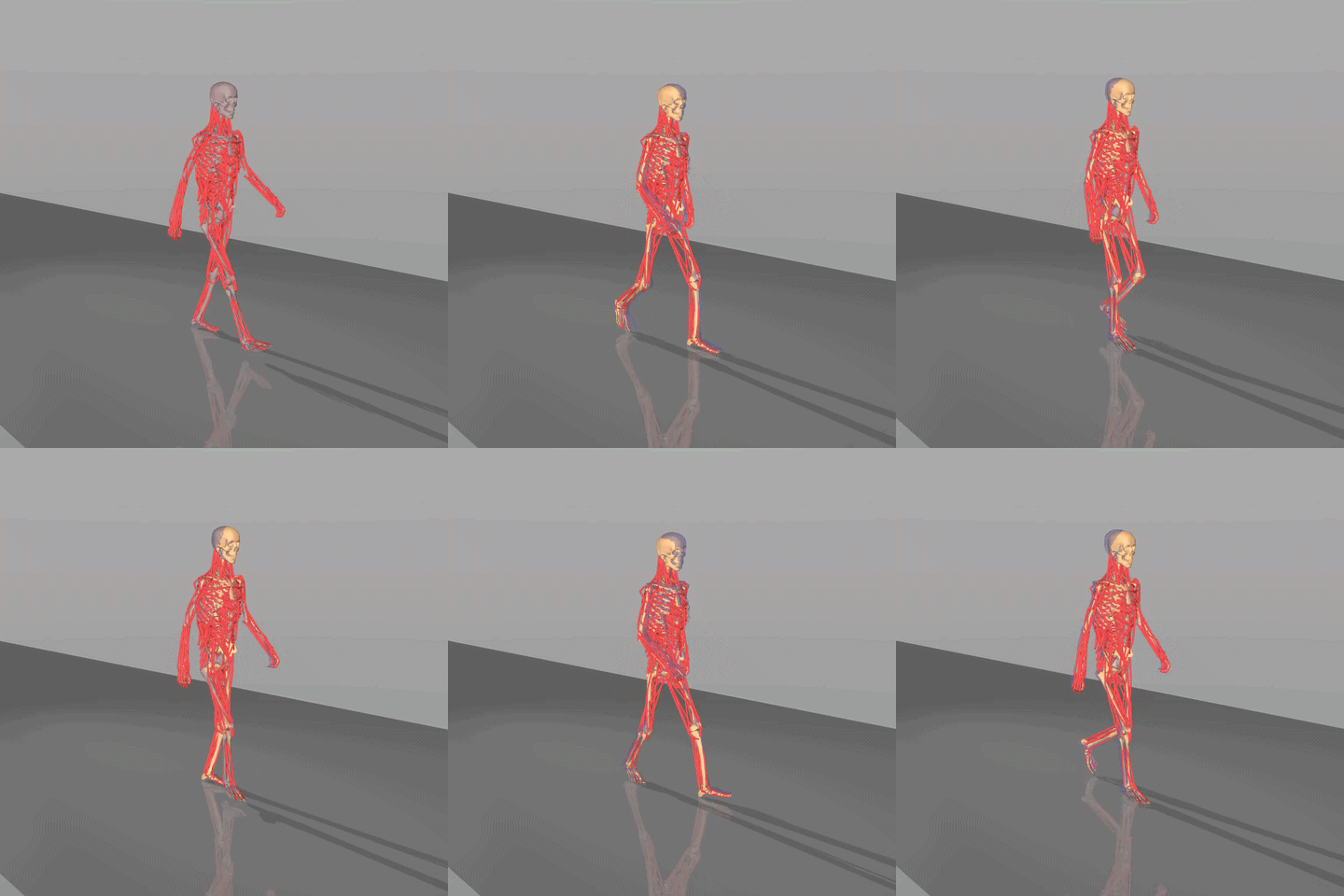
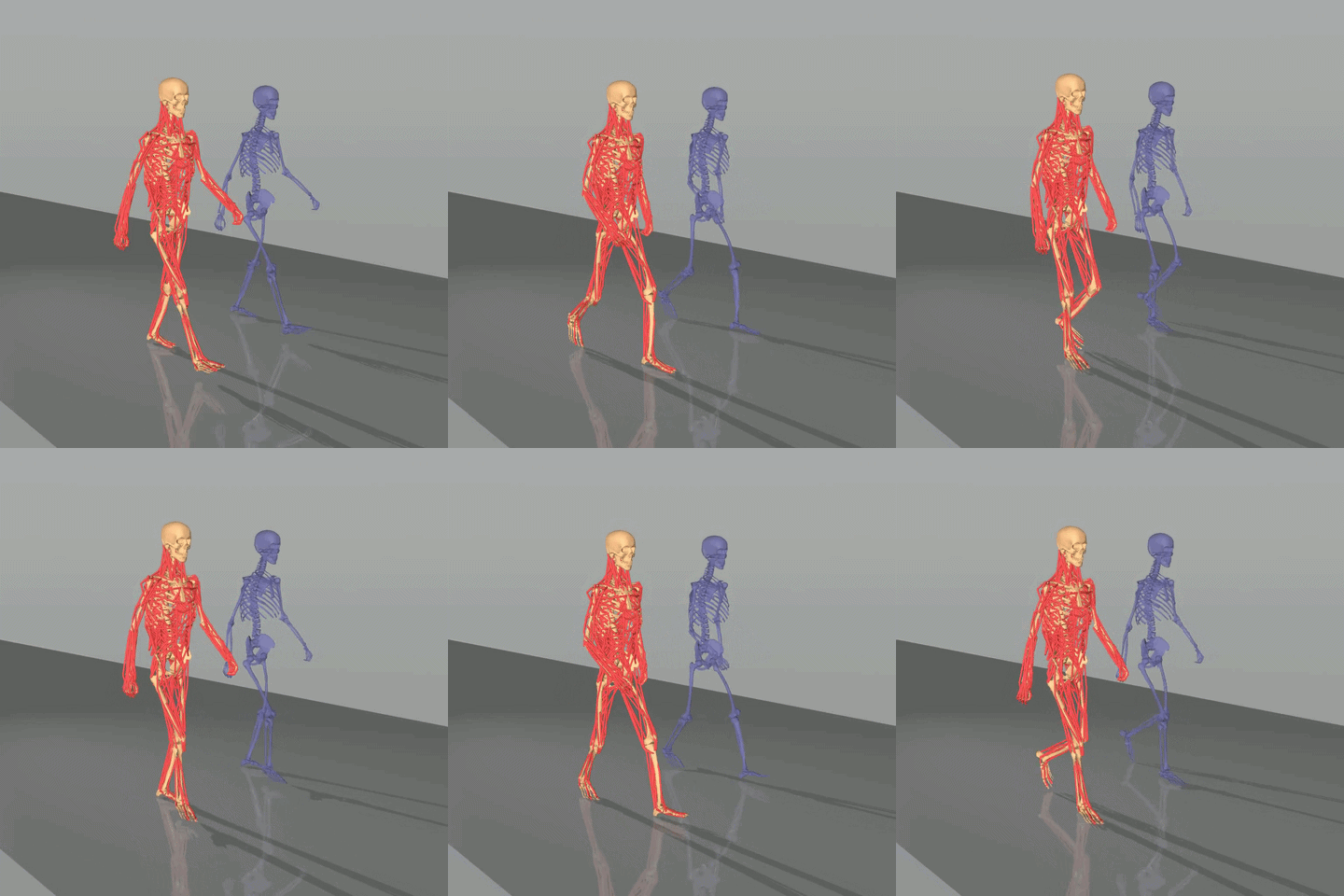
Leveraging MuJoCo Warp for massively parallel GPU simulation enables rapid and efficient training of control policies for high-precision motion tracking across diverse and dynamic trajectories.
The demos below illustrate tracking capabilities in two render modes: **Overlap** (model and reference trajectory rendered together) and **Separate** (offset rendering for detailed motion comparison).
#### Running - Overlap
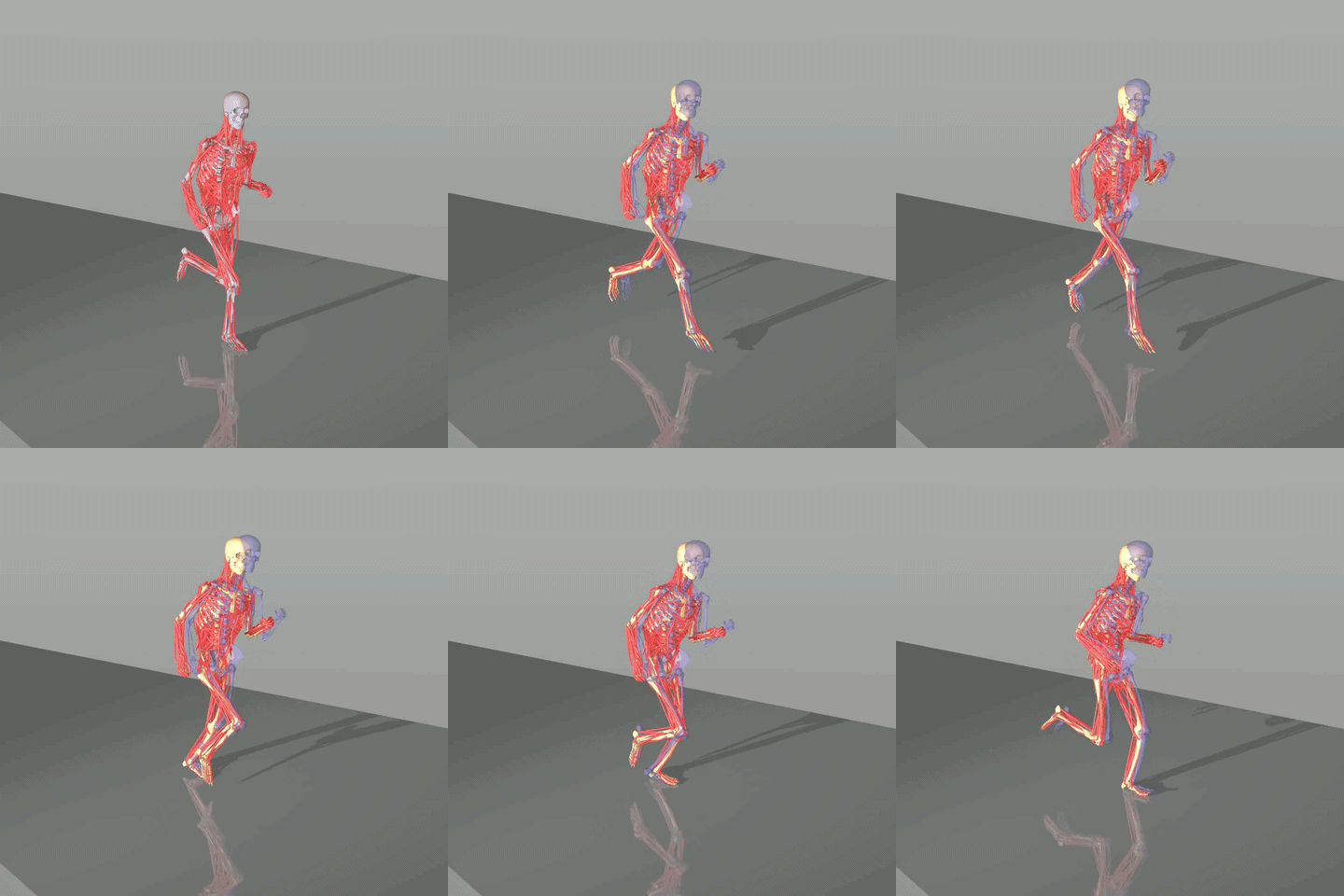
#### Running - Separate
#### Walking - Overlap
#### Walking - Separate
Research Papers
Self Model for Embodied Intelligence: Modeling Full-Body Human Musculoskeletal System and Locomotion Control with Hierarchical Low-Dimensional Representation
IEEE International Conference on Robotics and Automation (ICRA) 2024
This fundamental work introduces the MS-Human-700 model, a high-fidelity musculoskeletal system featuring 90 body segments, 206 joints, and 700 muscle-tendon units. It proposes a novel hierarchical deep reinforcement learning framework that leverages low-dimensional representations to achieve robust full-body control.
#### Key Contributions:
- Full-body human musculoskeletal model with 700+ muscles for simulation.
- A hierarchical control algorithm designed to manage high-dimensional muscle coordination.
- Validation with real-world human locomotion data.
Project PageCodearXivBibTeX
DynSyn: Dynamical Synergistic Representation for Efficient Learning and Control in Overactuated Embodied Systems
International Conference on Machine Learning (ICML) 2024
Addressing the complexity of high-dimensional, overactuated systems, DynSyn introduces dynamical synergistic representations. Drawing inspiration from biological muscle synergies, this research demonstrates how to extract synergistic structures from dynamics to enable efficient learning and task-specific adaptation.
#### Key Contributions:
- Novel dynamical synergistic representation for sample-efficient learning.
- Enhanced robustness and interpretability of synergistic control policies.
- Demonstrated generalizability across a diverse range of motor tasks.
Project PageCodearXivBibTeX
Motion Control of High-Dimensional Musculoskeletal Systems with Hierarchical Model-Based Planning
International Conference on Learning Representations (ICLR) 2025
MPC2 presents a hierarchical model-based learning algorithm enabling zero-shot, near-real-time control for complex high-dimensional systems. Just like biological motor control, it integrates sampling-based model predictive control with mechanism-aware proportional control to ensure robust actuator coordination.
#### Key Contributions:
- Hierarchical model-based framework optimized for high-dimensional control.
- Zero-shot generalization and near-real-time performance capabilities.
- Morphology-aware proportional controller for stable and robust coordination.
- Automated optimization reducing the dependency on manual reward engineering.
Project PageCodearXivBibTeX
Scalable Exploration for High-Dimensional Continuous Control via Value-Guided Flow
International Conference on Learning Representations (ICLR) 2026
QFlex proposes a value-guided probability flow to sustain effective directed exploration in high-dimensional continuous control. It enhances scalability while preserving flexibility in native action spaces, demonstrating superior performance on complex musculoskeletal control tasks.
#### Key Contributions:
- Value-guided flow exploration mechanism for high-dimensional continuous control.
- Theoretically grounded directed exploration ensuring valid policy improvement.
- Flow matching-based actor-critic implementation.
- Extensive validation on over-actuated musculoskeletal benchmarks and full-body control.
Project PageCodearXivBibTeX
Embodied Learning of Reward for Musculoskeletal Control with Vision Language Models
Learning for Dynamics & Control Conference (L4DC) 2026
MoVLR investigates the intersection of embodied intelligence and large vision-language models for musculoskeletal control. By utilizing the semantic understanding capabilities of VLMs, this work enables the learning of reward functions directly from visual observations, facilitating more intuitive and generalized control policy learning.
#### Key Contributions:
- Framework for deriving reward signals from Vision Language Models for complex control tasks.
- Enhanced generalization across different embodiments and task specifications.
- Demonstration of effective policy learning using VLM-guided rewards in high-dimensional spaces.
Project PageCode (Coming Soon)arXivBibTeX
Embodied Human Simulation for Quantitative Design and Analysis of Interactive Robotics
IEEE/RSJ International Conference on Intelligent Robots and Systems (IROS) 2026
This work uses MS-Human-700 as an adaptive digital human surrogate for quantitative physical human-robot interaction. The coupled simulation exposes internal biomechanical feedback and enables concurrent optimization of an interactive robot's structure and control.
#### Key Contributions:
- A full-body, physiologically grounded digital human for interactive robotics evaluation.
- Quantitative access to muscle, joint, and human-robot contact metrics in simulation.
- Joint optimization of exoskeleton morphology and controller parameters.
Project PageCode Coming SoonarXivBibTeX
×
Citation
Copy to Clipboard
**MS-Human-700** by the LNS Group at Tsinghua University.
Licensed under the Apache-2.0 License.