It doesn’t matter what’s right, it matters what’s left
First premise: AI is useful.1
Second premise: you should act as though we’re in an AI bubble.2
Imagine that, tomorrow, Anthropic and OpenAI hold a joint press conference, where they say the following.
> Ahhh jeez. This is really embarrassing. I know we’ve been talking about more powerful models coming soon, but they just didn’t pan out. It turns out we can’t make these things any better than they already are. > > > We feel really bad about the whole thing, so we’re just gonna shut down entirely and return as much as we can to our investors. Thank you and goodnight.
Markets crash. Google releases a similar statement. Trillions of dollars in market cap evaporate instantly. Elon Musk says something horrifically racist. That was already priced in.
Thousands of startups go out of business. The economy contracts. Millions of people lose their jobs. It’s the end of the world. And then life goes on.
Out of the ashes, does anything grow?
There are basically two kinds of bubbles. The first kind is purely destructive: they burn capital on fast-depreciating assets tied to the bubble itself, like the NFT craze of 2021. The second kind of bubble also destroys capital (investors get hosed), but the world gains a durable asset (railroad tracks, fiber, telegraph lines), priced way below the cost of the build.
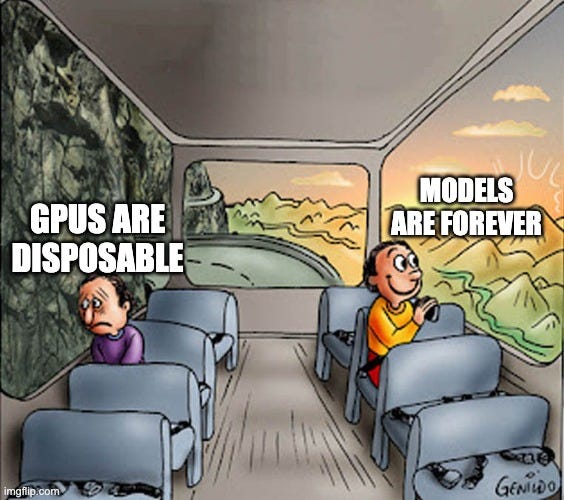
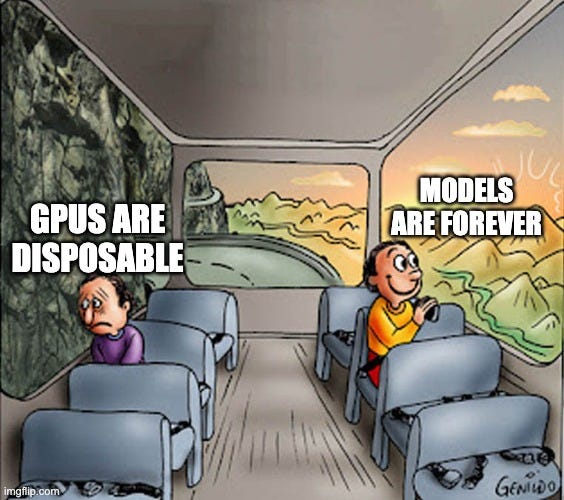
So what kind of bubble is AI? On its surface, it looks like the first kind: the vast majority of AI spending is going to GPUs with a useful life of only a few years. But in this case, hardware isn’t the infrastructure. The durable infrastructure is _the models themselves_.
Between 1996 and 2001, telecom companies in the US spent about $500 billion (close to $1 trillion in today’s dollars) of capital expenditures, spurred on by the seemingly boundless appetite for bandwidth and the indiscriminate capital market. They laid tens of millions of miles of fiber, financed through massive debt loads and irrationally high valuations. And when the bubble burst, and most of the builders went bankrupt, there was no way to claw that value back except to leave the fiber in the ground and hope that it could pay it back over the course of decades.
So, in 2002, there was suddenly a whole lot of fiber, and bandwidth became very, very cheap. A new set of startups bloomed: Web 2.0. Facebook, YouTube, Skype, Spotify, and others all took advantage of the empty fiber lines, creating business models that would have been impossible in 1999 (streaming _video?_ on the _Internet??_ what do you _mean_ it’s _free???_)
GPUs aren’t durable like fiber; they won’t stay useful for decades. That doesn’t matter!
We’re used to thinking of physical builds (fiber-optic cables, servers, data centers) as enduring, and software as ephemeral. But that intuition here is precisely backwards. GPUs are not an investment. They’re the fuel that we’re burning to create these models. Yes, they disappear quickly. That’s how fuel works.
Models, on the other hand, do not disappear. It _feels_ as if they do, because they get displaced, but DeepSeek-R1 is not any less useful today than it was in January 2025. Its absolute value hasn’t changed, only its value relative to the rest of the field. If frontier model progress stops (whether that is a cause or an effect of the bubble bursting), the last model generation will remain useful _forever._3
And even in the maximally destructive scenario, where the current frontier models stop being publicly available4, we are still left with open models, which are less than six months behind the frontier. Already, more and more spend is going to open models: on OpenRouter, they’ve gone from 11% of spend in January 2026 to 27% in September. And if you believe, as I do, that the cause of the bubble bursting will be the frontier labs’ inability to stay ahead of open models, that makes this an even better take.
So, from the ashes, what will rise?
Inference becomes dramatically cheaper and stays that way — not because GPUs are durable, but because research on quantization, speculative decoding, and other efficiency gains continues. For a historical analogue: 10-gigabit Ethernet became a standard in 2002, after the bubble had already burst.
At the same time, the market starts to reject any hint of AI. Pre-2000, adding .com to a company’s name produced cumulative abnormal returns of about 74% over the 10 days surrounding the announcement. Post-2000, _deleting_ .com produced cumulative abnormal returns of about 64% over the 605 days surrounding the announcement.
There will be a new wave of startups that treat the existence of AI like plumbing: we all agree it’s important, and it lets us do the things we need to do, but let’s not talk too much about it.
Having a stable inference layer will enable all kinds of applications that would make no sense today. Here’s one example: model-specific chips. Taalas released a chip with Llama 3.1 8B hard-wired into it, which allowed them to run 10x faster than the state of the art with 1/10th the power consumption.6
Right now, the risk with freezing a model is that it may end up obsolete before the chip is released. Taalas’s first chip shows this already: it launched in 2026 running a model from mid-2024, on a custom 3-bit format that standard formats overtook before it shipped. If models stabilize, though, these kinds of specialized chips could become cost-effective and reliable enough to deploy in devices designed to last years, rather than months.
What else? Who knows! Many startups will be founded; many will fail; a few will change the world.
Some of these startups will fulfill the promises made and broken during the bubble, as Netflix7 fulfilled the promise of Broadcast.com. Some will make something entirely new, as Facebook did by intentionally throwing out user anonymity and turning the Internet into a mirror of real life. And some will be the ground on which the others stand, as Google became the layer through which we accessed Web 2.0.
Whatever comes next, it will be built on what’s left.
from Dan Luu: “My position on AI has been extremely boring and is basically, ‘if something is currently happening, the people who are saying that it’s impossible that it will ever happen are probably wrong’.”
Will AI replace all cognitive work? Maybe! I don’t know, and neither does anyone else. Can AI enable people to do things they’ve never done before, as well as some things they’ve done many times, but 100x faster? Absolutely.
AI advocates might say that we are in fact at the dawning of a new age, a technological singularity, after which everything will be different. Okay. Given that one of the characteristics of a singularity is that everything after it is fundamentally unknowable, there’s nothing you can do to prepare for this, so it’s better to prepare for the world that is preparable.
There will be weirdness here — for example, if frontier model training really stops, all the best base models will have a knowledge cutoff in, say, 2026, and you’ll have to either finetune the model or give it search. But to the extent that these models have something like general intelligence, that will remain useful.
It’s not hard to imagine a scenario where, for example, Microsoft and Meta each end up swallowing one of the frontier labs and repurposing their models for internal development. If the models remain publicly accessible, that only strengthens the argument: after the death of the labs, the models still exist.
Yes, I know these are different numbers. They come from two different studies: adding.com, deleting.com, written by some of the same authors.
I would say something here like “not investment advice! they’re probably too early!” but it appears that AMD is planning to acquire them.
Founded before the crash, but their pivot into streaming was enabled by cheap bandwidth.