Missileer Watch
Binder 1
The message
The top of this page is where you listen to Emergency Action Messages (EAMs) and read the copies. An EAM is, in the words of a 1985 Scientific American article by Ashton Carter, "a short, preformatted, encrypted message." You can hear the preformatted part. Every message follows the same pattern.
An EAM opens with the net call, then the six-character preamble read three times with "standby," then "message follows," then the full string. Then "I say again," and the whole thing once more. Our receivers copy each one off air and a transcriber turns it into the text above.
They're encrypted, so all you can do is listen and copy them down.
Copy it yourself
Play a real broadcast and copy each character as the voice reads it. Mark anything you can’t make out with ?. Then check your copy against ours.
22 OCT 2026 · 2131Z ICELAND + KPH RECEIVERS · 1 OF 4
Standby
Message follows
I say again
Completes · 48
Out
**Standby ×3****Stby ×3****1st reading****1st****2nd reading****2nd**
**Message follows****Msg follows****I say again****Say again****This completes, out****End**
0:00 3:48
**Your copy** · 48 cells
Broadcast said: —
Press Play, then type or tap the keys. Mark anything you can’t make out with ?.
Match Missed Not made out Lower line: our copy
32 keys: every character a message can use. No 0, 1, 8 or 9.
Recording: Iceland + KPH receivers, 11175 kHz USB, 22 Oct 2026 2131Z. Our copy: the station’s copy. Lamps and the reading position: the station’s word timestamps for this recording.
SOURCES · 4
- Our own observations (two messages): the EAM format as heard, first transcribed by ear from 1502Z 23 SEP 2026.
- Our notes on external references, each marked secondary and unverified against our audio.
- Ashton B. Carter, "The Command and Control of Nuclear War," Scientific American 252, no. 1 (January 1985): 32–39. Print. One quoted phrase plus paraphrase; no images from the article.
- HD 2001: Minuteman Weapon System History and Description, prepared for the ICBM System Program Office, Hill AFB, Utah, by TRW, July 2001, p. 7 (the printed page number): an order to launch reaches the launch control center as an emergency action message. Obtained under the Freedom of Information Act by Hans M. Kristensen.
Binder 2
The network
The messages go out on the High Frequency Global Communications System (HFGCS), read aloud in the phonetic alphabet. The main frequency is 11175 kHz, upper sideband, and anyone with a shortwave radio can hear it.
Shortwave (HF) bounces off the ionosphere, so one transmitter can reach thousands of miles with nothing in between. The downside is that a nuclear burst fills the ionosphere with electrons, and HF gets absorbed instead of reflected. So HFGCS is one path among several. It's the only one the public can listen to.
HFGCS station (tap for details): Guam · Andrews · Ascension · Croughton · Diego Garcia · Grand Forks · Elmendorf · Hickam · Lajes · McClellan · Offutt · Salinas · Sigonella · Yokota
receiver, receiving: audio in the last 15 min: KPH
receiver, no audio in the last 15 min: Iceland
Known HFGCS stations, from public sources; not all current.
**WHAT ELSE YOU'LL HEAR**11175 kHz · our receivers
Not everything on the HFGCS net is an EAM, and only EAMs are copied here. These are the other things you'll hear, with one example of each.
1. EAM
A six-character preamble, then the full string of characters, read twice. The station copies it character by character. 24 SEP 2026 · 16:36Z · KPH · Point Reyes, CA + Iceland
0:00 / 2:51 16:36Z VQ6JYQ VQ6JYQVZW7HG6BRKDNRZYDNZZYDNRGCZ _corrected by a listener_ 32 characters **×2** copy this one ↑
2. Radio check
A radio check is a station counting up and down to test the circuit. 23 SEP 2026 · 19:17Z · KPH · Point Reyes, CA + Iceland
3. Authentication
An authentication exchange is two stations trading letter groups. 23 SEP 2026 · 21:17Z · KPH · Point Reyes, CA
4. Two-way traffic
Net traffic is ordinary operator calls: check-ins, check-outs, phone patches. 23 SEP 2026 · 23:17Z · Iceland
Not heard yet
1. 8888
A message shape the station has heard but not yet confirmed by ear. Not confirmed on this station yet.
2. Skyking
A Skyking ("Skyking, Skyking, do not answer") is a shorter message that outranks an EAM. Not heard on this station yet (0 in 5,445 recordings since 21 SEP 2026).
SOURCES · 7
- Ashton B. Carter, "The Command and Control of Nuclear War," Scientific American 252, no. 1 (January 1985): 32–39. Print. One quoted phrase plus paraphrase; no images from the article.
- Number Stations Research, "The HF-GCS and Emergency Action Messages", numbers-stations.com/usa/hfgcs/ (accessed 24 SEP 2026): the net, its sites and its primary frequency. Secondary; facts only, in our own words.
- U.S. Air Force, Grand Forks AFB, "319th CS hosts High Frequency Global Communications System open house" (2 June 2023), grandforks.af.mil/News/Display/Article/3415740/ (read from the Internet Archive capture of 10 April 2026): HFGCS is an Air Force system, operated at Grand Forks AFB and Joint Base Andrews.
- Priyom, "HFGCS", priyom.org/military-stations/united-states/hfgcs. Secondary: a listener reference, read 2026-09-28; paraphrased.
- NEET INTEL, "HFGCS FAQ", neetintel.github.io/hfgcs_faq.html. Secondary: a listener reference, read 2026-09-28; paraphrased.
- Milcom Monitoring Post, "What are Emergency Action Messages (EAM)?", mt-milcom.blogspot.com/p/what-is-emergency-action-message-or-eam.html. Secondary: a listener reference, read 2026-09-28; paraphrased.
- Skyking format: Number Stations Research, "The HF-GCS and Emergency Action Messages", numbers-stations.com/usa/hfgcs/ (the NSRIC HFGCS page; it cites the National Park Service and the CIA CREST reading room). Secondary, unverified against our audio.
Binder 3
The capsule
The messages above are sent to launch control centers like this one. A command post passes each message down to the capsules, where it comes in through the console.
The capsule is about the size of a school bus, sixty feet underground behind an eight-ton blast door. Two officers pull 24-hour alerts in it.
The crew commander sits left, the deputy right. Between them are the launch control console, printers, phones and a shelf of procedures.
A missile combat crew on alert. The red clock above the binders keeps Zulu time (UTC), which every message to the capsule uses. The crew checks it every day against the U.S. Naval Observatory's master clock, to the second.Clock detail: Daniel Frenkel, 321st Missile Squadron, 2012–2016.A combat crew at a REACT console, F.E. Warren AFB, Wyoming. U.S. Air Force photo (090413-F-1234S-007), National Museum of the United States Air Force. Public domain.
Tap a label on the drawing.
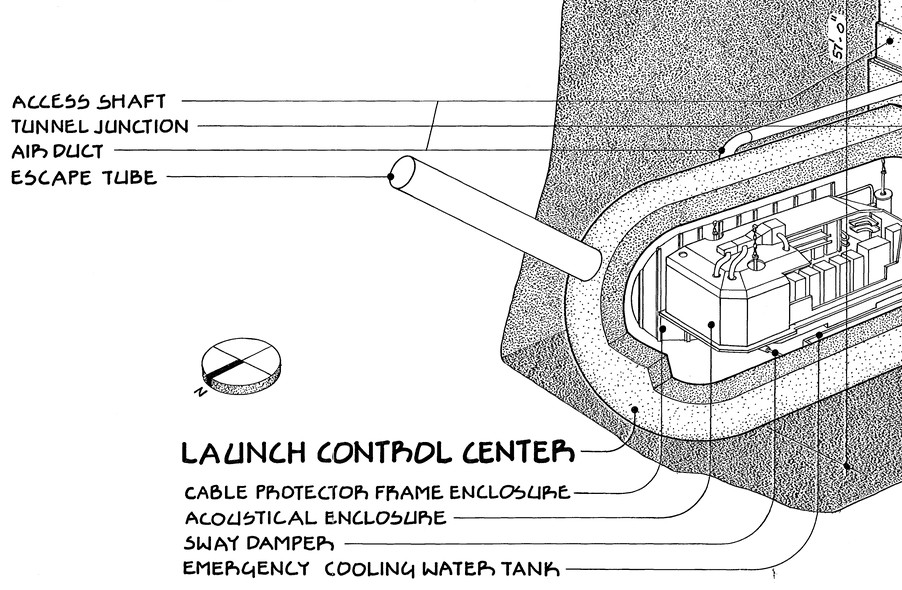
Minuteman III ICBM Launch Control Facility November-1, Weld County, Colorado. HAER CO-84, sheet 4 of 4, 'Perspective', delineated by Clayton B. Fraser, 1997. National Park Service, Historic American Engineering Record (Library of Congress HAER COLO,62-NERAY.V,1-). Public domain. The parts worth knowing: the launch control center, the launch control equipment building, the launch control support building, the escape tube and the access shaft.Source note on the sheet: “TAKEN FROM LAUNCH CONTROL FACILITY INSTALLATION DRAWING BY BOEING, SEATTLE, 1986; AND MAF ISOMETRIC BY U.S. AIR FORCE, F.E. WARREN AIR FORCE BASE, 1996.”Detail: x 238–1140, y 860–1450 of the drawing’s 2400 × 1689 web copy (px).
SOURCES · 8
- HAER CO-84, Minuteman III ICBM Launch Control Facility November-1 · sheet 3 of 4, "Launch Control Center" · 1997 · loc.gov
- HAER CO-84, Minuteman III ICBM Launch Control Facility November-1 · sheet 4 of 4, "Perspective" · 1997 · loc.gov
- HAER CO-84, Minuteman III ICBM Launch Control Facility November-1 · sheet 2 of 4, "Site Plan" · 1997 · loc.gov
- "A day in the life of a missileer: Preparation," 2nd Lt. Christen Downing, 90th Missile Wing Public Affairs, 29 March 2013. https://www.warren.af.mil/News/Features/Article/333228/a-day-in-the-life-of-a-missileer-preparation/ (retrieved 2026-09-25, not fetched by the build)
- "Missile alert facility life: 60 feet under," Airman 1st Class Dillon Johnston, 341st Missile Wing Public Affairs, 18 April 2015. https://www.af.mil/News/Article-Display/Article/585408/missile-alert-facility-life-60-feet-under/ (retrieved 2026-09-25, not fetched by the build)
- HD 2001: Minuteman Weapon System History and Description, prepared for the ICBM System Program Office, Hill AFB, Utah, by TRW, July 2001, pp. 3, 7 (the printed page numbers): a command post passes a coded message to the launch control centers under it (p. 3); a valid emergency action message directing launch is received at the launch control center and the crew takes the required actions (p. 7). Obtained under the Freedom of Information Act by Hans M. Kristensen.
- REACT fact sheet: Rapid Execution and Combat Targeting (REACT), program fact sheet, ESC / SMC-Det 10, c. 1996–97; a US Government work, archived by FAS. https://nuke.fas.org/guide/usa/c3i/react.htm (retrieved 2026-09-29, not fetched by the build)
- Photo: U.S. Air Force photo/Master Sgt. Lance Cheung, 18 August 2006, released with ID 060818-F-2907C-752 (1st Lt. John Manibusan and 2nd Lt. Trey Marshall, 740th Missile Squadron, launch control center B-1, Minot AFB, North Dakota). Public domain. http://www.af.mil/News/Photos.aspx?igphoto=2000541627 ; Wikimedia Commons, https://commons.wikimedia.org/wiki/File:Missile_Combat_Crew_on_alert.jpg (retrieved 2026-09-25, not fetched by the build)
Copy reviewed by Daniel, 25 Sep 2026
Binder 4
The crew
A missile combat crew is two officers, a commander and a deputy. They go to the field together, take the capsule over from the crew before them, and hold it for 24 hours.
Here's how a typical alert day goes.
A flight commander, left, and a deputy flight commander of the 10th Missile Squadron check their communications equipment at a launch control center near Malmstrom Air Force Base, Montana, 16 March 2015.U.S. Air Force photo by Airman 1st Class Dillon Johnston, 341st Missile Wing Public Affairs. VIRIN 150316-F-HA826-128. Public domain.
A missile combat crew commander, 319th Missile Squadron, and her deputy commander simulate key turns of the Minuteman III weapon system in the E-01 Launch Control Center, F.E. Warren Air Force Base missile complex, Wyoming, 9 February 2016.U.S. Air Force photo by Senior Airman Jason Wiese, 90th Missile Wing. VIRIN 160209-F-BR137-127. Public domain.
From the message to the keys
1. #### The message
An order reaches the capsule as an emergency action message, an EAM. A command post passes the coded message to the launch control centers under it. In the capsule the message comes in through the console's communications element, which handles messages from higher authority and processes emergency action messages. It is the same kind of message you can copy above.
Sources: HD 2001 p. 7 · HD 2001 p. 3 · REACT fact sheet
2. #### Authenticate
The crew authenticates the message first. Both officers have to agree it's authentic before they go on.
Sources: NPS HRS p. 115 · HD 2001 p. 7
3. #### Two officers, two keys
The system was built so that no single person could launch a missile. A crew is two officers, a commander and a deputy, and each has a launch key. In the Cold War capsule preserved at Delta-01, the two key switches were 12 feet apart. The console is the REACT system, fitted in 1995 and 1996. In the 2016 photograph above, the two officers sit side by side at the console, each at their own panel; the Air Force caption says they are simulating key turns. The launch switches are on separate panels of that console, and the keys are still turned together.
Sources: NPS HRS p. 85 · HAER CO-84 p. 10 · NMUSAF "Missile Combat Crews" · SAC guide p. 7 · NPS TwHP, Reading 3 · HD 2001 pp. 20, 24 · DVIDS 2406843 · DVIDS 2991929 · HD 2001 p. 7
4. #### Two capsules
One crew's keys are not enough, because the system was also built so that no single crew could launch. Normally a second capsule has to vote as well. Without that corroborating signal from another launch control center, the missile does not launch.
Sources: NPS HRS p. 85 · HD 2001 p. 7 · DVIDS 2406843 · DVIDS 2991929 · NPS HRS p. 115
5. #### What a capsule reaches
Each capsule has primary control of the ten missiles in its flight. Five flights make a squadron of 50, and any of its five capsules can command and monitor all 50. With two officers in each, that's ten people on alert per squadron.
Sources: HD 2001 p. 7 · NPS HRS p. 28 · AF LGM-30G fact sheet, current as of February 2019
All the Airmen going to the field that day are briefed on road conditions, weather, maintenance, the security status of the launch facilities and more. It can take 15 minutes or an hour and a half; mission planning by squadron follows.
"A day in the life of a missileer: Preparation", USAF, 29 March 2013 (F.E. Warren, 321st Missile Squadron).
SOURCES · 13
- "A day in the life of a missileer: Preparation," 2nd Lt. Christen Downing, 90th Missile Wing Public Affairs, 29 March 2013. https://www.warren.af.mil/News/Features/Article/333228/a-day-in-the-life-of-a-missileer-preparation/ (retrieved 2026-09-25, not fetched by the build)
- "Missile alert facility life: 60 feet under," Airman 1st Class Dillon Johnston, 341st Missile Wing Public Affairs, 18 April 2015. https://www.af.mil/News/Article-Display/Article/585408/missile-alert-facility-life-60-feet-under/ (retrieved 2026-09-25, not fetched by the build)
- NPS HRS: National Park Service, The Missile Plains: Frontline of America's Cold War, Historic Resource Study, Minuteman Missile National Historic Site (Mead & Hunt, 2003), pp. 28, 85, 115 (the printed page numbers). https://www.govinfo.gov/content/pkg/GOVPUB-I29-PURL-gpo247167/pdf/GOVPUB-I29-PURL-gpo247167.pdf (retrieved 2026-09-28, not fetched by the build)
- HD 2001: Minuteman Weapon System History and Description, prepared for the ICBM System Program Office, Hill AFB, Utah, by TRW, July 2001, pp. 3, 7, 20, 24 (the printed page numbers). Obtained under the Freedom of Information Act by Hans M. Kristensen.
- NPS TwHP, Reading 3: National Park Service, Teaching with Historic Places, "Minuteman Missile National Historic Site: Protecting a Legacy of the Cold War", Reading 3, "Silent Soldiers: Missileer Duty". https://www.nps.gov/articles/minuteman-missile-national-historic-site-protecting-a-legacy-of-the-cold-war-teaching-with-historic-places.htm (retrieved 2026-09-28, not fetched by the build)
- NMUSAF "Missile Combat Crews": National Museum of the United States Air Force fact sheet. https://www.nationalmuseum.af.mil/Visit/Museum-Exhibits/Fact-Sheets/Display/Article/197677/missile-combat-crews/ (read from the Internet Archive capture of 8 December 2025; not fetched by the build)
- SAC guide p. 7: "SAC Needs a Few Good Men and Women": A Guide to ICBM Operations Duty, Air Command and Staff College student report 88-0825, Air University, 1988, p. 7. DTIC; approved for public release.
- DVIDS 2406843: "Maintainers, missileers conduct successful SELM", photo by Senior Airman Jason Wiese, 90th Missile Wing, 9 February 2016, its caption. https://www.dvidshub.net/image/2406843 (read 2026-09-29, not fetched by the build)
- REACT fact sheet: Rapid Execution and Combat Targeting (REACT), program fact sheet, ESC / SMC-Det 10, c. 1996–97; a US Government work, archived by FAS. https://nuke.fas.org/guide/usa/c3i/react.htm (retrieved 2026-09-29, not fetched by the build)
- HAER CO-84 p. 10: Minuteman III ICBM Launch Control Facility November-1, data pages (NPS, Historic American Engineering Record, 1997), p. 10. https://www.loc.gov/item/co0475/ (retrieved 2026-09-29, not fetched by the build)
- DVIDS 2991929: "Silent Sentinels: 320th MS Missileers", photo by Staff Sgt. Christopher Ruano, 5 November 2016, its caption. https://www.dvidshub.net/image/2991929 (read 2026-09-29, not fetched by the build)
- AF LGM-30G fact sheet, current as of February 2019: U.S. Air Force, "LGM-30G Minuteman III". https://www.af.mil/About-Us/Fact-Sheets/Display/Article/104466/lgm-30g-minuteman-iii/ (read from the Internet Archive capture of 31 December 2025; not fetched by the build)
- SAC guide p. 10: "SAC Needs a Few Good Men and Women": A Guide to ICBM Operations Duty, Air Command and Staff College student report 88-0825, Air University, 1988, p. 10, "Alert Duty": the common events of an alert day. DTIC; approved for public release.
Binder 5
The missile sites
There are 400 Minuteman III missiles today, in three wings: F.E. Warren in Wyoming, Malmstrom in Montana and Minot in North Dakota. Each wing is 150 launch facilities and 15 launch control centers spread over thousands of square miles of ranchland.
There used to be more fields, and the map shows the shut-down ones too. The map draws every site we could place from a public-domain source, and no others.
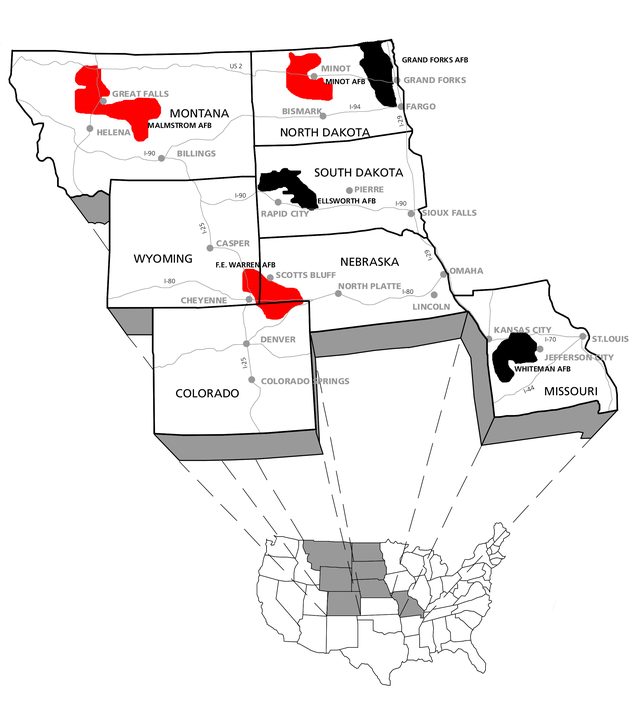
Minuteman missile fields, active (red) and deactivated (black). National Park Service.
base (tap a wing to zoom)field outline deactivated field, approximate
former site, NAIP-confirmed former site, approximate MUSEUM, open to the public
These are private property. You can see them from public roads.
How this map was drawn
Not drawn (no confirmed position): Fairchild AFB Atlas E site 2 (Newman Lake) (not found on NAIP at the finding-aid position); Fairchild AFB Atlas E site 3 (Rockford) (no public-domain position); Fairchild AFB Atlas E site 6 (Davenport) (no public-domain position); Fairchild AFB Atlas E site 7 (Wilbur) (no public-domain position); Fairchild AFB Atlas E site 9 (Reardon) (no public-domain position); Mountain Home AFB Titan I complex 569-A (Bruneau) (no public-domain position); 400th Missile Squadron, 90th Missile Wing: P-01, P-04, P-05, P-10, Q-01, Q-02, Q-06, Q-07 (not found on NAIP).
Fields not drawn site by site
- Atlas D: 1959–1964 (NPS, www.nps.gov/articles/atlas-icbm.htm)
- Atlas F: deactivated by the end of 1965 (NPS, www.nps.gov/mimi/getinvolved/upload/mimi_srs_1995-508.pdf)
The three Minuteman III wings; tap one to zoom to its field. Each wing: the outer hull of its flights (their sources are in each field's caption). Deactivated fields. A site is drawn only where we confirmed its position on a USGS topographic map or a NAIP aerial, or a public-domain source places it: the former layer (the 400th and 564th Missile Squadrons’ flights, the Pacific Northwest sites, the museum sites). The Ellsworth, Grand Forks and Whiteman fields are shown as approximate outlines only; the other deactivated fields (Atlas, Titan I and II) are not drawn site by site: no public-domain source places their sites yet. Field years from NPS, HAER or USAF, as each popup says. Hollow outlines: the Ellsworth, Grand Forks and Whiteman fields, approximate, traced from the NPS map 'United States Minuteman Missile Wings' (Minuteman Missile National Historic Site; nps.gov/articles/minuteman-missiles-on-the-great-plains.htm, retrieved 25 SEP 2026). Fitted to the map's city dots and state borders: good to about 15 km in the Dakotas and 35 km in Missouri.
SOURCES · 11
- Base positions (base level): USAF, Sentinel Deployment and Minuteman III Decommissioning and Disposal Final EIS, Vol. I, sections 2.1.6-2.1.8, March 2023.
- HAER CO-84, Minuteman III ICBM Launch Control Facility November-1 · sheet 1 of 4, "Site Map" · 1997 · loc.gov
- Site coordinates compiled by siloworld.net: siloworld.net/COORDINATES/LOCAL.htm and its Minot file, retrieved 25 SEP 2026.
- Malmstrom sites: a coordinate list compiled by Jim Kirk from aerial imagery, personal page, University of Wyoming, asuwlink.uwyo.edu/~jimkirk/malmstrom.html, archived 17 July 2011 (web.archive.org/web/20110717203324/http://asuwlink.uwyo.edu/~jimkirk/malmstrom.html), retrieved 25 SEP 2026. Ids and coordinates only.
- Malmstrom 564th Missile Squadron (flights P–T): HAER MT-138, Malmstrom Air Force Base, 564th Missile Squadron (NPS; Library of Congress, https://www.loc.gov/item/mt0487/), data pages: the years, 1967–2008, and Figure 1, the squadron's site map, the cited check on P–T's positions: all 55 sites matched to within 0.9 km (mean 0.2 km).
- Not drawn: Forbes AFB Atlas E sites #8 and #9 (Kansas). siloworld.net's coordinate table and its own map links disagree: #8 table 39.24 N, 95.92 W, link 39.70 N, 95.85 W; #9 table 39.53 N, 95.74 W, link 39.42 N, 95.94 W.
- Not drawn: Minot O-01 (the flight O missile alert facility). siloworld.net's coordinate table gives 48.49 N, 101.28 W; its Minot file gives 48.83 N, 101.28 W. Flight O is drawn from its other ten sites.
- National Park Service, Minuteman Missile National Historic Site, "Minuteman Missiles on the Great Plains" (last updated October 20, 2020), https://www.nps.gov/articles/minuteman-missiles-on-the-great-plains.htm ; its map "United States Minuteman Missile Wings", https://www.nps.gov/mimi/planyourvisit/upload/U-S-Minuteman-Missile-Fields.jpg (linked as a 272KB PDF, served as a JPEG). Retrieved 2026-09-25, not fetched by the build. The inset beside the map, and the hollow outlines of the deactivated Ellsworth, Grand Forks and Whiteman fields, traced from it.
- AF LGM-30G fact sheet, current as of February 2019: U.S. Air Force, "LGM-30G Minuteman III": the force today, 400 Minuteman III missiles in three wings. https://www.af.mil/About-Us/Fact-Sheets/Display/Article/104466/lgm-30g-minuteman-iii/ (read from the Internet Archive capture of 31 December 2025; not fetched by the build)
- USAF, Sentinel (GBSD) Deployment and Minuteman III Decommissioning and Disposal Final EIS, Vol. I, March 2023 (Air Force Global Strike Command): section 2.1.1, p. 2-3, each wing's 15 missile alert facilities, each with its launch control center, and 150 launch facilities; sections 2.1.6.1, 2.1.7.1 and 2.1.8.1, pp. 2-13, 2-33 and 2-40, the fields' areas (about 12,600, 13,800 and 8,500 square miles); section 3.9, pp. 3-444, 3-453 and 3-458, the land they stand in (cropland, grazed rangeland or grassland).
- Ours: "The map draws every site we could place from a public-domain source, and no others." (this page's map) and "These are private property. You can see them from public roads." (advice). No external source.
Binder 6
The missile
The LGM-30G Minuteman III is a three-stage, solid-fuel missile, 59.9 feet long and 5.5 feet across, first deployed in June 1970. It stands in a silo on a shock-isolated suspension, under a launcher closure door.
Because the fuel is solid, it can sit ready without anyone pumping or topping off fuel.
Below is the missile drawn to scale, and the Air Force's exploded view showing which company built each part, such as Boeing's body sections and Thiokol's first stage.
A maintainer looks over a Minuteman III in a silo about 60 miles from Grand Forks AFB, N.D., in 1989. U.S. Air Force photo (090413-F-1234S-004), National Museum of the United States Air Force. Public domain.
Beside it, at the same scale
A person 6 ft (1.83 m) tall, for scale.
three solid-propellant rocket motors
- **First stage** ATK refurbished M55A1. Thrust 203,158 pounds.
- **Second stage** ATK refurbished SR-19. Thrust 60,793 pounds.
- **Third stage** ATK refurbished SR-73. Thrust 35,086 pounds.
Everything is drawn at one scale. The outline uses only the USAF fact sheet’s length and diameter, 59.9 feet (18 meters) by 5.5 feet (1.67 meters). The sheet doesn’t give stage lengths or the nose shape, so neither is drawn. A depth stands on the same baseline as the missile: the top of the launch control center (the capsule) is marked SURFACE, and the levels of the launcher (the silo) are the sheet’s own words.
Tap a part of the missile.
- AEROJET
- AUTONETICS
- BOEING
- GENERAL ELECTRIC
- THIOKOL
- BELL
- (UTC/CSD)
As drawn in the Air Force's Minuteman Weapon System History and Description (2001).Minuteman Weapon System History and Description, ICBM System Program Office (SPO), Ogden Air Logistics Center, Hill AFB, Utah; prepared by the ICBM Prime Team, TRW Systems, July 2001, p.34, "LGM 30G OPERATIONAL MISSILE". Supplied by Daniel Frenkel, retrieved 2026-09-26.
How a Minuteman III flies, from launch to reentry. Animation: Northrop Grumman, used with permission.
The animation's stages, in order: launch from the silo; first stage; second stage; third stage; post-boost; reentry.
Days since June 1970
**400** Active force
Counted from 1 June 1970: the fact sheet gives only the month, “Date deployed: June 1970”.
Tap a label on the drawing.
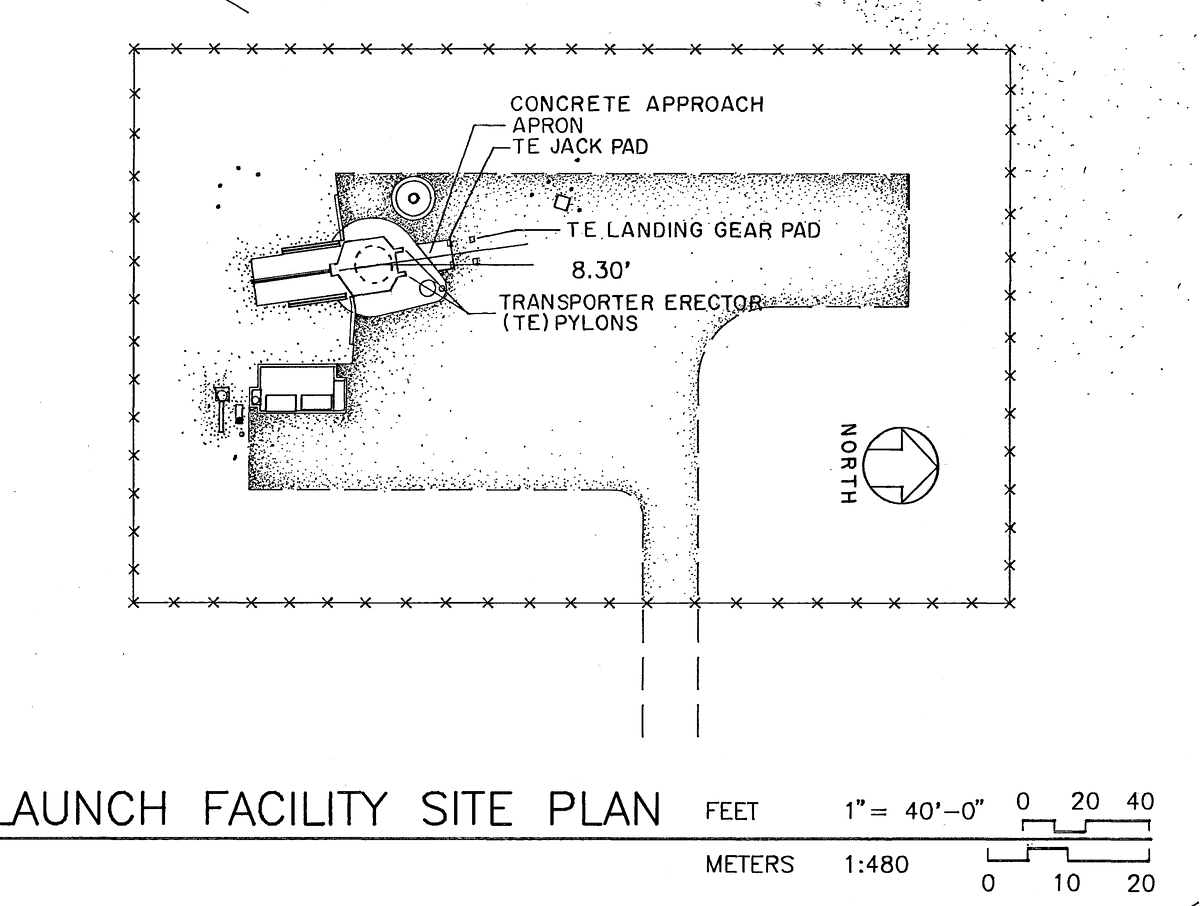
Launch Facility Site Plan (1" = 40'-0"). The security fence: about 278 ft × 176 ft, measured from the drawing's scale.
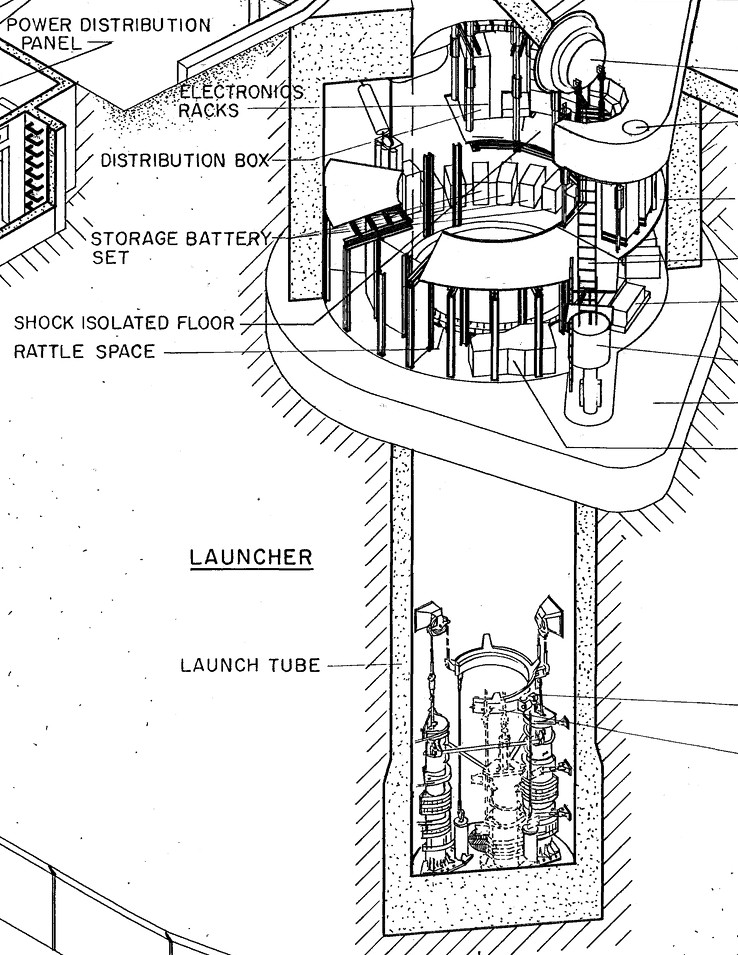
Launch Facility Delta-09, Delta Flight, Ellsworth AFB, South Dakota — a Minuteman II site, recorded by HAER (Gary R. Stephens, NPS Rocky Mountain Regional Office) before it became part of Minuteman Missile National Historic Site. Public domain. The parts worth knowing: the launcher, the launch tube, the launcher closure (the silo's door) and the launch equipment room, upper and lower levels (LER-1 and LER-2 on the sheet). The launcher closure and the equipment rooms are in the full drawing.Detail: x 910–1648, y 645–1600 of the drawing’s 2400 × 2215 web copy (px).
SOURCES · 10
- USAF fact sheet, "LGM-30G Minuteman III", current as of February 2019: diameter, weight, power plant, date deployed, inventory. https://www.af.mil/About-Us/Fact-Sheets/Display/Article/104466/lgm-30g-minuteman-iii/ ; read from the Internet Archive capture of 31 December 2025, https://web.archive.org/web/20251231163055/https://www.af.mil/About-Us/Fact-Sheets/Display/Article/104466/lgm-30g-minuteman-iii/ (retrieved 2026-09-25, not fetched by the build).
- USAF fact sheet, "LGM-30G Minuteman III", posted 26 July 2010: the length, which later versions omit. http://www.af.mil/information/factsheets/factsheet.asp?id=113 ; read from the Internet Archive capture of 14 December 2012, https://web.archive.org/web/20121214014142/http://www.af.mil/information/factsheets/factsheet.asp?id=113 (retrieved 2026-09-25, not fetched by the build).
- HAER CO-84, Minuteman III ICBM Launch Control Facility November-1 · sheet 4 of 4, "Perspective" · 1997 · loc.gov
- HAER SD-50-C, Ellsworth AFB, Delta Flight, Launch Facility (Delta-09) · sheet 1 of 1 · loc.gov
- Photo: U.S. Air Force photo 090413-F-1234S-004, National Museum of the United States Air Force image gallery ("Boeing LGM-30G Minuteman III"); the museum's caption: a maintainer with a Minuteman III in a silo about 60 miles from Grand Forks AFB, N.D., 1989. The museum serves a landscape crop; the page serves the full portrait frame from Daniel's copy. Public domain.
- Exploded view: "Minuteman Weapon System History and Description", ICBM System Program Office (SPO), Ogden Air Logistics Center, Hill AFB, Utah (prepared by the ICBM Prime Team, TRW Systems), July 2001, p.34, "LGM 30G OPERATIONAL MISSILE", traced to line; the cards' feature lines from p.33, "Minuteman III Major Features". Supplied by Daniel Frenkel, retrieved 2026-09-26.
- HD 2001: Minuteman Weapon System History and Description, prepared for the ICBM System Program Office, Hill AFB, Utah, by TRW, July 2001, pp. 7, 93 (the printed page numbers): the launcher closure door (p. 7) and the missile suspension system within the launch tube (p. 93). Obtained under the Freedom of Information Act by Hans M. Kristensen.
- NPS HRS: National Park Service, The Missile Plains: Frontline of America's Cold War, Historic Resource Study, Minuteman Missile National Historic Site (Mead & Hunt, 2003), pp. 17, 26, 28, 31, 88 (the printed page numbers): liquid fuel loaded just before launch (p. 17); solid fuel, and a missile designed to stand unattended and endure long periods in storage (pp. 26, 28, 31); Delta-09's missile suspension on coil spring-type shock absorbers (p. 88). https://www.govinfo.gov/content/pkg/GOVPUB-I29-PURL-gpo247167/pdf/GOVPUB-I29-PURL-gpo247167.pdf (retrieved 2026-10-01, not fetched by the build)
- Ours: "the missile drawn to scale" names this page's own scale drawing (below). No external source.
- Flight animation: Northrop Grumman's animation of a Minuteman III flight (2007), shown here with Northrop Grumman's written permission (26 October 2026); re-encoded for the web with the black bars trimmed, nothing else changed.
What you can do here
- ### Listen and read
Listen to 11175 kHz live, or play any message we've copied and read it character by character.
- ### Your account
Signing in is optional: it needs only your email address, no password, and lets you say you heard a message, correct copies and choose which emails you get. The privacy page lists everything we keep.
- ### Copy a message
Play a real recording and copy it yourself, writing down each character as the voice reads it, then check your copy against ours. Signed in, you can also fix what the machine got wrong with **Correct this copy**, under the message.
- ### The aircraft
There's also a map: five aircraft types (E-6B, E-4B, B-52H, WC-135, B-2) when they're up on public ADS-B, on a page of its own. The site draws no connection between an aircraft and a message.
- ### Alerts
Tap **Notify me of new messages** on the latest message to get a browser notification each time a new one is copied, no account needed. Signed in, your account page can also email you a daily summary, or when the Doomsday plane (E-4B) shows up on public receivers.
- ### I heard it too
If you heard a message go out, here or on your own radio, sign in and tap **I heard it too** on it within 24 hours. When two or more people are listening live, the player shows how many.
- ### The Missileer device
Missileer is a small round display that copies the traffic on 11175 kHz as it's heard and keeps Zulu time (UTC). It isn't on sale yet. Sign up for **device news** at the bottom of this page and I'll email you when it is.
Questions
What is an EAM?
An Emergency Action Message is coded traffic of the US nuclear forces, read aloud in the phonetic alphabet on the High Frequency Global Communications System. The main frequency is 11175 kHz. The messages are encrypted, so the public can hear them but can't read them.
Is it legal to listen? These are public shortwave (HF) broadcasts that anyone with a shortwave radio can receive. Beyond that, we can't give legal advice.
Why is the aircraft map often empty?
It only shows five aircraft types, and only when a public receiver picks one up broadcasting its position. Most of the time they aren't flying, aren't broadcasting, or are out of range. An empty map is normal, and a busy one doesn't mean anything.
Who runs this? Me, Daniel Frenkel. I was a missileer from 2012 to 2016, and I run this through my company, Valar Systems, in Oregon. My story is just below. Write to me at hello@missileer.watch.
Ideas or bugs? Send feedback (sign in first).
Binder 7
Who built this
I'm Daniel Frenkel. I was a missileer from 2012 to 2016, a combat crew member with the 321st Missile Squadron at F.E. Warren, pulling alerts in the field shown on The missile sites map above. The photo is from a mass brief in March 2013. I'm in it.
I hated the job, but I'm proud of it. It was a grind. I was always tired, bored, or stressed, usually two of the three. You train for years to do absolutely nothing: sit in a capsule in your sweatpants and wait. That is not a fulfilling way to spend your twenties. The food was good and cheap, though. Three big meals a day, which is why most of us put on weight out there.
What was worth it: the friends, the adventure of the whole thing, and the responsibility. Being handed that much of it at 23 is something I still haven't found anywhere else.
I've (thankfully) been out for a while now. It was only recently that I learned the same traffic goes out over shortwave, on 11175 kHz, to anyone with a radio. Nobody ever told us that. Four years in the capsule and I'd never heard an EAM read aloud until I was a civilian with a Kiwi receiver open in a browser. Missileer is something I made to share my pride in the job: a small round display that copies the traffic on 11175 as it's heard, and keeps Zulu time the way the capsule does.
To correct a copy, pick the message, listen, and tap Correct this copy under it (you'll need to sign in). If you were a missileer, heard something on 11175 you can't place, or want a Missileer device of your own, write to me at hello@missileer.watch. Please don't send anything that isn't already public.
Ideas or bugs? Send feedback (sign in first).
Mass brief, 321st Missile Squadron, F.E. Warren AFB, 25 March 2013. Every crew going to the field that day is in this room.U.S. Air Force photo by 2nd Lt. Christen Downing, 90th Missile Wing Public Affairs. Public domain.
No tracking cookies. Signing in is optional; its cookies are only to sign you in and keep you signed in. This page reads two public files, archive.json and status.json, and Cloudflare Web Analytics counts visits without cookies. Everything we keep, why, and how to delete it is on the privacy page. Times are UTC (Zulu).
Our recordings and decodes are released under CC0 1.0 (public domain dedication); attribution appreciated: missileer.watch.