The Motif Atlas
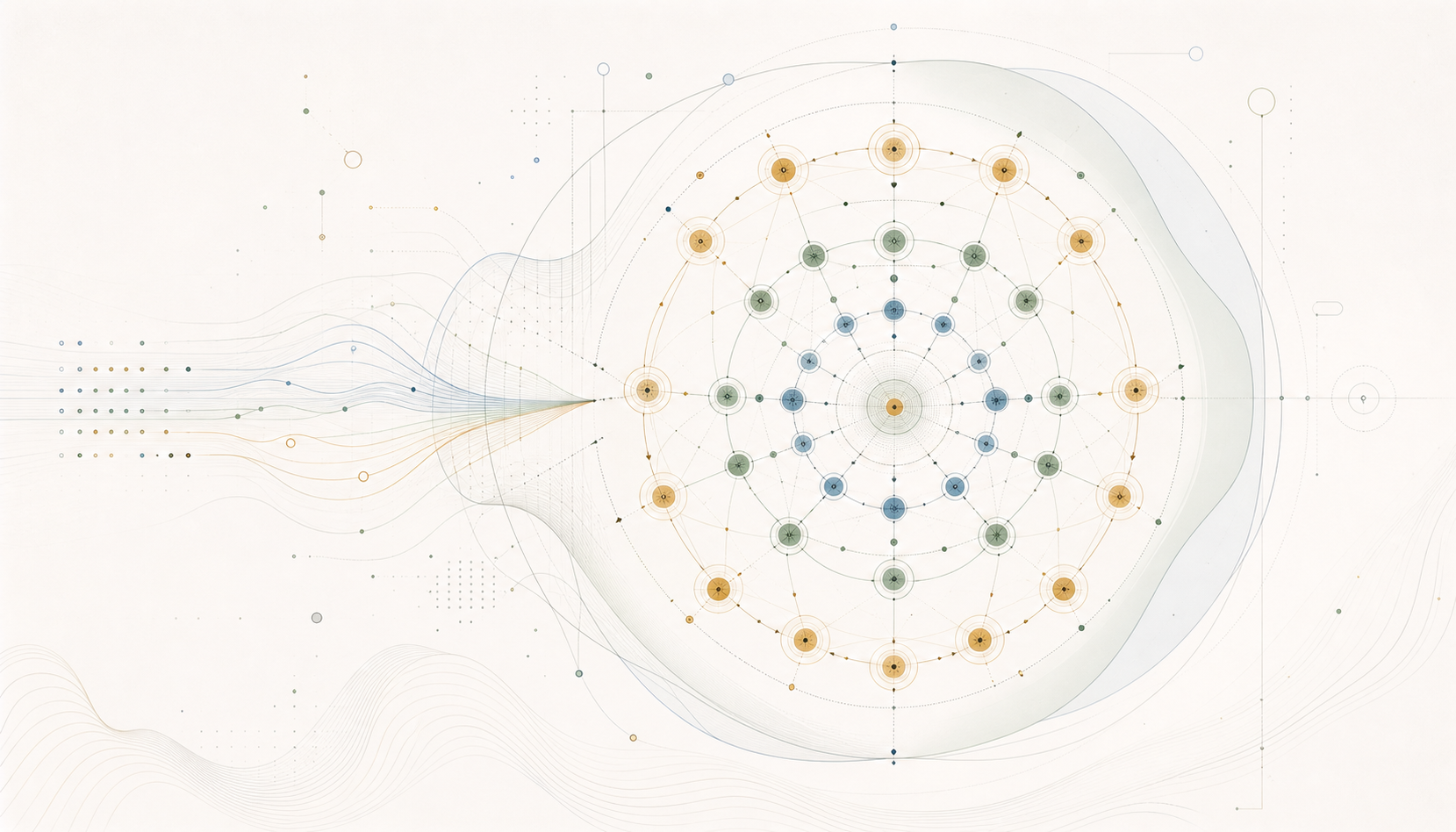
Universal Systems Compiler
Thirty-two structural questions for seeing across computing, biology, economics, organizations, psychology, and civilization.
Core thesis
Hard problems are often sparse regions of motif space.
The atlas strips away substrate vocabulary and exposes reusable structure: what persists, what changes, what constrains change, what crosses boundaries, and what lets distant systems converge.
Try the compiler
The atlas is the map. SIC is the instrument.
The Motif Atlas presented here is the conceptual foundation, not the full machine. The Systems Innovation Compiler is already a substantially more developed applied framework built on top of it.
SIC combines the 32 motifs with primitive decomposition, innovation methods, distortion analysis, institutional templates, validation procedures, and implementation planning. It is designed to be pasted into an LLM and used on real systems.
The current skill package is focused on the software domain for demonstration purposes. The underlying compiler structure is domain-general, and can be extended to economics, governance, biology, organizations, and other complex systems.
Some words from the author
Hello, and thank you for being here.
This project grew out of a question I have carried for a long time: what are the hidden structures underneath the things we see every day? Beneath software, economics, biology, organizations, psychology, governance, and culture, there seem to be recurring patterns that quietly shape how systems behave.
For years, I felt the absence of a tool that could help me see those patterns clearly across domains. The internet made knowledge accessible, but not always structurally comparable. Working with LLMs helped push this search past a threshold. Moving across subjects and systems, I began to see a recurring set of structural concerns: motifs that combine to produce the architectures we recognize as knowledge, institutions, technologies, and behavior.
The number I arrived at is thirty-two. I believe this atlas is comprehensive in a meaningful empirical sense, but I do not claim the number itself is sacred. Someone thoughtful may argue for thirty, or thirty-six, or a different decomposition altogether. That debate is welcome. The deeper claim is that reality appears to be composed from a finite structural alphabet, and that understanding this alphabet lets us compare, diagnose, and transfer solutions across domains.
This site introduces the foundation, not the full machine. The Systems Innovation Compiler is significantly more built out than the theory shown here. The atlas explains the structural alphabet; the compiler is the applied engine that uses that alphabet to analyze and redesign real systems.
So I would ask you to try it before dismissing it. Take a software system, a policy problem, a market, an organization, a research question, or a product you are building. Run it through the skill. Look at what is present, what is weak, what is absent, and what combinations are doing the real work.
If SIC helps you understand a system more precisely, identify hidden failure modes, or generate better interventions, then this work has done what it set out to do.
Nikit Phadke
The 32 motifs
A structural alphabet for systems.
Compiler
Domain language becomes transferable structure.
01 Domain description
02 Motif tokens
03 Motif AST
04 Semantic analysis
05 Patterns and interventions
Lexer
Surface language is reduced to a thirty-two-symbol motif vocabulary.
Parser
Boundary nesting creates a tree of scopes, signatures, and typed edges.
Analyzer
Valence, invariants, viability, and collisions are checked structurally.
Generator
The modified structure returns as a domain-specific intervention.
Geometry
Every system occupies a point in motif space.
Structural distance makes unlikely neighbors visible. A distributed database, a cooperative bank, and a treaty system may sit close together when their motif signatures rhyme.