Google can now use your Gmail data for ads: How to turn it off


- PersonalPersonal
- BusinessBusiness
- Download
- Discover ProtonDiscover Proton
- Resources
- Pricing



Proton
Choose an internet where your privacy comes first


Industries
TechHealthcareNonprofitsNews and media
Business resources
Trust centerHIPAAGDPRData Breach ObservatoryISO 27001Case studiesBusiness blog
Switch from
Proton Workspace
Your whole team, one encrypted workspace
Proton Mail Proton VPN Proton Drive Proton Pass Lumo AI Proton Meet Proton Calendar Proton Authenticator Proton Wallet

Scan to get the mobile app
Mobile apps
iOS(new window)Android(new window)
Desktop apps
Web app
Desktop client add-on

Scan to get the mobile app
Devices
Windows(new window)macOS(new window)Linux(new window)Chromebook(new window)Android(new window)iOS(new window)
Extensions
Chrome(new window)Firefox(new window)
Smart TV
Android TV(new window)Apple TV(new window)Firestick(new window)

Scan to get the mobile app
Mobile apps
iOS(new window)Android(new window)
Desktop apps
Web app

Scan to get the mobile app
Devices
WindowsmacOSLinuxAndroidiOSCommand line interface(new window)
Extensions
Web app

Scan to get the mobile app
Mobile apps
iOS(new window)Android(new window)
Web app

Scan to get the mobile app
Mobile apps
iOS(new window)Android(new window)
Desktop apps
Web app

Scan to get the mobile app
Mobile apps
iOS(new window)Android(new window)
Desktop apps
Web app

Scan to get the mobile app
Mobile apps
iOS(new window)Android(new window)
Desktop apps

Scan to get the mobile app
Mobile apps
iOS(new window)Android(new window)
Web app
Company
About usImpactTeamCareers We’re hiringProton FoundationProton blog
Privacy
Open sourceZero-access encryptionBig Tech alternatives
Connect
Partners and affiliatesSocial mediaMedia contact

Proton
We believe a better world starts with privacy and digital freedom
Get started with Proton
Beginner video guides(new window)Learn about encryptionBusiness resources
News
Reports and insights
Investigative reportsProton VPN observatory(new window)Data breach observatoryTech fines trackerEurope’s tech sovereignty watchEuropean alternativesAge verification explainedProton’s guide to AI
Videos about privacy
Mass surveillance explained(new window)How employers spy on you(new window)The data you leak in 24 hours(new window)How to disappear online(new window)See all videos(new window)
Tools
What is my IP address?(new window)Password generatorUsername generatorPDF watermarkImage watermarkFlock camera map
Support
EN
Open menu
[](https://proton.me/blog)
- Proton updates
- Latest
- Videos
- News
- Guides
- Opinion
Search for blog posts
Google can now use your Gmail data for ads: How to turn it off
- News

Published on October 26, 2026
Share this page:
- 

- 

- 

- 

- 

- Copy link
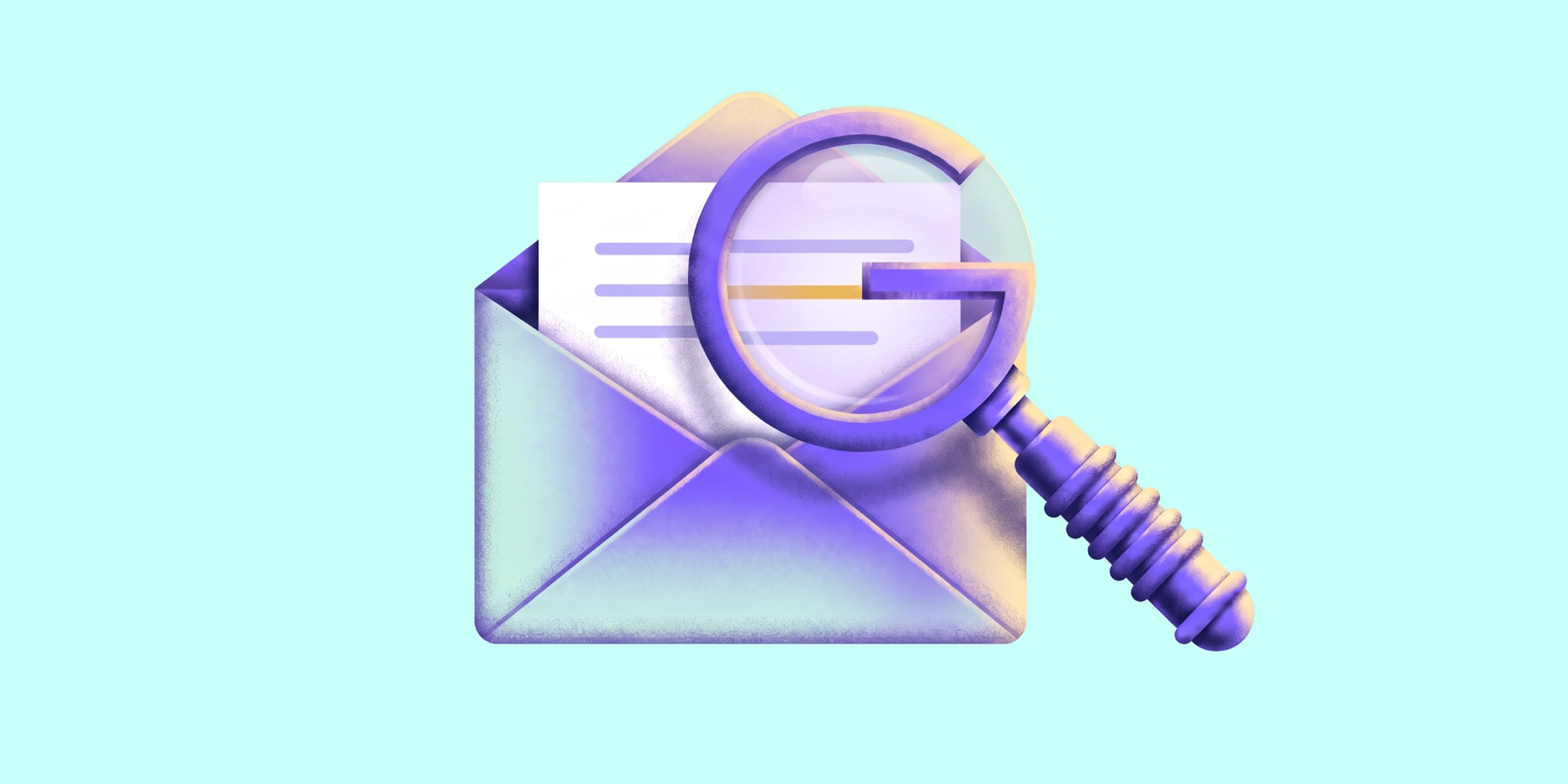
For years, Google promised it wouldn’t use your emails, files, and photos to profile you for ad targeting. This month they gave themselves a way out of that promise.
On October 16, Google changed a sentence in its privacy policy that said your Gmail, Drive, and Photos content would not shape the ads you see. The sentence now has an exception spotted by Android Authority(new window): If you connect those apps to Google’s Personal Intelligence features, that data can inform ads in Search.
!Image 46: Google's privacy policy now allows Gmail, Drive and Photos data to be used in ads

If you’ve never connected your Google apps to Personal Intelligence, then nothing changes for you. But if you turn it on, then Google will turn your most private information into fodder for ads. For better privacy, you can disconnect the ad machine from Gmail or disconnect personalization entirely —or switch to privacy-first services. We show you how below.
Stop Google from scanning your files for Search ads
To stop connected Gmail and Google Photos data from reaching Search, disconnect those apps in your Google Account settings:
1. Open your Google Account and go to **Data & privacy**. 2. Under **Personalization & activity**, select Personalization settings. 3. Choose **Manage Personalized Recommendations** in Search Services. 4. Under **Additional Personal Intelligence**, find Connected Content apps. 5. **Disconnect** Google Workspace and Google Photos.
You can also turn off personalized recommendations entirely from the same Search Services personalization page. The easiest route is the Gemini settings for Personal Intelligence, where you can disable the connected apps. If you use Gemini, check both places. If you use Gmail’s built-in Gemini features, our guide to turning off Gemini in Gmail covers those separately.
Disconnecting does not erase what Google has already saved. Google’s help page says that disconnecting an app, or deleting the original email or photo, doesn’t remove data from your Search Services History, and that data can still be used for product improvement, including training generative AI models. To clear it, delete your Search Services History from your Google Account’s activity controls. You can also review your ad settings separately in My Ad Center.
If you’re in Europe: connecting apps has reportedly not been made available in the EU, the UK, or Switzerland. The privacy policy is a single global document, though, so the new wording covers you even where the feature isn’t live yet.
What the new policy wording allows
Google’s policy used to say it doesn’t show personalized ads based on your content from Drive, Gmail, or Photos. Since October 16, that sentence carries an exception for data you choose to make available to other Google services that support personalized ads. Google’s own example is Search processing the data you allow it to access to personalize content, including ads.
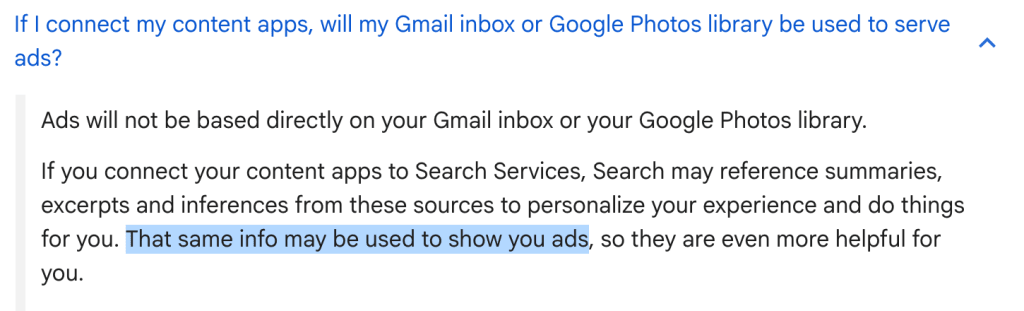
In a statement to Ars Technica(new window), Google said “connecting your apps is entirely opt-in”. Google’s help page for Personal Intelligence uses tricky wording to explain how your Gmail will feed the ad machine: “Ads will not be based directly on your Gmail inbox or your Google Photos library.” If you connect your apps, Search may use summaries, excerpts, and inferences from them, and Google says that same information may be used to show you ads.
!Image 47: Google FAQ stating that Gmail data can be used for ads
Ads are not the only use. The same help page says connected data may be used to improve Google services, including by training generative AI models, and that a subset of data processed by AI Mode is reviewed by human reviewers, including trained service providers. Google advises against connecting apps that hold confidential information you wouldn’t want a reviewer to see. Google has confirmed it is testing ads in AI Mode(new window) for people who connect their apps.
Google’s no-ads promise now has conditions
Google has said since 2017 that it won’t show ads based on Gmail messages. The sentence in its privacy policy about Drive, Gmail, and Photos was added in July 2021 and stayed the same through 17 versions of the policy, until October 1, 2026, according to PPC Land’s review of the policy archive(new window).
Google launched Personal Intelligence on January 14, 2026. In March, the company said there were no ads for people who connect their apps with AI Mode, adding that this was not changing “right now.” The policy changed on October 16, about nine months after launch.
Store your data where the provider can’t read it
Personal Intelligence works because Google can read your email and photos. If Google instead used end-to-end encryption and zero-access encryption, they couldn’t. A policy change alone wouldn’t give them access to the content.
That is how we built Proton Mail and Proton Drive. Your messages and files are encrypted so that we can’t read them. Our revenue comes from paid plans rather than ads, and we can’t scan your inbox or use your photos to train AI models.
If you want AI help without handing over your data, Lumo is our private AI assistant(new window). It keeps no logs of your conversations, stores saved chats with zero-access encryption, and doesn’t use your chats to train its models.
Moving off Google is manageable in two steps:
- **Email and calendar:**Easy Switch imports your Gmail messages and can forward future mail to your Proton inbox. Google Calendar events can be imported as well, as a one-time import.
- **Photos and files:** Export them from Google with Google Takeout, then upload them to Proton Drive. Here’s how to switch from Google Photos to Proton Drive.
Learn more about Proton security here.
Share this page:
- 
- 
- 
- 
- 
- Copy link
Ben Wolford Ben is a writer and editor whose work has appeared in major newspapers and magazines around the world. Ben joined Proton in 2018 to help to explain technical concepts in privacy and make Proton products easy to use.
Related articles
Oct 22, 2026
- News
Meta ordered to pay $25 billion over Cambridge Analytica privacy case
A New Mexico judge ordered Meta to pay $25 billion for misleading Facebook users about their data. What the Cambridge Analytica ruling means.
Oct 16, 2026
- News
Google’s selfie video sign-in puts your face on its servers
Google lets you sign in with a selfie video it stores on its servers. Here's what it means for AI training, government access and age checks.

Sep 30, 2026
- News
Meta’s Muse AI agent sent a total stranger to a user’s home
Meta's Muse AI agent shared a Facebook Marketplace seller's home address with a buyer without asking. Here's what happened.
Sep 24, 2026
- News
Survey: People don’t trust AI, but they tell it everything
New research finds that most AI chatbot users have shared something sensitive, but few trust the companies behind them.
Sep 9, 2026
- News
Australia’s opt-out law could change how social media algorithms work
Draft Australian legislation could let people switch off social media algorithms on apps like Instagram and TikTok. See why opt-out matters.
Sep 4, 2026
- News
A Gmail scam is exploiting Google Account recovery emails
See how the Google Account recovery Gmail scam uses real security emails and a fake Google call to trick victims, and learn the warning signs.
!Image 60: ProtonPrivacy by default
- 

- 

- 

- 

- 

- 

- 

- 

- 

- 

- 

- 

- 

- 

Proton AG
Route de la Galaise 32 1228 Plan-les-Ouates Geneva, Switzerland
- Products
- Proton SheetsNew
- Proton MeetNew
- Lumo AI
- Pricing
*
Products
- Proton SheetsNew
- Proton MeetNew
- Lumo AI
- Pricing
- Privacy
- Tor
*
Privacy
- Tor
- Company
- About us
- Team
- Impact
- CareersWe’re hiring
- Donate
- Blog
*
Company
- About us
- Team
- Impact
- CareersWe’re hiring
- Donate
- Blog
- Connect
*
Connect
- * *
English
- Request a feature(new window)
English
- © 2026 Proton AG. All rights reserved.