Where Have All the Literary Men Gone?
Are literary men disappearing? Somehavebeen saying. As publishing’s cultural status and financial prospects have declined, men—per Sarah Brouillette’s astute analysis—have left, and women have taken control of the industry.
Some commentators have offered data to support the narrative: prizes, bestseller lists, Stegner Fellowships, the gender composition of publishing professionals, readerships for fiction. Jacob Savage writes, “not a single white American man born after 1984 has published a work of literary fiction in _The New Yorker_,” which isn’t quite true: the magazine published Adam Ehrlich Sachs. Since Savage’s claim, the magazine also published Nathan Blum and Andrew Martin.
Here I bring in a new tranche of data: short stories. Over the last few months, with Claude Code, I gathered data for 211 literary magazines, spanning 1841–2026, which amounts to more than 289,000 stories and 63,000 authors. Some of this data—especially twentieth-century pulps and slicks—is drawn from the Fiction Magazine Index, a crowdsourced project created by William G. Contento and edited by Phil Stephensen-Payne. Nora Shaalan provided the foundation for the _New Yorker_ data.
According to this data, women have more than tripled their share of the short stories in these 211 magazines. Women outpublished men in the mid-nineteenth century, underwent a precipitous decline in the 1880s, 1890s, and 1900s, hovered around 20% from the 1910s through the 1970s, before climbing decade-by-decade, only exceeding men in the 2020s, for the first time in 150 years at 54.6%.
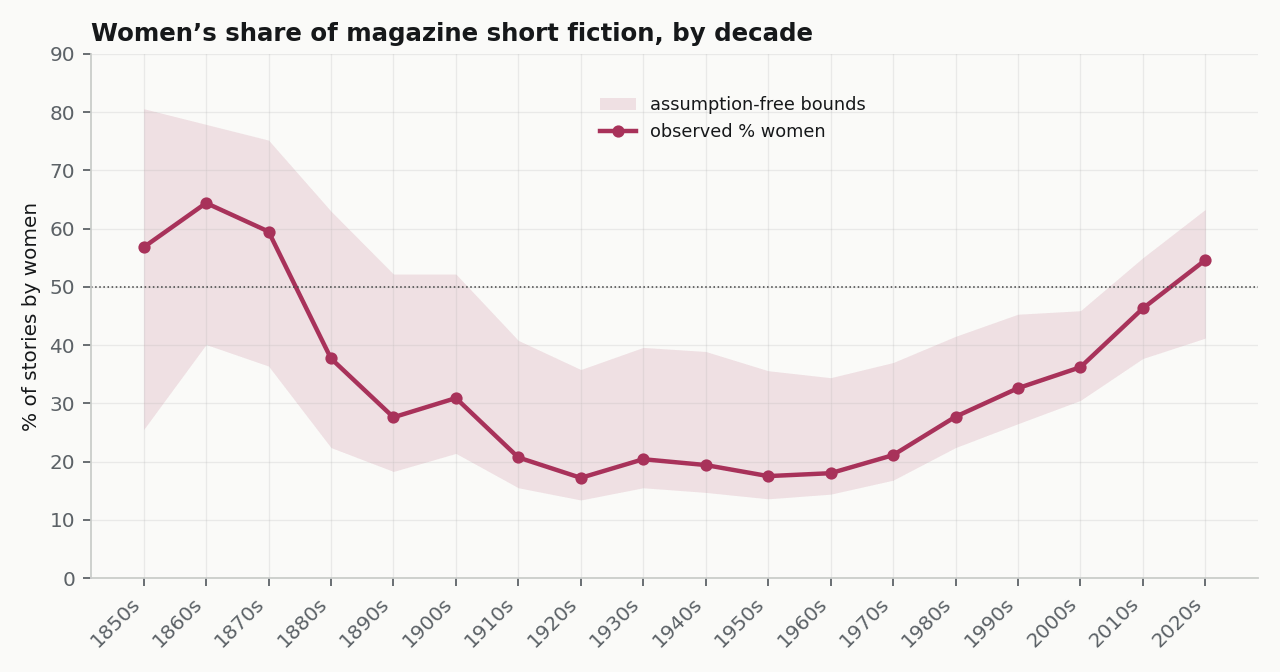

In short: men have been receding from the short story, but from such a position of dominance that women have only just passed parity.
I will discuss the data in more detail momentarily and provide a table that allows you to see the trend for each magazine. But first: we have reason to believe my numbers roughly correspond to reality. They are corroborated by those in “The Transformation of Gender in English-Language Fiction” by Ted Underwood, David Bammon, and Sabrina Lee. Underwood et al chart changes in the authorship of books—rather than magazine stories—held by the digital library, HathiTrust. Across 104,000 books, mostly from 1780 to 2007, they find erratic numbers in the early years of the nineteenth century, which stabilize around the 1830s with women around 30%, climbing to parity in the 1860s and 1870s, before dropping to their nadir in the 1920s, under 25%, then slowly climbing to 40% early in the twenty-first century. Our charts don’t map onto each other _perfectly_, but closely enough that it seems there’s a there there.
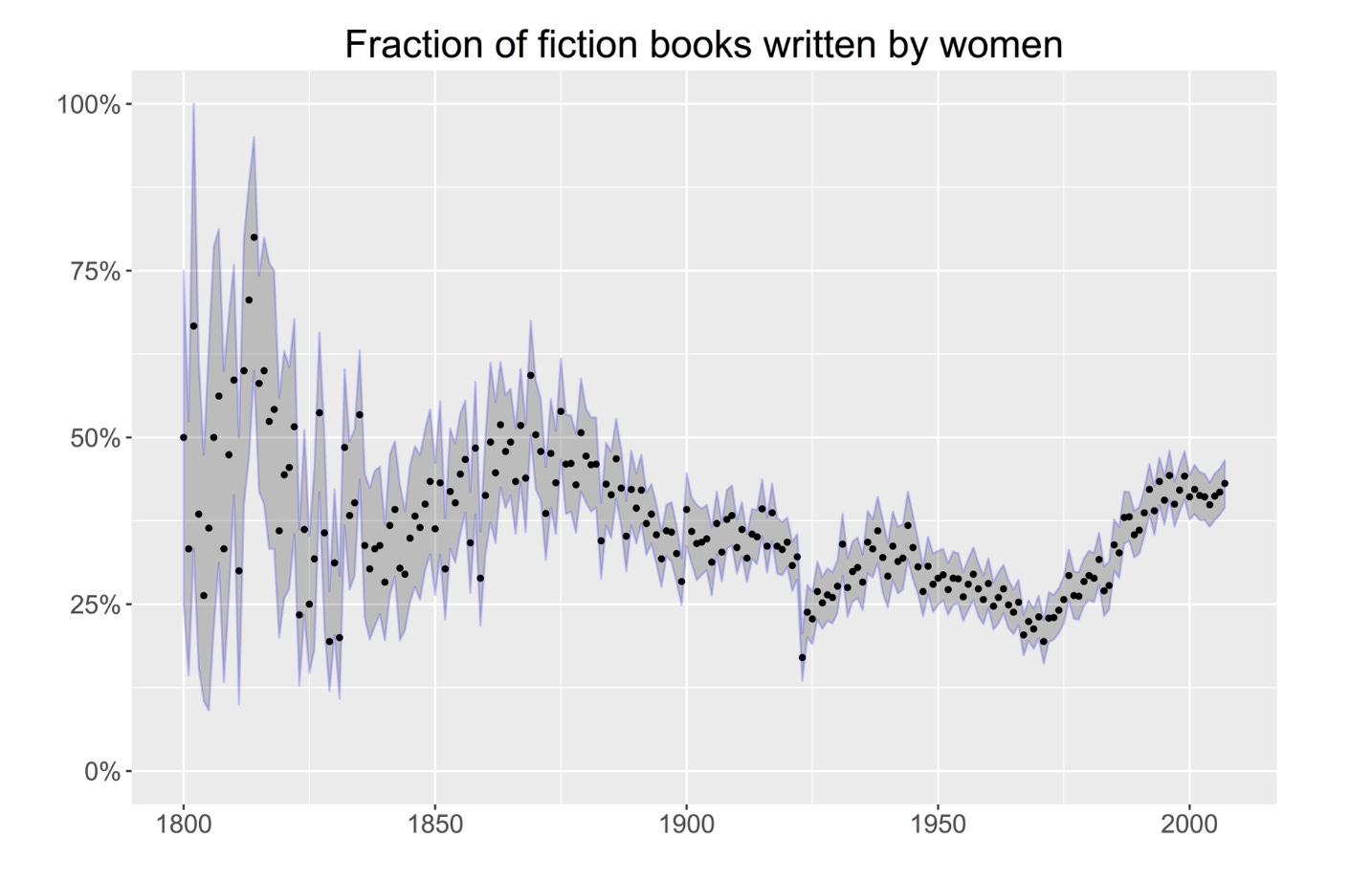

Let me address the main reason why Underwood et al’s numbers and mine might be skewed against women: romance. HathiTrust’s holdings come from university libraries and inherit their biases. Do university libraries select against fiction by women? We don’t know. We know they select against mass market genre fiction. But it is probably true more of such fiction is by men. Men dominated adventure, mystery, science fiction, and western. Women dominated romance. Romance was popular from 1900–1960, but it really blossomed in the 1970s and 1980s. As for my data, the worry is that the Fiction Magazine Index underrepresents romance—which it does, it’s true. I have attempted to address this by overrepresenting the Index’s romance holdings in my own data. As far as I know, there is no complete or comprehensive bibliographic data on pulp magazines, so we cannot know for certain how far from exact my data is. But I believe any errors would fail to meaningfully change the narrative. See Underwood et al for further corroborations of the general trend, if you’d like. (Their essay is fascinating and entirely worth your time.)
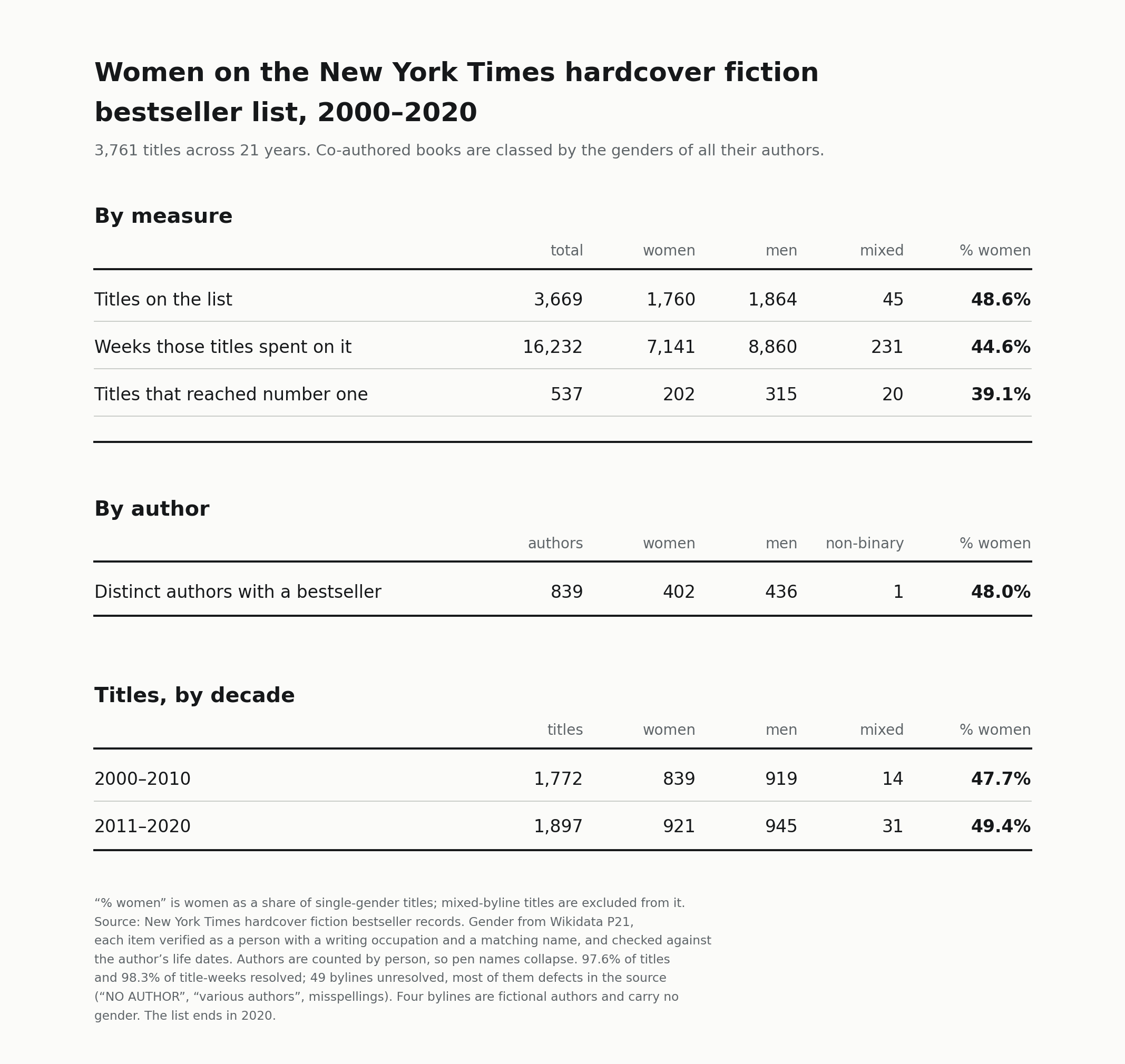
Not only that: out of curiosity, I ran the numbers for bestsellers and prizes. I used the _New York Times_ hardcover fiction bestsellers from data published by Jordan Pruett in the Post45 Data Collective. That data only runs through 2020. Things might have changed in the last five years. But women are very close to, but have not quite reached, parity.

For prizes, I used the finalists and winners of the National Book Award, the National Book Critics Circle Award, and the Pulitzer Prize from 2000-2025. I drew some of this from the Index of Major Literary Prizes, published by Claire Grossman, Juliana Spahr, and Stephanie Young in the Post45 Data Collective. Women represent, again, just under 50%. If we just look at 2016-2025, the numbers are nearly identical to the story numbers for the 2020s. Women climb to 52.7%.
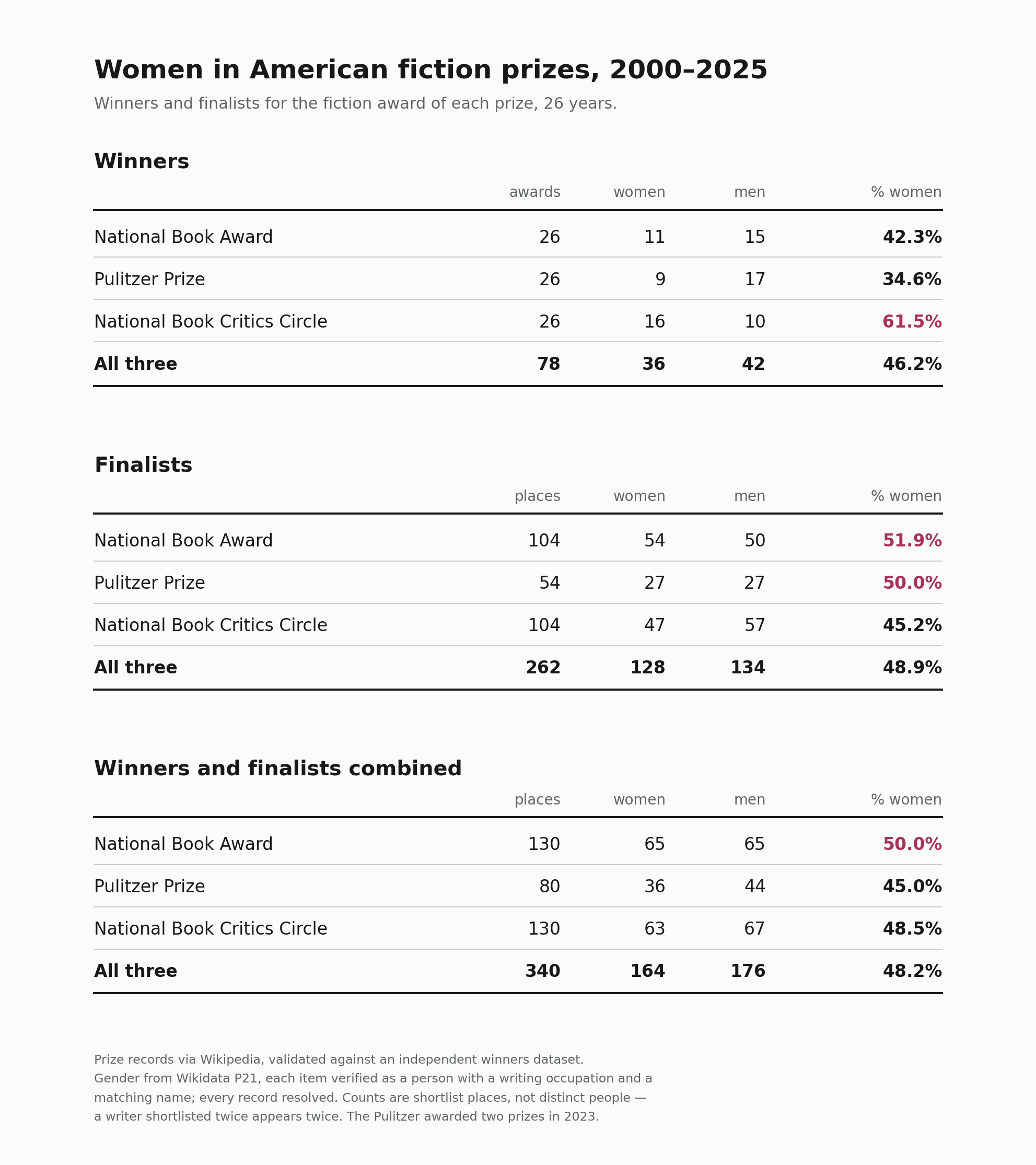

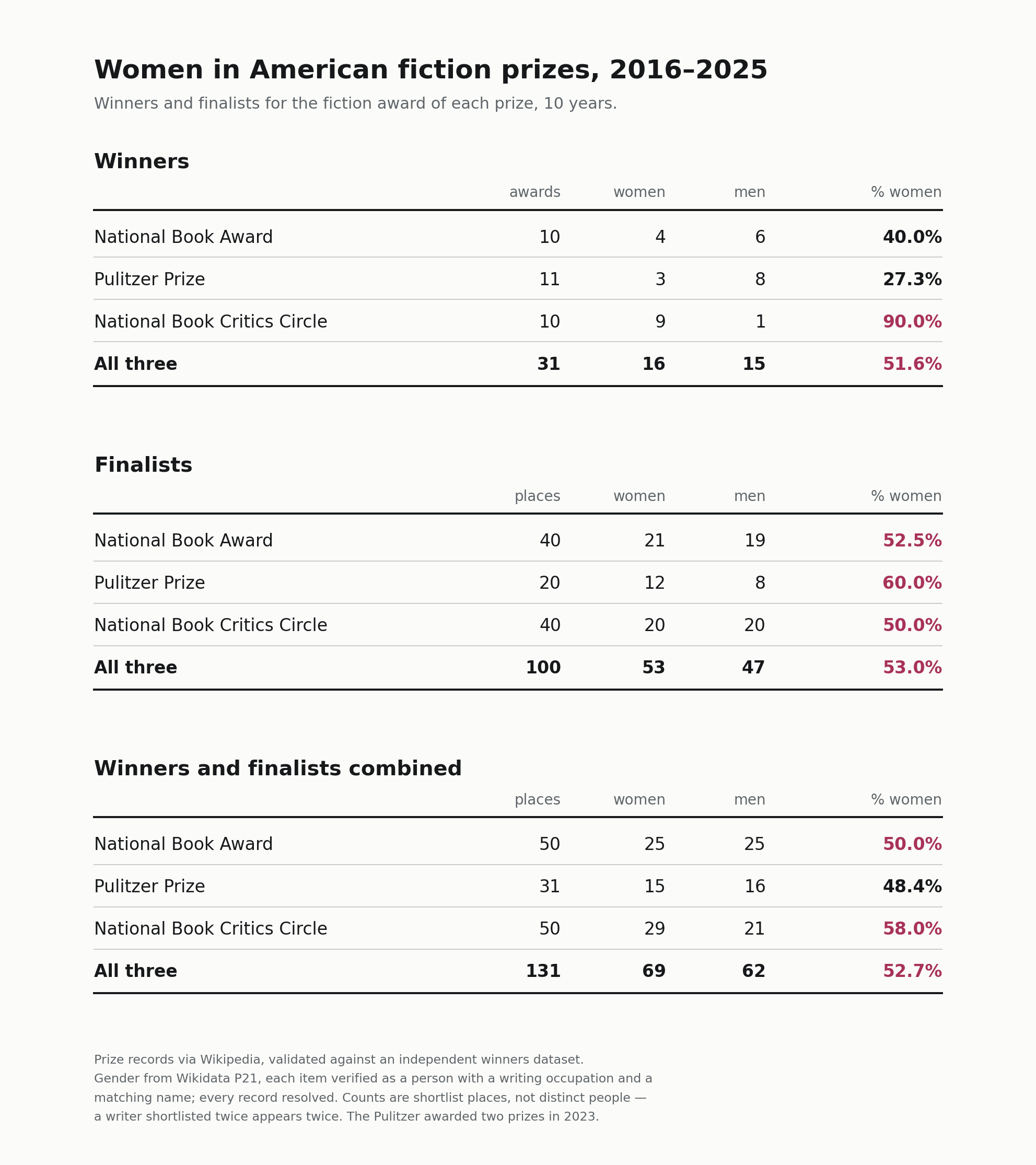

Again and again, it seems that after decades of underrepresentation, women have, in recent years, approached or just achieved parity, which is the backdrop against which we hear about fears that literary men are disappearing.
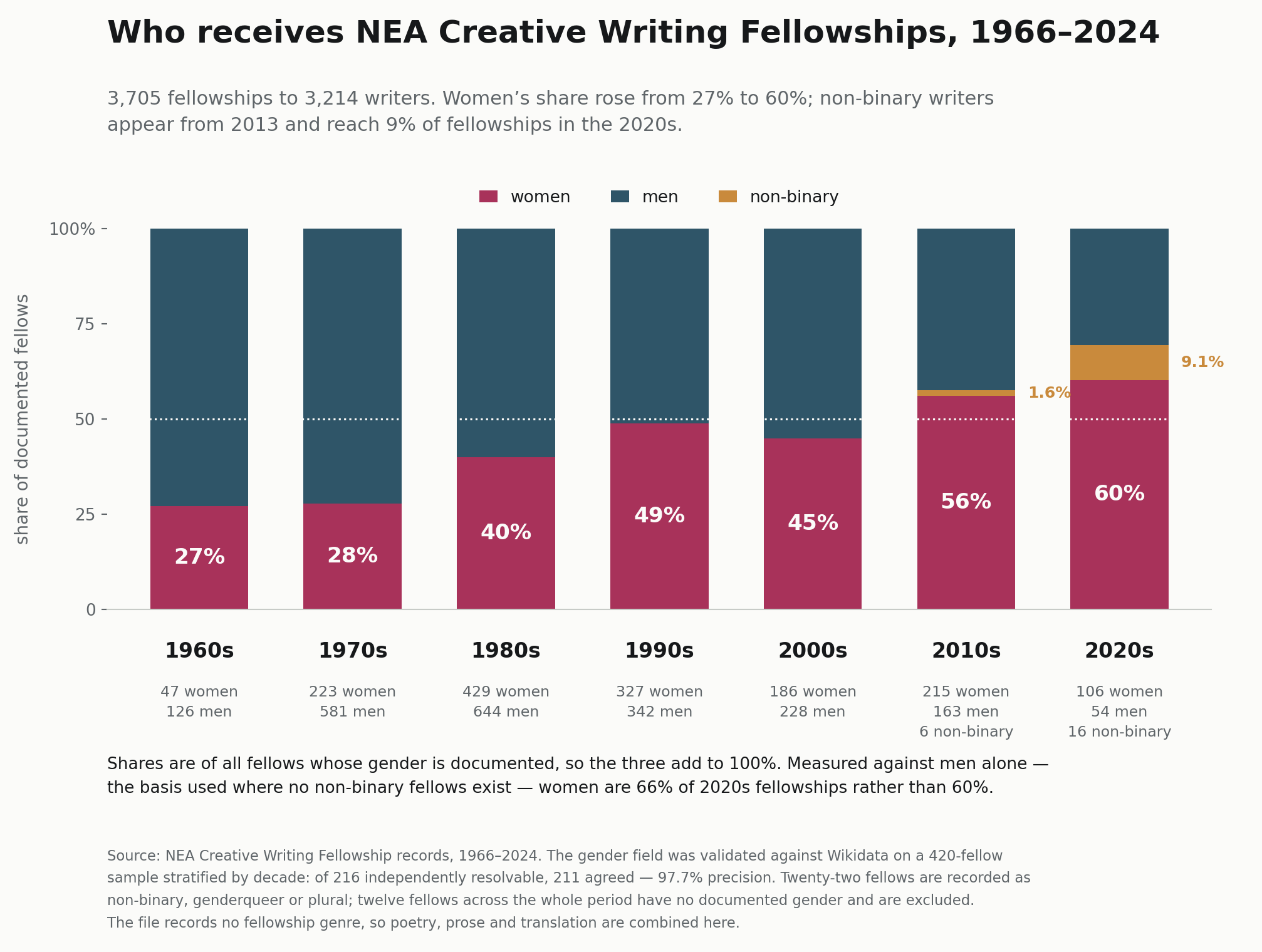
One caveat. One dataset shows more extensive advances for women: The National Endowment for the Arts Creative Writing Fellowships, published by Alexander Manshel in the Post45 Data Collective. By my calculation, women exceeded parity with 56% of the fellowships in the 2010s and reached 60% in the 2020s, with nonbinary writers winning 9.1%, leaving men with 30.9%.

Fiction in the US has undergone a tremendous demographic transformation in the last fifty years. Men have lost a lot of ground, which women have gained. But the way some commentators have written about it, you’d think men are, as the _New York Times_ headline suggested, disappearing. Hardly! Women have just caught up.
Let’s look a little more at the short story data. I find the details the most interesting. In the early- and mid-twentieth century, magazines were highly segregated by gender, a segregation that has mostly evaporated. In the 1930s, a woman writing short fiction was typically publishing in a magazine that was nearly half women, while a man, in the same decade, was typically publishing in one that was one-eighth women. In the 2020s, a woman typically publishes in a magazine that is 57.2% women; a man, 50.3% women. (In technical terms, Duncan’s index moves from 54.5% in the 1930s to 17.6% in the 2010s. Theil’s index moves from 0.341 in the 1930s to 0.039 in the 2010s.)
How about the extremes? Across 6364 stories published in _Adventure_ (1910–1953) 1.5% were by women. _Dime Detective_(1931–1953)? 0.4% women. Of the 2613 published in _All-Story Love_(1932–1939), 90% were by women. _Playboy_, a major venue for fiction, was about 2% women in the 1960s, 5% in the 1970s, 4% in the 1980s, and 7% in the 1990s.
About one-third of those _Playboy_ stories written by women? By Joyce Carol Oates.
You can explore the visualization below to see how different magazines shifted with time. Most follow the general trend. _The New Yorker_ was 32% women in the 1970s, 52% in the 2020s. _Harper’s_ was 32% in the 1980s, 56% in the 2020s. _Ploughshares_ was 29% in the 1970s, 59% in the 2020s.
A few resist the trend. Women have remained in 30s in _Hobart_ across the twenty-first century. _Santa Monica Review_ has hovered around 40%. _Beneath Ceaseless Skies_ has declined from 53% women in the 2000s to 43% in the 2020s. _Threepenny Review_: 57% in the 1990s, 46% in the 2020s. _The Baffler_, with its quite small output, at 34% in the 2010s, 33% int he 2020s. But take a look for yourself, explore:
_Methodological Note_:
I was conservative in assigning gender. I relied on Wikidata, self-identification, peer-reviewed data, or pronoun inference from three or more reliable sources. I did not infer gender from names (as Underwood et al, for instance, did). Would it make a difference for my results if I resolved all unknown genders? I tested this by doing rigorous name-inference, which I did not use for the final results, but learned that it would raise women’s percentages marginally—as much as 5% in the 1860s, for which our data is quite sparse, and as little as 0.1% for the 2020s, where we have pretty good coverage for gender already. In short, resolving gender would be unlikely to make a significant difference in the narrative these results suggest.
My corpus is far from perfect. It is missing big chunks of important magazines, such as _Epoch_, _Prairie Schooner_, and _TriQuarterly_; it is missing important magazines I couldn’t get because of archival challenges, like _Fence_, _Grand Street_, _Michigan Quarterly_, and _Tin House_. Again, I don’t think having these would change the story significantly. I selected modern magazines in large part by following Erika Krouse’s rankings. I did not get every magazine she ranks—not even half. At a certain point it seemed like diminishing returns.
I’m sure there are errors in here. If you find some, feel free to reach out. I’d like to make this work better.