Disturbed loners probably pose an exponentially increasing threat to society
I mentioned this in a post the other day:
> [Acknowledging the threat of lone bad actors with access powerful AI agents] doesn’t even get to the point that we are also creating more loners than ever, thanks to technology. In the olden days, recluses still had to keep a handful of regular interactions to survive, today that number is zero.
I thought it might be best to enunciate my words and make it clear that this is not a throwaway idea.
Starting with Dario Amodei laying the following argument out in his last essay, The Adolescence of Technology:
(_btw this is not a post for arguing about the level and speed of model advances, i do not claim special knowledge about this)_
> Everyone having a superintelligent genius in their pocket is an amazing advance and will lead to an incredible creation of economic value and improvement in the quality of human life. [But] It can potentially amplify the ability of individuals or small groups to cause destruction on a much larger scale than was possible before, by making use of sophisticated and dangerous tools (such as weapons of mass destruction) that were previously only available to a select few with a high level of skill, specialized training, and focus. > > > … > >
> Advances in molecular biology have now significantly lowered the barrier to creating biological weapons (especially in terms of availability of materials), but it still takes an enormous amount of expertise in order to do so. I am concerned that a genius in everyone’s pocket could remove that barrier … the disturbed loner who wants to kill people but lacks the discipline or skill to do so will now be elevated to the capability level of the PhD virologist. > > > … > > > I am worried there are potentially a large number of such people out there, and that if they have access to an easy way to kill millions of people, sooner or later one of them will do it. > > > … > > > Wanting to kill as many people as possible is a motive that will probably arise sooner or later, and it unfortunately suggests bioweapons as the method. Even if this motive is extremely rare, it only has to materialize once.
What is the probability of it materialising once, once you consider the existence of 8 billion people, and allow just a couple of years of time passing?
In any case, I think there are a couple of things you can add to Dario’s argument that makes it even worse.
(1) There might be far more disturbed loners than we think, already.
(2) Disturbed loners are less likely to take the form of the characterised violent Bad Actors, they are more likely to be psychotic actors who think they are doing good.
Point one first, what does the data say?
From the FT this week:
> While exploring data from the American Time Use Survey, which draws on detailed diaries to track how and with whom people spend every minute of a randomly selected day, I came across the following: on an average day in 2023, one in 10 young Americans aged between 23 and 29 did not spend a single minute interacting face to face with another person.
I think it’s safe to add a few more percentage points to account for some social desirability bias too.
John Burn-Murdoch adds this good point:
> Much has been written about the decline in socialising among young people over recent years, but these analyses have tended to focus on societal averages. Doing so misses a critical part of this story: anti-socialising forces have had radically different effects on different young people. > > > The most socially connected quarter of young people used to spend 87% of their day with other people, whether family, friends, co-workers or others. This has dipped to 83%. > > > The most isolated segment used to still spend roughly a third of their day around others, but that has now collapsed to essentially zero.
i.e. lonely people are getting lonelier. If you think AI positively changes that trend you are probably high.
Another stat to top it off: the portion of young britons with zero close friends has moved from 1 in 100 (2015) to 1 in 20 today. Again, account for the fact that bias suggests the reality is probably worse.
And in visual form:
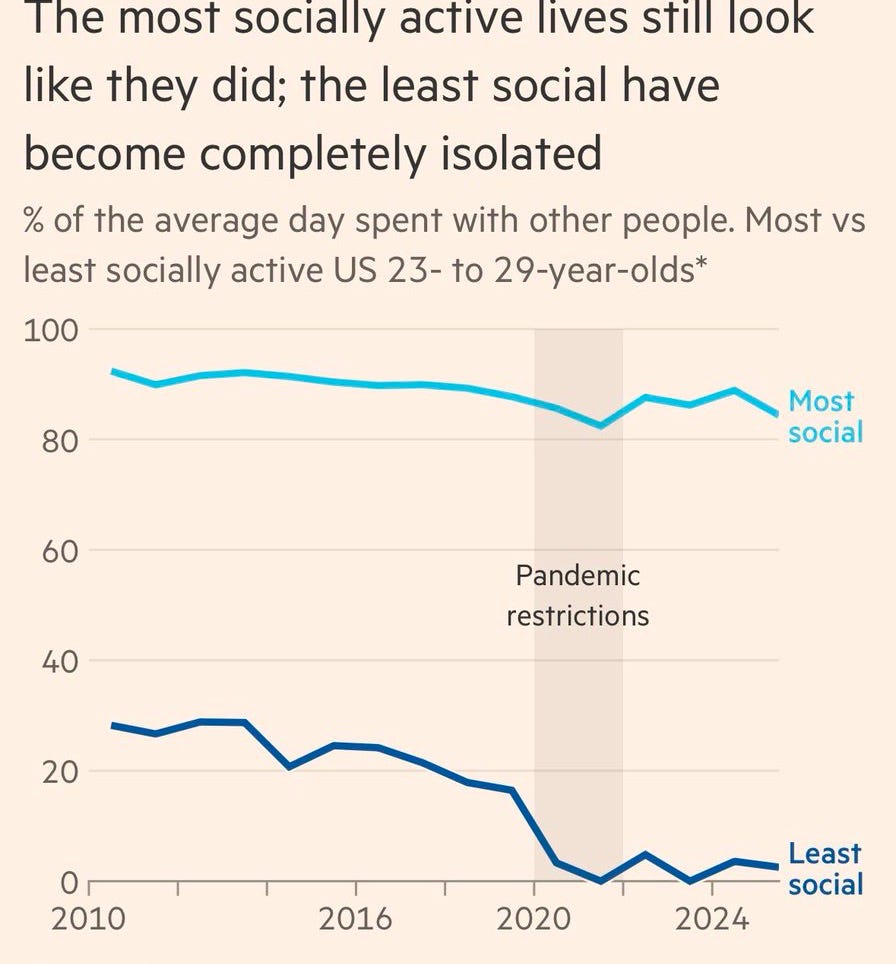

There are of course some groups that have always suffered from isolation. Old people whose partners/friends have passed, for instance. But the group where people are _increasingly_ isolated are young people, particularly ones out of work and past education. Not only are they low in intentional human interaction, but they are also the beneficiaries of an era where incidental interaction is down also. Sounds basic to say, but you can do your big weekly shop without saying hi to a person now.
What happens to you when you are on your own all the time? It is an important question as jumping from the above data to talking about disturbed loners requires too many jumps.
I’ve had a look at the available research. You get a lot of:
- Lab experiments where people who probably aren’t self-isolators get told to sit in a room alone for 10 hours, vs people told to spend time with others.
- Huge longitudinal datasets which identify mortality risks associated with less human interaction.
But nothing getting at what we actually need to know. We know most people hate being totally on their own and it will cause them negative emotions, that’s why most people _aren’t loners_. But we need to know about the group who are.
And sure mortality risk is interesting, but it tells you nothing about the actual mechanisms, nor does it draw any kind of picture of what the experience is like.
Of course this is logical and expected. How could you possibly attempt to study people that are impossible to have a connection to or contact? We have to be in the dark about what extreme isolation does to people, because if we found out then those people we’re studying cannot be extremely isolated.
But just because that’s logical doesn’t mean the resulting hole in our knowledge isn’t still a huge problem.
Give 1,000 people who have no friends or human contact an LLM to use everyday. How many grow attached to it? How many are already resentful at the world? How many have distorted views of reality? How many have superiority complexes?
I have no idea. My gut instinct is to guess 1-5% for the worst versions of those questions but I can’t really explain why in any depth. And to Amodei’s point, so what if it is <1%? So what if it’s <0.00001%? You only need one.
Part of me wonders if the reason Amodei’s arguments failed to find any lasting place in the discourse is because the thing he is describing is simply so unrelatable. These people just do not feel real to the average person. Hence, when these people do crazy things and the news identifies them, the instinct is to say that ‘something doesn’t feel right’.
I think about this with some of the most famous recent shooters: Luigi, Thomas Crooks who shot Trump, Tyler Robinson who killed Charlie Kirk. People raise inconsistencies or weird things about their lives and worldviews as evidence that the story being told about their behaviour doesn’t add up. But like .. you expect someone who would do that to have a coherent, rational worldview and life?
In fact, let’s see what we do know about their lives.
Thomas Crooks was 20, still stuck in his childhood bedroom in his parents’ house. He had graduated in engineering but was working in a nursing home. No one said they ever thought he ever seemed particularly concerning, but this is because no one actually knew him. Investigations into his younger life produced no friends to give a full account of him, apart from one person who saw him every morning and claims he didn’t seem that lonely. But that’s only because you need to be somewhat close to someone to actually pick up on the fact that they must not have any other friends.
After he left school, what was he doing in his time that wasn’t spent working at the nursing home? No one knows. I don’t mean that as missing data, or cover-up. I mean there was no one to know that information.
Thus it makes no sense when people treat it as suspicious when perpetrators don’t seem like a plausible person. The reason you don’t know anyone like that is because people like that _don’t know other people_.
Luigi Mangione is different. Not a lifelong loner, but a person who became a loner as final step. He shot Brian Johnson in December 2024, but by summer/autumn of that year, friends and family had lost contact with him. A friend publicly wrote that nobody had heard from him for months and that his family was looking for him. His mother eventually reported him missing, before she probably saw his face on TV.
Or consider Tetsuya Yamagami, who shot Shinzo Abe in 2022.
Yamagami lived by himself in a small apartment in Nara. None of his neighbours knew him, at all. He worked in a factory as a forklift operator. He didn’t choose to spend time with his coworkers, and at lunchtime he would eat alone in his car. His dad killed himself when he was four, and his mother’s repeated absences due to her Church work abroad ended their relationship before Yamagami became a self-sufficient adult.
Again, there simply is no other information about who he was or what he was doing with all of the years preceding the assassination, because the police had no one to ask.
But the important thing to remember is that these are cases of people who have the rare combination of isolated lives with the bravery, knowhow and physical skills to _actually_ go to the trouble of trying to kill a major figure. How many more cases would there be if the loner in their room just had to press a button, or instruct an agent? How many more would there be if their desires for violence only needed to last a few hours, or minutes, rather than the months required to plan an attack today?
What’s the worst day you ever had? You ever wished harm on someone for fucking you over?
You’ll note that they all chose to kill significant figures to offer some kind of statement. But if shooting someone with a gun is your only available method to cause harm, and you know that shooting someone will inevitably end your life too, you will choose someone famous as a way to have the most impact. But if size of impact is what you care about, what if you had a mechanism to cause damage to way more people in a much easier way? Would you still choose to target one singular figure?
I recognise I’m leaving some important questions out, such as:
1. If someone retreats into total isolation, isn’t the damage already done in some sense i.e. if that’s the life someone wants and chooses for themselves, they are already unhealthy, and so you don’t know if it’s the isolation that partially causes the damage they do?
2. What are you actually specifically saying the relationship between zero human interaction and disturbed motivations actually is? How much worse is having zero friends than the everyday social loneliness most of feel semi-regularly anyway?
Answer 1: I don’t know.
Answer 2: On this one, the empirical data can be slightly useful.
Here is a meta-analysis of what psychologically happens to people who are put in solitary confinement. I will try to get all the caveats out the way first.
Generalisability wise, bear in mind the sample of people who end up in that situation. Not just solitary confinement prisoners versus the average citizen, but against the average prisoner. This is the comparison this analysis bases its results on, versus regular prisoners. But those in solitary will of course be more disturbed on average. Most of the studies in the meta-analysis will control for existing mental issues, so they can say their study is only studying the effect of the solitary confinement itself, but you cannot ever really know how good your control is. The difference that shows at the end could be a difference that already existed, and you just didn’t know what question to ask at the start in order to measure it.
And of course don’t assume that I’m claiming solitary confinement is the same as self-imposed isolation with internet access. It’s just the best data we have (which is also scary to think about).
Most of this data is taken via interviews by clinicians, who are observing the presence of psychological issues including: excessive grandiosity, suspiciousness (about other intending harm on them etc), unusual thought content (thinking the tv is talking to them, assuming a helicopter in the sky is tracking them), hallucinations, hostility, general disorganised thinking.
_(This meta-analysis does lack in detail into each of these, and I also offer you this Cremieux post on how you’re often better off with a strong single study than a weak entire literature. I don’t know enough about this area to really know if that applies here. I will continue looking at the results anyway.)_
If you group all of those together into one measure, this analysis shows a 0.45 standardised mean difference. I think my math is right by saying this means if you randomly take a non-solitary prisoner and a solitary prisoner, the solitary prisoner will display more psychological problems around 62% of the time (assuming normal distributions, which might be a bad assumption). This would be considered a moderate difference, but that’s an arbitrary label. Use your own judgement.
With all those caveats in mind, it seems still fair to say that as far as we can tell, extreme isolation is associated with increased psychotic symptoms, more hostility, more paranoia, more depression.
And it is within those psychotic symptoms that I have worries.
Because Dario Amodei paints a picture of almost movie style bad actors and villains. I want to take over the world/I want to kill them all/whatever. But this is not the type of evil most worth worrying about. To be a bit crass about it, people just aren’t really like this. It isn’t in our psychology. We want people to thrive, spread, develop.
The issue is when a lack of exposure to others means that absolutely nothing in your model of reality can get checked. There’s no feedback mechanism for every inference you make or connection you spot or issue you identify. So you can easily slip into modes of reality that a clinician would observe as deluded, paranoid, grandiose. And if you are eventually challenged, the compounding issue is that the isolation also made you more hostile. So you are going to swing back.
The evils of human history are purely occupied by people who thought they were the Good Actors. That’s the logical end point of our psychology. We all very naturally think we are the ones who are going to save the world. By whatever means necessary.
So Dario worries about how a _malicious_ loner may _want_ to cause mass harm and can now engineer a dangerous biological agent.
But this totally neglects the deluded loner who doesn't intend to hurt anyone at all, has just spent five months developing some completely wrong theory of biology, become absolutely certain that the scientific establishment is too captured or stupid to understand it, and now suddenly possess the tools to test it themselves and accidentally releases the same agent.
Or the deluded loner who has become convinced by their own theory of everything that places consciousness as primary, and thinks our embodied lives are only holding us back from experiencing universal love, so does kill us all on purpose, but only because they want to set us free.
Or the deluded loner who believes they have discovered evidence that humanity (or just them as an individual) is living in a simulation, and decides causing some enormous anomalous event is the only way to force whoever is outside it to reveal themselves.
Or the deluded loner who becomes convinced that a pandemic is inevitable anyway, and releases one themselves because controlled exposure now will save more lives than an uncontrolled outbreak later.
Or the deluded loner who becomes convinced that an AI lab is months away from ending the world, and concludes that killing a few hundred people to stop it is the straightforward utilitarian choice.
How many of those are there?
You know anyone like that?