Fewer Americans Pay to Use ChatGPT / Claude Than Still Pay to Play... World of Warcraft
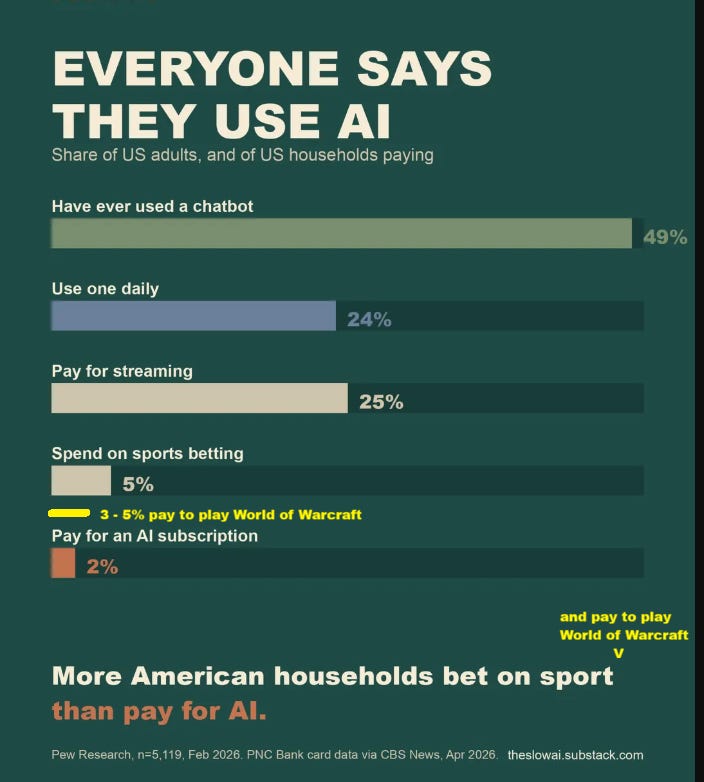
_Image credit (and apologies!) to Slow AI from this post_
This isn’t a completely fair comparison, but since OpenAI’s Sam Altman is admitting that ChatGPT subscriptions are slow to gain traction, I think it’s important to illustrate just _how_ slow. The Substack Slow AI (heh) recently compiled some sources on slow subscription uptake:
> PNC Bank looked at its own card data and found that **about 2% of US households** [emph. mine!] pay for a generative AI subscription, up roughly 155% on the year before. The vast majority of them pay $20 a month, and the average subscription lasts seven months. Bank of America Institute, looking at its own customers in March 2026, put the figure at about 3%. > > > In the same PNC data, 5% of US households spend money on sports betting and roughly 25% pay for streaming.
There are about 134 million households in the US, so that nets out to about 2.7 million LLM subscriptions. Sports betting online is a relatively recent phenomena, only becoming legal across the US in 2018, so how about we look at another, older apples/oranges comparison:
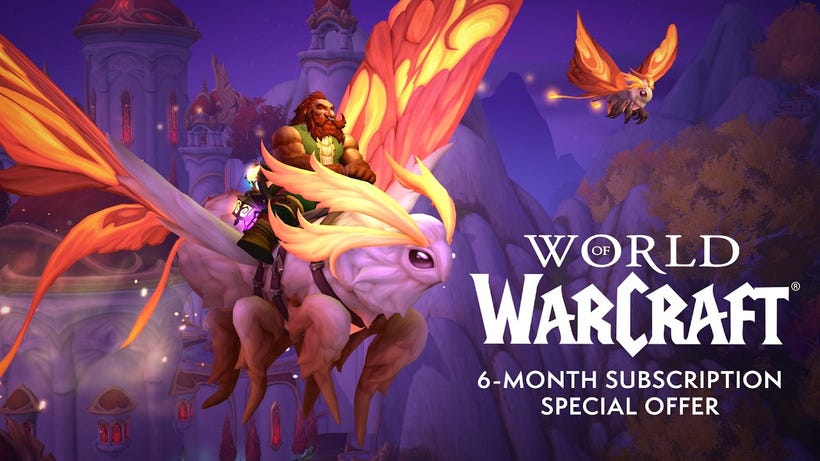
Image credit: Battle.Net, currently offering a subscription special!
WoW?
Yes, wow.
Launched in 2004 and reaching a peak of around 12 million subscribers worldwide in 2010 (an insider tells me they hit as high as 20 million players at peak), World of Warcraft still has a pretty large subscriber base -- an estimated 9 million as of late 2025. To be fair, a lot of those subscribers are in China and across the world, so for the sake of argument, let’s assume about 4 million are in the US, still paying $15/month (give or take) for a virtual world that’s now 22 years old.
4 million subscribers nets out to around 3% of US households. (But perhaps a bit more, if more of those 9 million subs are in the US, so let’s say 3-5%.)
Again, this is not a completely fair comparison, since ChatGPT and Claude are LLM-powered chatbots, and World of Warcraft is an MMO-based virtual world. Then again, I’ve also heard promises that ChatGPT and Claude would transforming gaming (as well as everything else), with declarations like --
> ## **“[With ChatGPT] movies are going to become video games and video games are going to become something unimaginably better”**
-- which was made by someone named... Sam Altman.
And the “who really pays to use this?” question is important, since LLMs require such heavy computing and data costs, and there’s no way they’re sustainable, unless end users (both consumers and enterprise) are willing to pay to keep using them. It’s almost certainly not sustainable if it only exists on ads, like Google or Facebook still mostly do. (On some quick back-of-envelope math, subscribers would need to pay as much as $1000/month to keep ChatGPT afloat.)
Just today, Bill Gates is warning of apocalyptic changes from AI because “[m]arket forces will make adoption go faster and faster”. But where is the evidence of that mass adoption?
By comparison, the number of Americans paying for an iPhone/Android smartphone (the device and the calling plan, roughly $1000+/year), passed 100 million within 5 YEARS of the first iPhone going on sale in 2007:
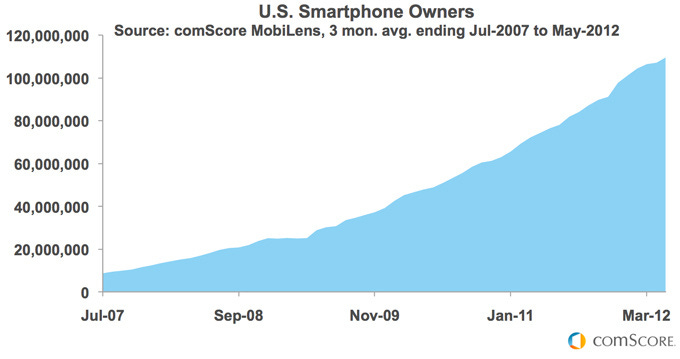
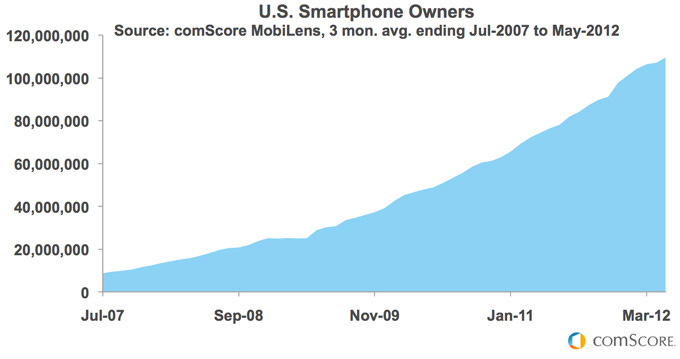
100 million means that within 5 years, most everyone in a US household had at least one smartphone in their home.
_That’s_ what mass adoption looks like.
And as regular readers know, World of Warcraft is not even the largest virtual world in terms of paying users, not even close. But if the leading LLMs can’t even compete on a subscription basis with one of the oldest MMOs on the market, maybe they’re not as groundbreaking and transformative as people say they are?