Nobody Cares About the Code in the Box
!Image 1: A theater stage with an empty magic box above hidden machinery and another box below the floor Every great magic trick has three acts.
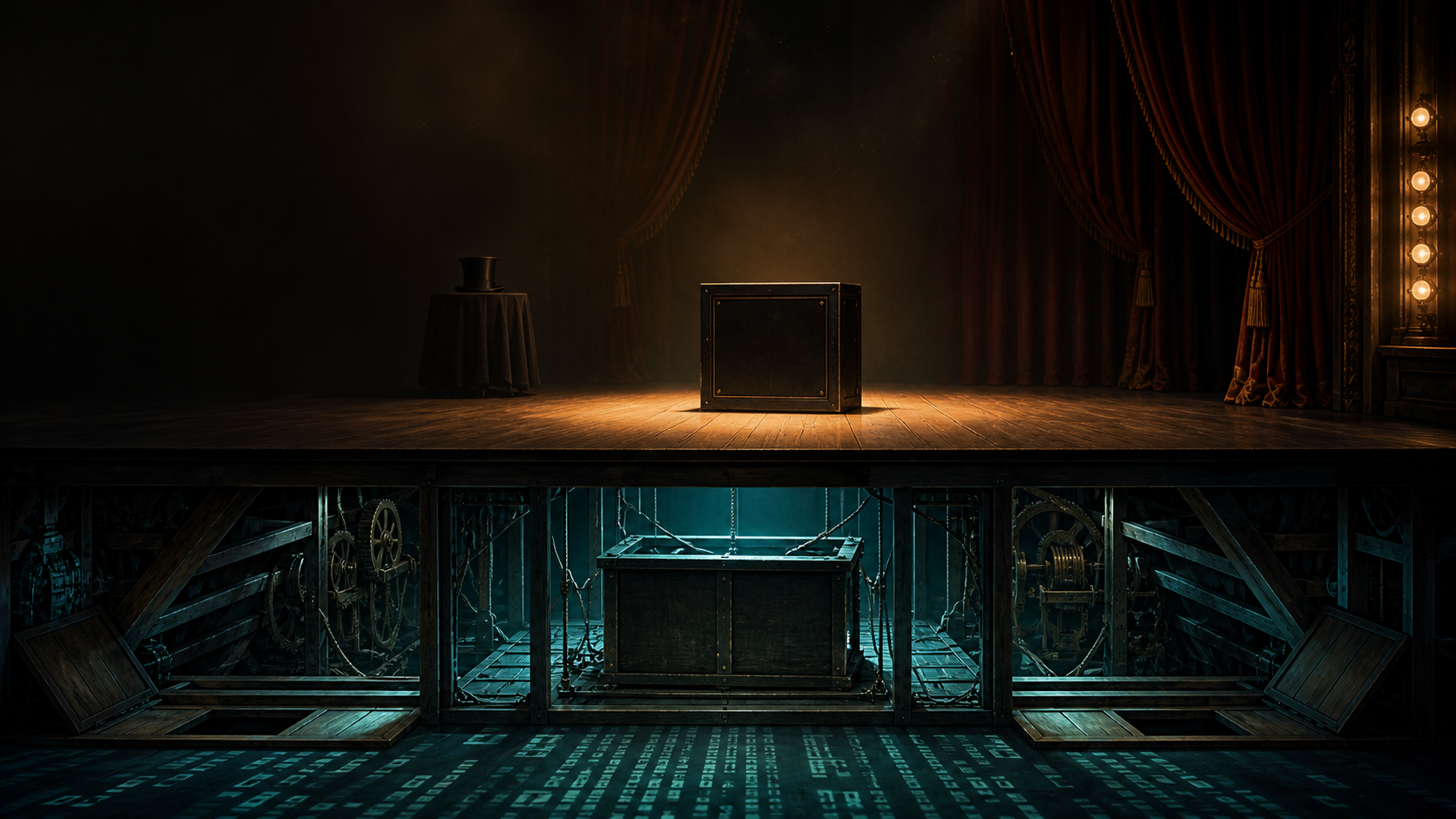
First comes the pledge. The magician presents something plain and lets you believe you understand it. A coin. A card. A locked box. Nothing suspicious, at least not yet.
Then comes the turn. The ordinary thing refuses to stay ordinary. It disappears, changes places, or behaves in a way it has no business behaving. This is where everyone starts looking for the secret, which is funny, because most of us do not really want a diagram. We want the feeling of being fooled.
But a disappearance is only half a trick. The hard part is bringing the thing back. That last act is the prestige. The thing you thought was gone returns, and for a second the room agrees to believe.
Software development has a similar arc. The pledge is intent: the human need, the business rule, the outcome someone is hoping for. The turn is implementation: code, configuration, data, services, tests, and all the hidden machinery that makes the thing work. The prestige is the outcome: the user gets one of those small impossible moments, like the first time Shazam names a song from a noisy room or your phone identifies a house by simply taking a picture of it.
For a long time, code was where the mystery lived. Most people could see the result, but not the mechanism. Developers understood the hidden machinery. The wand was a keyboard. The cape was mostly a hoodie. The mystery still worked.
The better question is more practical: which parts of software work have been hiding inside the box, waiting to become tools?
My bet is the code-shaped part. AI is getting good at producing the machinery: endpoints, migrations, tests, glue code, little refactors, and the thousand boring cuts that make a feature stand up. That machinery still matters. A trick with bad machinery is just an accident with better lighting. But it changes where I want to spend my judgment: defining intent, testing the result against reality, making architectural calls, and asking whether the thing is worth building at all.
That is why I keep coming back to the phrase "the man in the box."
🏳️🌈 A quick note on language
In _The Prestige_, "the man in the box" is the movie's wording. The phrase is not meant to exclude anyone. Developers are women, men, nonbinary people, and people with plenty of other ways of describing themselves. Here, it means the hidden role in the trick.
For a long time, code was the thing in the box. Essential, but not the thing anyone came to see. The audience was never there to admire the latch, the hinges, or the joinery. They were there for the impossible moment.
Developers knew how the box worked. We knew where the trapdoor was, which latch stuck in winter, and why one "small change" to the billing rules could break an API contract, overload a SQL query, or wake up a workflow everyone thought had been retired. That knowledge mattered. It still matters. But the box is changing.
The pledge
!Image 2: A closed magician's box on a theater stage with papers and faint code-like light nearby The pledge is intent. It is the ordinary thing we show up with before the machinery starts moving: a business rule, a user need, a promise about how the software should behave.
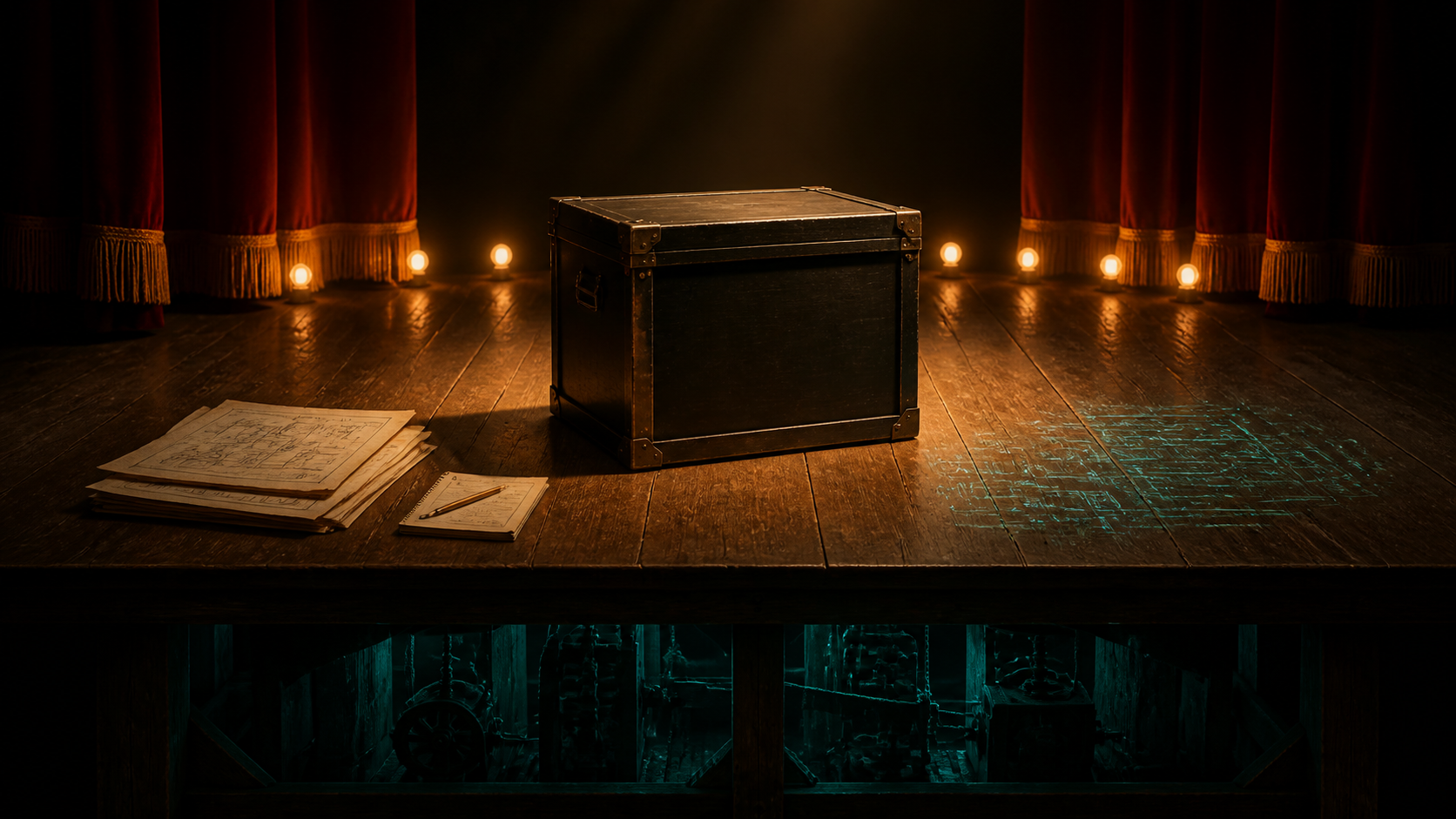
In real projects, the pledge is rarely a neat sentence in a ticket, no matter how many systems we use to pretend otherwise. We have put it in Jira tickets, GitHub issues, kanban cards, user stories, acceptance criteria, and meeting notes with dates in the filename. Then someone says, "Can we just..." and the room slowly discovers that "just" is doing a lot of cardio.
This is where experienced developers earn their keep before writing a line of code. We ask what should happen, what must not happen, who depends on the current behavior, and which part of the system will wake up angry if we touch it. We remind people that the simple screen has a batch job behind it, that the API has outside callers, that the report nobody loves is still how finance closes the month.
The pledge is also where we name what is easy, what is hard, and what is merely pretending to be easy because nobody has looked behind the curtain yet. That work used to feel like prelude. Increasingly, I think it is the durable part.
The turn
!Image 3: An open magic box on a theater stage with teal light flowing from hidden machinery below The turn is implementation. It is where intent becomes code, configuration, data, tests, services, and all the other machinery that makes software move.

For decades, code was where intent finally became real, so we treated it like the main event. We wrote it, organized it, argued about it, reviewed it, and renamed things until the naming debate had its own weather system. We argued over tabs versus spaces as if civilization depended on the outcome.
I used to obsess over alphabetizing methods. At the time, I honestly thought my OCD made me a better developer. I also treated duplicate code like a moral failure. Some of that discipline helped. Some of it was just me trying to make the file look sane because the business rules would not return the favor.
Tooling changed that. Formatters made my formatting opinions less interesting. IDEs made some organization habits obsolete. Static analysis caught things I used to hunt by hand. I did not stop caring about craft. The reason I cared changed.
Code still matters because it is where intent becomes executable. It is the machinery that either honors the promise or quietly mutates it into something else. But software value was never really the code. The value is what the software lets someone do: find the right house from a photo, move money without thinking about bank rails, buy something in two taps, flag a risky transaction, or turn a messy support thread into a useful answer.
AI changes the bargain because it can produce more of the machinery. Boilerplate, migrations, endpoints, tests, mocks, glue code, the stuff nobody wants to admit consumes half a sprint. If your identity is built entirely on typing those things into existence, that is going to feel threatening. I get it.
But the scarce work moves upward. What are we trying to accomplish? What are we not allowed to break? What risks are hiding behind the happy path? What does "done" mean when the demo works but reconciliation is wrong by 0.3%?
That is why intent has to become more durable. None of this is brand new. Behavior-Driven Development, Specification by Example, executable specifications, and living documentation have all been circling the same idea: make behavior understandable before, during, and after the code exists.
Intent-Driven Development is the useful label here because it puts the weight in the right place. The durable artifacts are acceptance criteria, business rules, behavior descriptions, risk notes, migration plans, and PR summaries written clearly enough that humans can challenge them and AI can consume them. Not prose as decoration. Prose as an artifact.
Tests and pull requests have to follow that shift. Unit tests still matter, but if AI can write both the implementation and the tests, the test suite is no longer the highest-trust artifact by itself. Human-readable intent has to sit above it. And in a 127-file AI-assisted PR, the review cannot just be, "Did every line look okay?" It has to ask, "What is the software supposed to do now?"
Clean code is cheaper code
Clean code still matters because it gives humans and AI less ambiguity to work through. Fewer misleading names, dead paths, duplicate ideas, and surprise side effects means less machinery to inspect before changing the system.
The craft is still there. It just moved.
The prestige
!Image 4: An open magic box on a theater stage releasing warm light and abstract symbols of useful outcomes The prestige is the outcome. The vanished thing comes back. The audience gets the impossible moment.

In software, the prestige is not the pull request. It is not the green build. It is not the beautifully factored service with the tasteful interface names, though I do appreciate those more than is probably healthy.
The prestige is the user getting the outcome they needed. An app names the song, moves the money, calls the ride, or identifies the house. The system reflects reality closely enough that someone can trust it and move on.
That is the magic. Nobody applauds the trapdoor. Nobody remembers the code in the box.
And in _The Prestige_, if you remember what happens around that box, the image is hard to shake. The water does not care how essential the role was.
The hidden labor still matters. Someone has to understand the machinery. Someone has to know when the shortcut is about to bend the system into a shape it will regret later.
I still care about code. I care about names, boundaries, tests, cohesion, and all the little choices that make software either supple or miserable. I will probably still alphabetize something now and then when nobody is looking.
I just spend less of my attention there now. More of it belongs in defining the intent, validating the outcome, and making the architectural calls that keep the system honest. I want to understand what the business is actually trying to do, especially when the ticket does not. I want to make sure the trick is worth performing.
The audience remembers the magic. They remember the impossible thing. They remember the moment the vanished object returns and the room briefly agrees to believe.
> "I'm an ingénieur. I design illusions and construct the apparatus necessary for performing them."
Software engineers are not really the magician at center stage. We are the ones who design and build the apparatus, who understand the mechanism, the load, the timing, and why the trick is worth doing at all. If AI wants the code in the box, fine. Let it. I want to design the trick, define the intent, and make damn sure that when the curtain falls, what comes back is the thing we actually meant to build.
~codenaked