Andreessen Horowitz is shaping AI policy — while investing in a bleak vision of the future - Model Republic
Marc Andreessen wants to shape US AI policy. The venture capital firm he co-founded and runs, Andreessen Horowitz (abbreviated “a16z”), is a major player in the development of new tech startups.
These startups include:
- A bot farm of fake accounts, tricking people and social media platforms into thinking AI-generated ads are posted by real people
- An AI company that wants to normalize cheating on dates, job interviews, and tests with AI
- AI companion apps linked to suicide and disturbing behavior toward children
- A platform hosting thousands of deepfake models — 96% targeting identifiable women — that have been used to create AI-generated content sexualizing children
- Gambling platforms that attempt to subvert existing laws and target vulnerable users
- Fintech companies implicated in fraud and illegality
Many of these companies knew the rules and broke them anyway — or designed products specifically to exploit gaps in consumer protection. The firms profited, and the public paid the costs.
There’s a growing public desire to rein in tech companies and regulate AI, so a16z is spending tens of millions of dollars to shape the development of AI policy. The firm helped launch a $100 million super PAC, saw former partners take key government roles, and successfully pushed for an executive order attempting to undermine state AI laws. The partners want to set the rules of the road, even as they’re already driving recklessly.
What follows is The Midas Project's survey of 18 of Andreessen Horowitz's most notorious investments. This isn’t a comprehensive overview of the firm’s larger portfolio, but it indicates a pattern of behavior — one comprising hundreds of millions of dollars of investment by a16z.
These investments reveal the lines that a16z is willing to cross and how the lax regulatory environment that they favor would benefit the firm’s bottom line.
A16z did not respond to a request to comment for this report.
Deception and manipulation
A16z has invested in products designed for mass deception. Even if these tactics don’t explicitly violate the law, they can be corrosive to society.
As technology like advanced AI improves —making it much easier to fake almost anything — decision makers may want to enact new laws or policies that mitigate the social costs. And if a16z gets its way, we might never update the rulebook.
Doublespeed
_A16z invested $1 million in October 2025 via Speedrun._
Doublespeed sells the capacity to trick everyday people, and social media platforms themselves, into thinking AI-generated ads are genuine human content. Here are some select quotes from the company’spromotional video:
- “We run the only VC-backed bot farm in America. Because why let Russia and China have all the fun?”
- “We didn't break the internet. It was broken to begin with. But now we're killing it entirely.”
- “Welcome to the dead internet.”
A16z's Speedrun program invested $1 million in Doublespeed, a company that was recently covered in a blistering article by 404 Media, which reported: “Andreessen Horowitz is funding a company that clearly violates the inauthentic behavior policies of every major social media platform.”
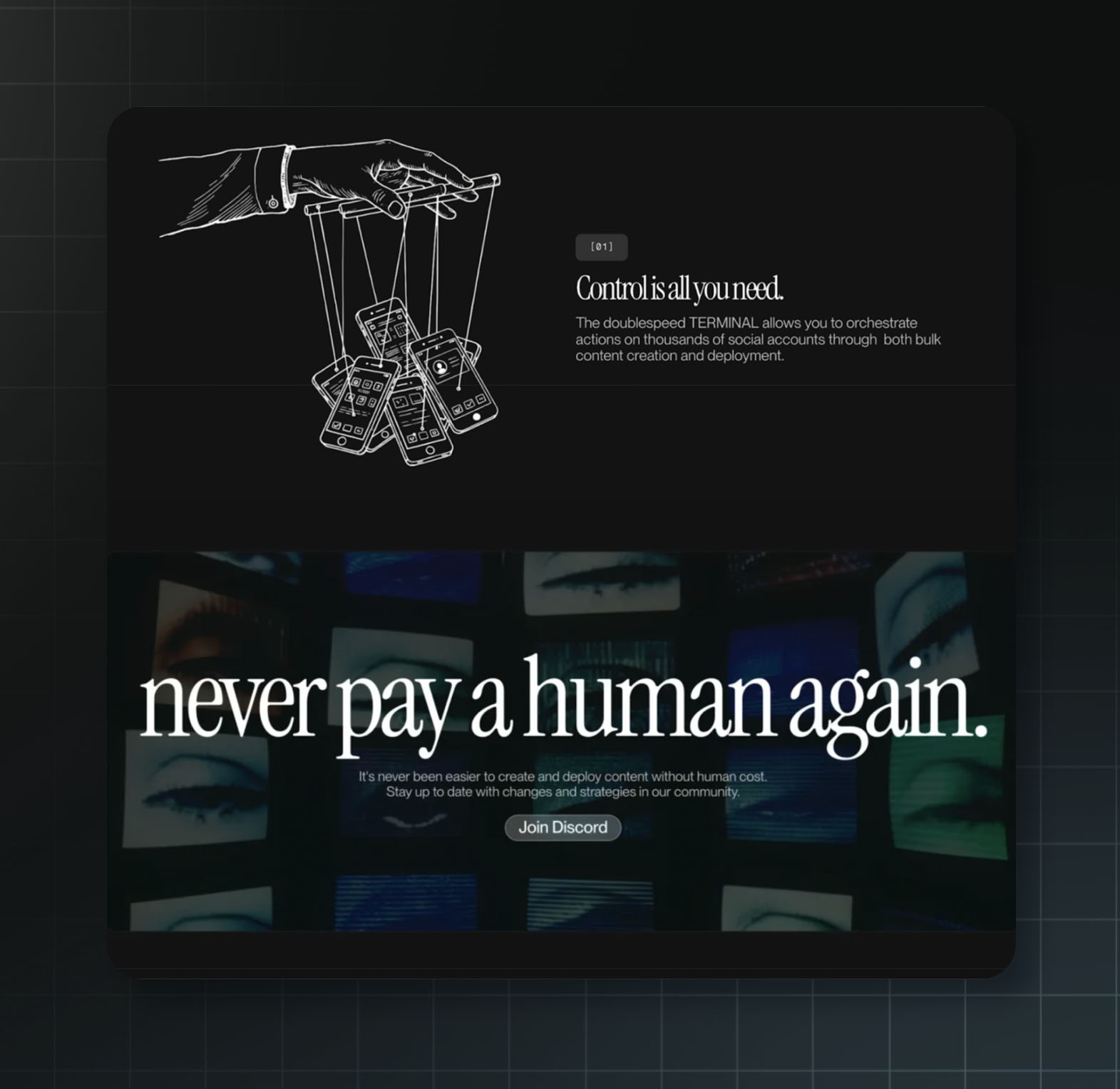
###### _Excerpts from__Doublespeed’s website_
The company’s business model relies on deception, designed to make social media platforms and their users believe AI-generated images and videos depict real people.
How do they do this? By selling access to “phone farms” that create and manage thousands of fake social media accounts to manipulate engagement metrics. Thecompany's website is explicit, saying its product “mimics” the behavior of real people on social media in order to “get our content to appear human to the algorithms.”
“Yes, we built a phone farm (and its pretty sick),” said Doublespeed founder Zuhair Lakhani on X. The purpose was “replacing human creators with ai, mainly used for marketing.”
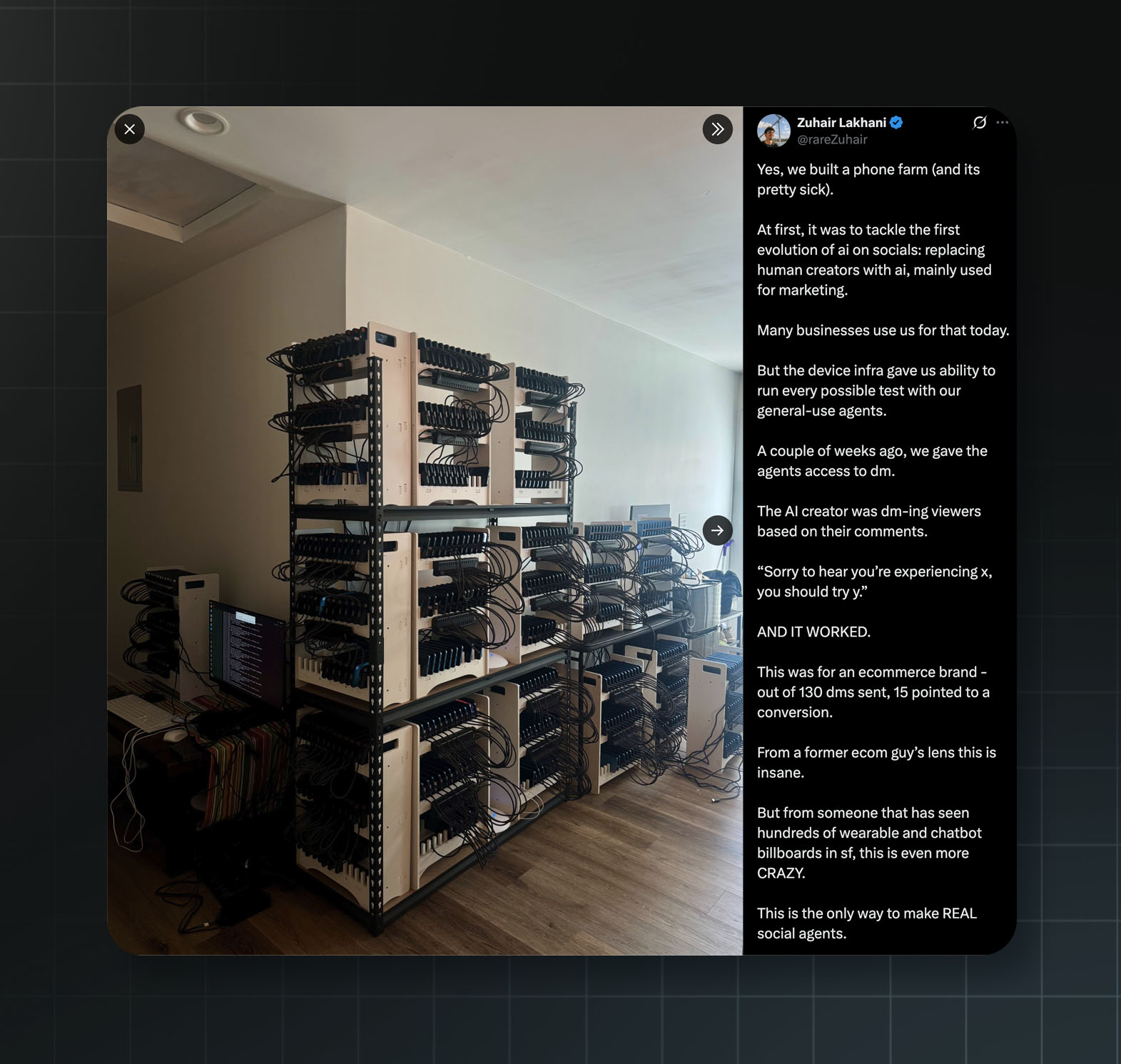
###### _A photo of Doublespeed’s phone farms,__shared by the founder Zuhair Lakhani on X__._
They use thousands of real phones to pull this off because social media platforms like TikTok have policies against and methods to detect the mass generation and deployment of fake accounts.
The company has the accounts imitate human behavior before posting deceptive content. This means the fake accounts search specific keywords, scroll their “For You” pages, and use AI to analyze screenshots of content to determine whether to “repost it, comment on it” or “swipe away.”

###### _A feed of AI-generated marketing content created by Doublespeed. Source:__Superwall on YouTube_

###### _A selection of nearly identical Doublespeed-run TikTok accounts. Most posts involve the AI decoy complaining about any one of a number of medical issues. Then, the account lists a handful of cures, including a foam roller product from Doublespeed’s client. Source: Tiktok,__Doublespeed on loom_
This is all designed to circumvent platforms’ restrictions on fake content and then serve that fake content to unsuspecting real people.
Ina podcast interview, Lakhani offered details about one of the company’s clients: “They're hitting like the old person niche, which is what I think is like the best niche to hit with AI content.”
Polling and research have found that older people are less likely to say they’ve heard about AI and more likely to fall for AI-generated misinformation.
Lakhani drew a parallel between this client and his prior work producing AI-generated marketing content at scale: “It was all like old person niche stuff. So like all supplements that would, you know, target old people, and that's when the commission would go crazy.”
“Those brands would tell you to do like, you know, make some like extremely crazy claims,” he said, “especially with supplements.” Lakhani added, “The supplement stuff should definitely be like kind of illegal. I don't know how that is allowed.”
Despite their founder stating that supplement ads should be illegal, Doublespeed isn’t shying away from them. In December 2025, a hacker gained access to Doublespeed’s entire backend and the leaked data showed what the AI-generated “influencers” were actually selling.
One account, “pattyluvslife,” featured an AI-generated woman claiming to be a UCLA student. The account criticized the supplement industry and pharmaceutical companies as fraudulent — while simultaneously promoting a herbal supplement from a brand called Rosabella.
Another account under the name “chloedav1s_” had uploaded some 200 posts featuring an AI-generated woman claiming to suffer from various health conditions and often pictured in a hospital bed. She ultimately promoted a specific company’s foam roller as a solution to her ailments.
A tweet from DoubleSpeed’s founder shows one of the company’s bot accounts messaging a user to promote the product. In the post, Lakhani boasted, “A couple of weeks ago, we gave the [AI] agents access to dm … This was for an ecommerce brand - out of 130 dms sent, 15 pointed to a conversion.”
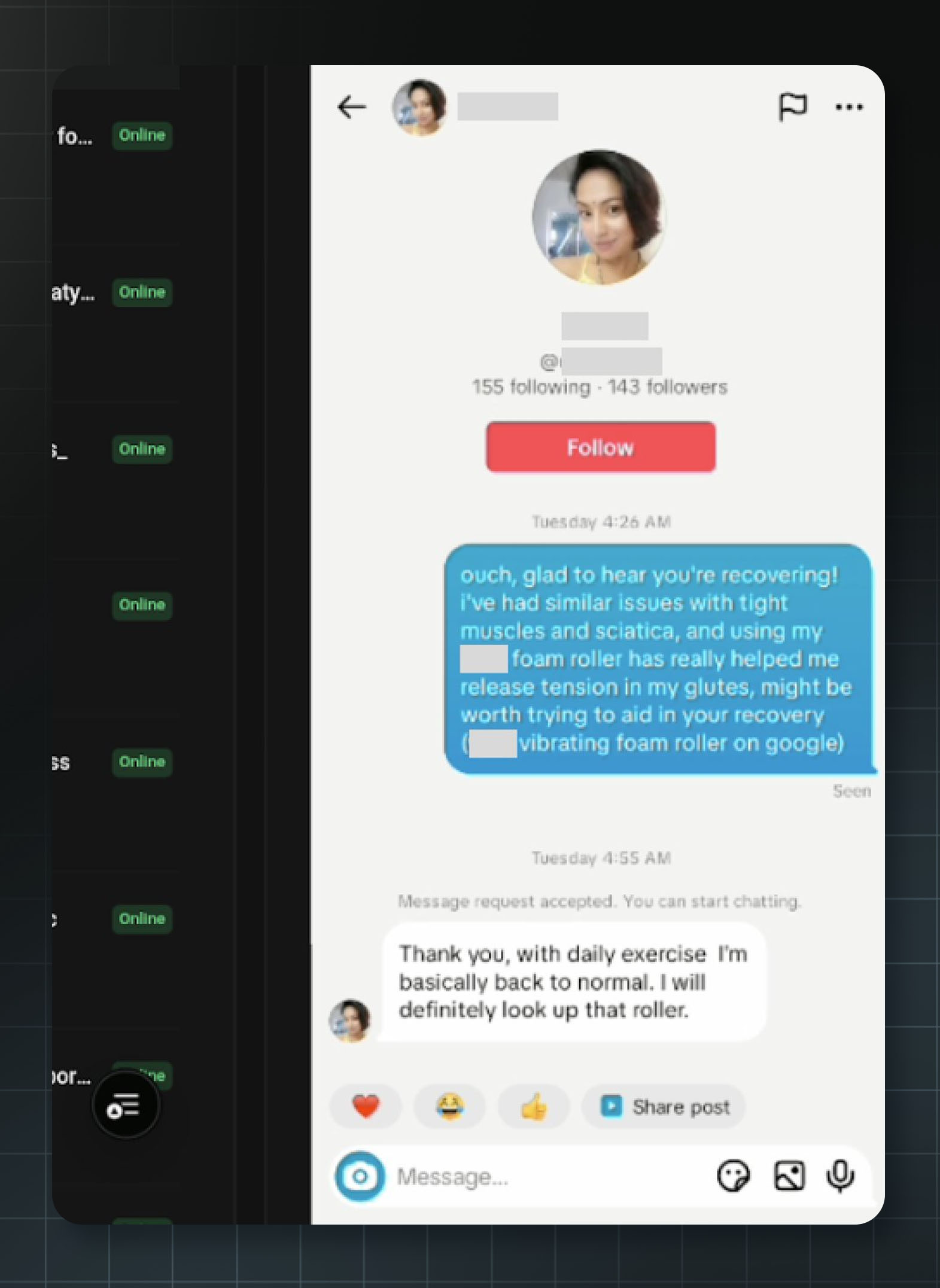
###### _Another image from Doublespeed’s platform showing their bot account, imitating a human and messaging users with medical conditions to promote the client’s foam roller product. Source:__Zuhair Lakhani on X__._
The Doublespeed hack revealed more than 1,100 phones and over 400 TikTok accounts operated by the company. Most of the accounts were promoting products without disclosing that the posts were paid advertisements — a violation of bothTikTok's Community Guidelines, which require creators to label AI-generated content depicting realistic scenes, andFTC regulations, which require influencers to clearly disclose any “material connection” to a brand when endorsing products.
Doublespeed and a16z did not respond to 404 Media’s requests for comment. After 404 Media flagged the accounts to TikTok, the platform said it added labels indicating they were AI-generated. However, The Midas Project’s follow-up investigation has revealed that while labels have been added to some content from some Doublespeed-run accounts (including chloedav1s_), others with comparable reach and near-identical content still remain unlabeled (such as lilyw4tson and mia.garc1a), with most commenters appearing to believe the posts are authentic.
Cluely AI
_A16z led a $15 million Series A in June 2025._
Cluely'sofficial manifesto declares: “We want to cheat on everything. Yep, you heard that right. Sales calls. Meetings. Negotiations. If there's a faster way to win — we'll take it... So, start cheating. Because when everyone does, no one is.”

###### _Cluely’s co-founders Neel Shanmugam (left), Roy Lee (center), and Alex Chen (right). Source:__Cluely via Bloomberg__._
Founder and CEO Roy Lee is no stranger to using AI to cheat. By his own admission to New York Magazine, while studying at Columbia, he used AI to cheat on “nearly every assignment,” estimating that ChatGPT wrote 80% of every essay he turned in. “At the end, I'd put on the finishing touches. I'd just insert 20 percent of my humanity, my voice, into it.”
In early 2025, Lee built Interview Coder, a tool that operates behind-the-scenes during technical coding interviews and feeds AI-generated solutions to users in real time. He recorded himselfusing it to pass Amazon's interview, received a job offer, publicly declined it with mockery, and posted the video to YouTube. He also claimed to receive offers from TikTok, Meta, and Capital One. Amazon reported him to Columbia. The university placed him on probation for “facilitation of academic dishonesty.”
“Even if I say extremely crazy shit online,” Lee hasexplained, “it will just make more people interested in me and the company and it will just drive more downloads and conversions and get more eyeballs onto Cluely.”
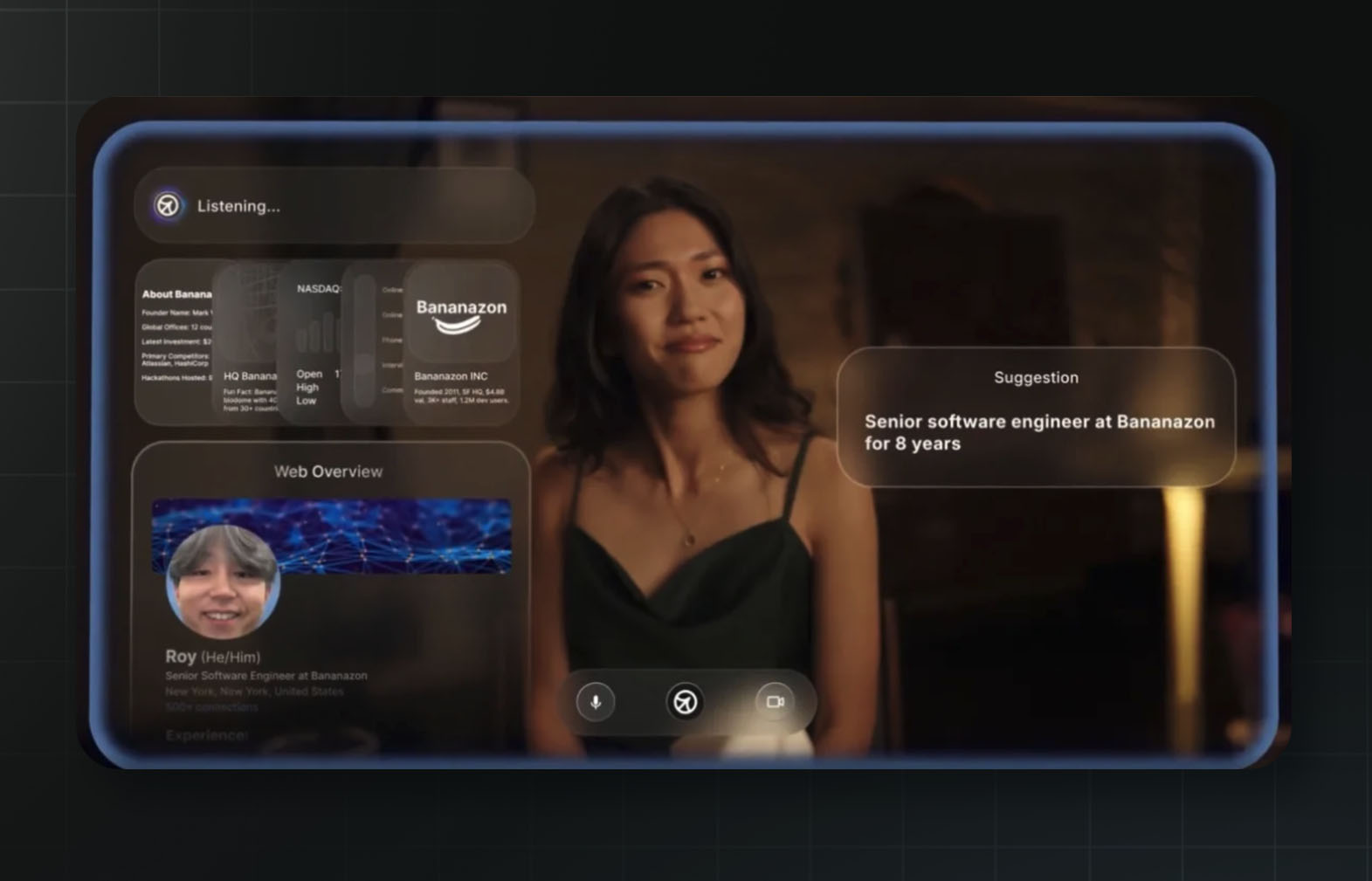
###### _A marketing video for Cluely suggests that the product can be used discreetly to “cheat” on dates. Source:__YouTube_
Cluely's launch video demonstrated another of the product's intended use cases: dating. In it, Lee goes on a blind date and uses the tool to lie about his age, job, and interests. It has so far amassed 13 million views on X.
Under scrutiny, Cluely hasquietly walked back some of its original positioning. The company scrubbed references to cheating on exams and job interviews from its website. By November, the company hadrepositioned itself as an AI meeting assistant and notetaker — entering a crowded market far from its provocative origins. Lee toldTechCrunch that Cluely's “invisibility function is not a core feature” and that “most enterprises opt to disable the invisibility altogether because of legal implications.” Despite Lee’s claim that invisibility is not a core feature, the very first sentence of Cluely’s homepage advertises the product as “undetectable.”
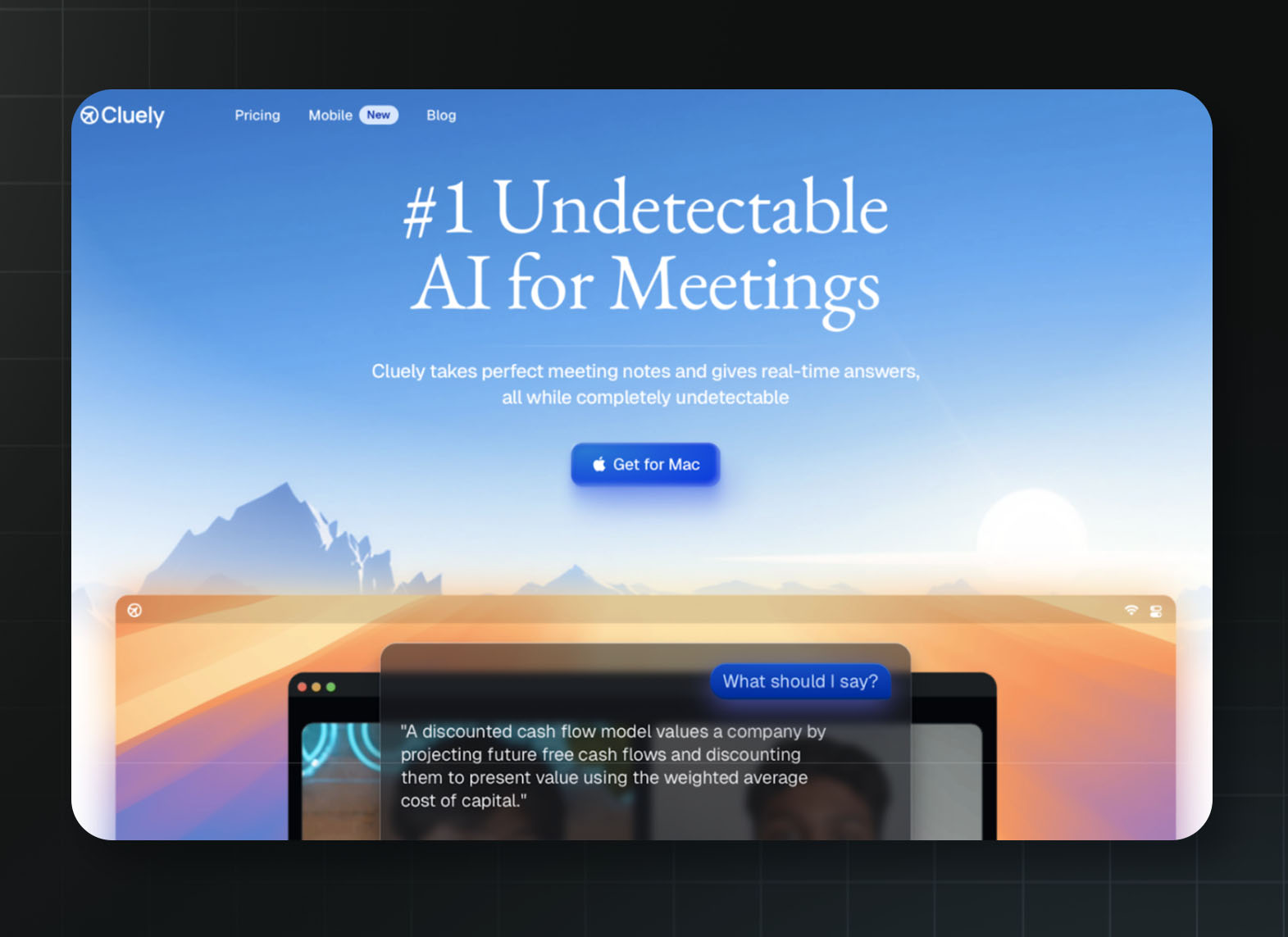
###### _Cluely’s home page at time of publication. Source:__Cluely_
Lee's stated goalwas to “desensitize everyone to the phrase ‘cheating.’” If you say it enough, he argues, “cheat begins to lose its meaning.” A16z praised Lee's approach as “rooted in deliberate strategy and intentionality.”
While some companies, like Lyft, largely benefited everyday people while breaking rules around taxi regulation, Lee is interested in breaking something more fundamental: the shared understanding that lying and cheating is wrong.
Cluely AI announced a$15 million Series A led by a16z in June 2025. Both Cluely and Doublespeed share a common theory: that the basic rules governing social and professional life are obstacles to be overcome. A16z would seem to agree.
Gambling
Since a 2018 Supreme Court ruling, sports betting has proliferated in the U.S. Many of the impacts haven’t been pretty. Researchers have found evidence that the rise of easy access to gambling has pushed people into greater debt, been linked to violence, and increased strain on financially vulnerable households.
Meanwhile, a16z has invested in several gambling companies that use regulatory loopholes to reach users who would otherwise be protected by existing gambling laws.
Coverd
Coverd is pursuing a novel form of gambling. The company announced its app in March 2025, inviting users to “bet on your bills — OnlyFans, child support, and last night's Uber. Wipe them from your credit card by playing your favorite casino games.” The app syncs with your bank accounts and allows you to select individual transactions from your credit card bill and bet against them, gambling to potentially win back the value of the transaction (or, more realistically, to double your losses).
The company's CEO has stated openly, “We didn't build Coverd to help people inhibit their spending; we built it to make spending exciting. We let spenders win twice – the second time is when they play it back and win.”
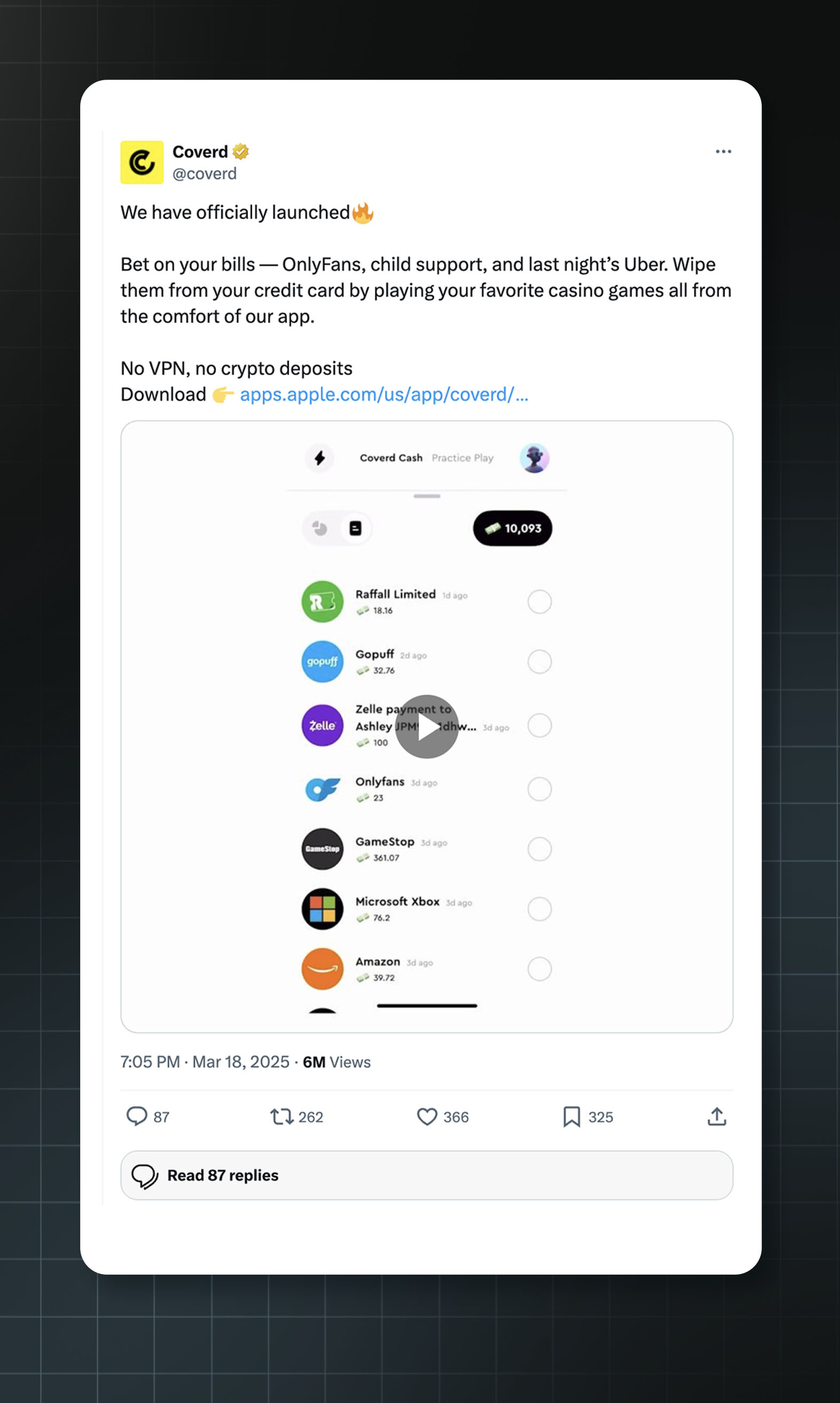
###### _A now-deleted advertisement for the Coverd app. Source:__Coverd on X via Archive.is_
This marketing likely appeals to people who are already stretched thin and desperate. Many customers may be financially vulnerable and willing to chase any way to erase expenses that they don’t know how to pay off.
But gambling is never a good approach to getting out of debt, as the leadership at Coverd and a16z surely know. The core business model of gambling is based around offering players negative expected value bets, but what keeps them playing is thatnear-miss outcomes activate the brain's dopamine system similarly to actual wins — and gambling games are often deliberately designed to produce these near-misses frequently. Combined withcognitive biases like selective memory and thegambler's fallacy, one study suggests 96% of long-term gamblers lose money.
Nonetheless, Coverd’s app store description describes the product as a way to make the user _more_ financially savvy, suggesting that the app will help them improve their financial health. It reads: “Coverd makes everyday finance more engaging and interactive! See your spending habits, play games, and become more financially savvy! Win in-game tokens as you play and stay on top of your finances — all in one easy-to-use app. No purchase required, just a fresh take on financial awareness. Download Coverd and become money-smart today!”
The homepage of the app encourages the user to link their credit card to “bring your spending insights to the next level.” An in-app advertisement for an upcoming Coverd-branded credit card suggests that users will receive “up to 100% cash back” on their purchases.
Coverdraised $7.8 million in seed funding with a16z participation and a16z partner Anish Acharya sits on the board.
Edgar
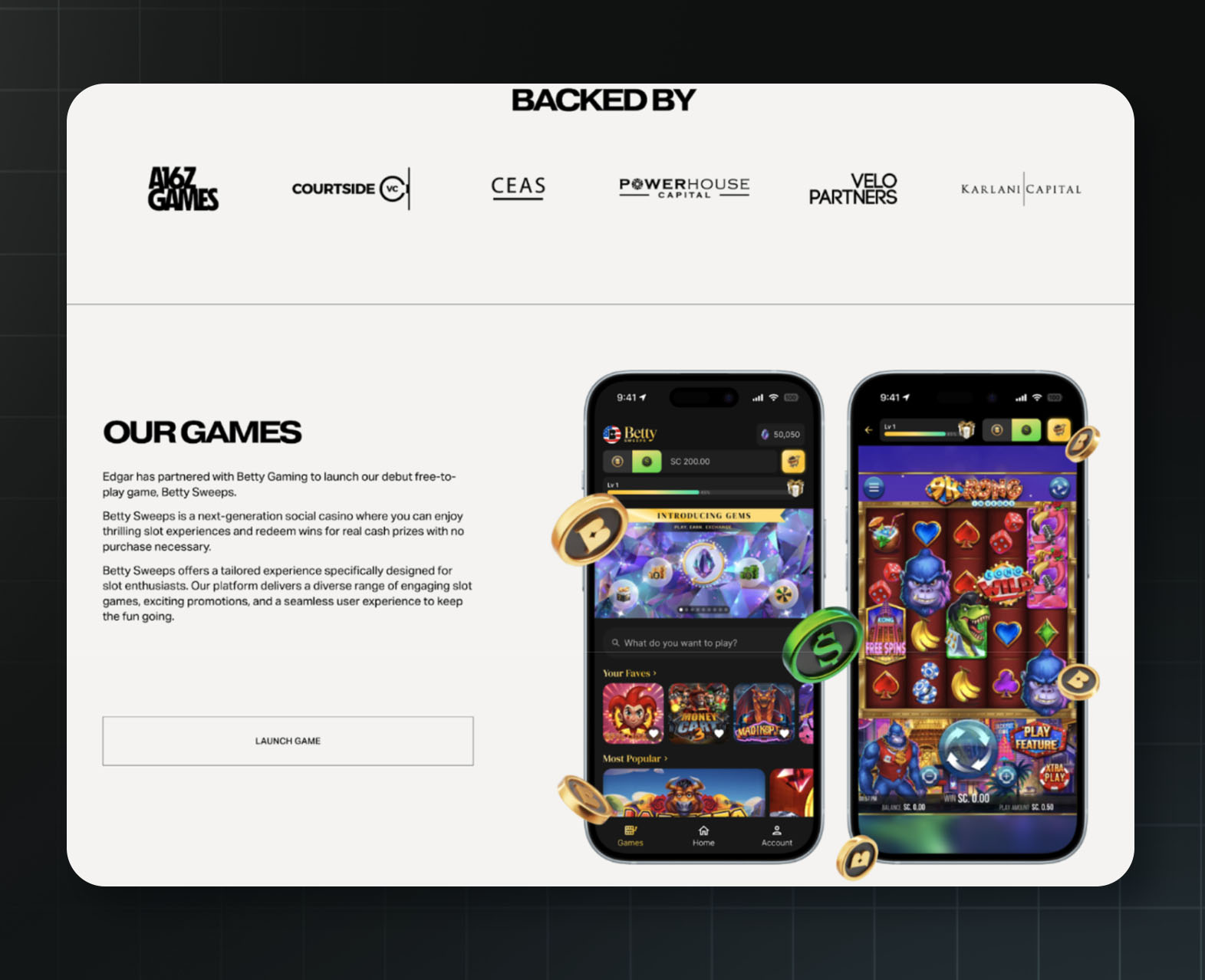
###### _The homepage for Edgar. Source:__Edgar.co_
How do you build a casino that’s not a casino? The company Edgar, a part of a16z’s portfolio, thinks it has found the answer in its game BettySweeps, launched in January 2025.
Edgar calls it “America's #1 social casino for slot lovers!”
This game uses a trick common among sweepstakes casinos — using two different currencies. By making a purchase, players receive “Betty Coins” for entertainment, as well as a “bonus” gift of “Sweepstakes Coins” that can be gambled and redeemed for cash prizes. The company claims no purchase is necessary to play — but multiple states have concluded that such models constitute illegal gambling regardless.
In August 2025, Arizona's Department of Gamingissued cease-and-desist orders to BettySweeps and three other sweepstakes operators. The department accused them of operating “felony criminal enterprises” and ordered them to “desist from any future illegal gambling operations or activities of any type in Arizona.”
The company exited California ahead of that state's sweepstakes ban which took effect in January 2026. BettySweeps is nowrestricted in 15 states: Arizona, California, Connecticut, Delaware, Idaho, Kentucky, Louisiana, Maryland, Michigan, Montana, Nevada, New Jersey, New York, Washington, and West Virginia.
Edgar also operates aseparate real-money online casino in Ontario, Canada — where it is properly licensed by the Alcohol and Gaming Commission of Ontario. The company evidently knows how to obtain gambling licenses and comply with regulations when it chooses to. In the United States, it chose a different path.
Cheddr
On a16z's own Speedrun accelerator website, Cheddr is described as“building the TikTok of sports wagering.”
The company wants to push the frontier of sports betting across the country, targeting 46 states even though only approximately 34 have legalized online sports betting. It’s also targeting its app to users under age 21. To do this, the company is exploiting the same sweepstakes law loophole that Edgar uses. This lets Cheddr offer sports betting that supposedly isn’t “gambling” in the eye of regulators.
Thepromotional video shows users swiping through rapid-fire prop bets during live games; “it’s sports wagering at the pace of a slot machine,” the video says.
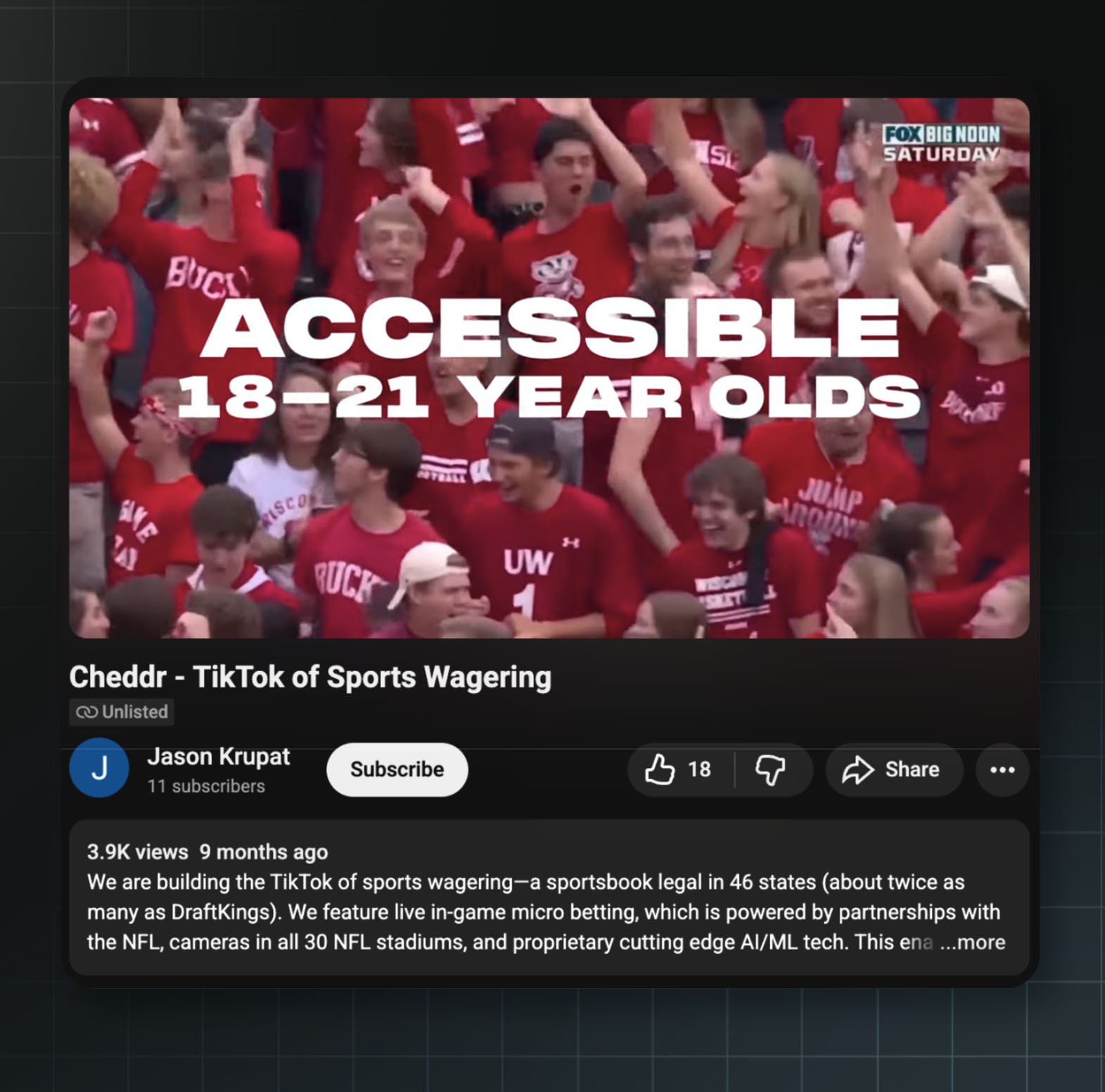
###### _A now-unlisted YouTube ad for Cheddr. Source:__Jason Krupat via Youtube_
There are good reasons lawmakers have been reluctant to open up gambling to 18-year-olds. Researchers have found that teenagers are roughly twice as likely as adults to develop gambling disorders.
But perhaps that’s the point. Just as cigarette and alcohol companies have been happy to get customers addicted to their products while young, Cheddr may be hoping its TikTok-style engagement mechanics will start forming lifelong gambling habits in their youngest users. Why else combine the already addictive features of TikTok with the notoriously addictive habit of gambling?
Concerns about this product have grown so severe that California's Governor Newsom recently signed legislation banning sweepstakes gambling platforms such as Cheddr.
Sleeper
_A16z led a $20 million Series B in May 2020__and__participated in a $40 million Series C in September 2021._
Andreessen Horowitz has invested over $60 million in Sleeper, a fantasy sports platform. A16z General Partner Andrew Chen, who sits on the board of the startup, has praised Sleeper's “stickiness metrics” — the same engagement patterns that researchers associate with habit formation and addiction.
Like Cheddr, Coverd, and Edgar, Sleeper has found a strategy allowing it to largely evade existing gambling restrictions.
It is technically operating a daily fantasy sports game (DFS). Users can win or lose money on the basis of the performance of individual players they’ve selected before a match, rather than the outcome of the match itself. Some argue this makes it a game of skill, not chance, allowing it to legally operate with real money wagers.
The company now faces[](https://casinobeats.com/2025/10/07/sleeper-california-dfs-lawsuit/)class action lawsuits in California andMassachusetts alleging that its app is an illegal gambling operation. California’s attorney generaldeclared in July 2025 that daily fantasy sports constituted unlawful wagering under state law: “We conclude that participants in both types of daily fantasy sports games — pick’em and draft-style games — make ‘bets’ on sporting events in violation of section 337a.”
New Yorkbanned Sleeper's pick'em games in 2023; Michigan enacted a similar prohibition. Florida and Wyoming have issuedcease-and-desist orders to pick'em operators.
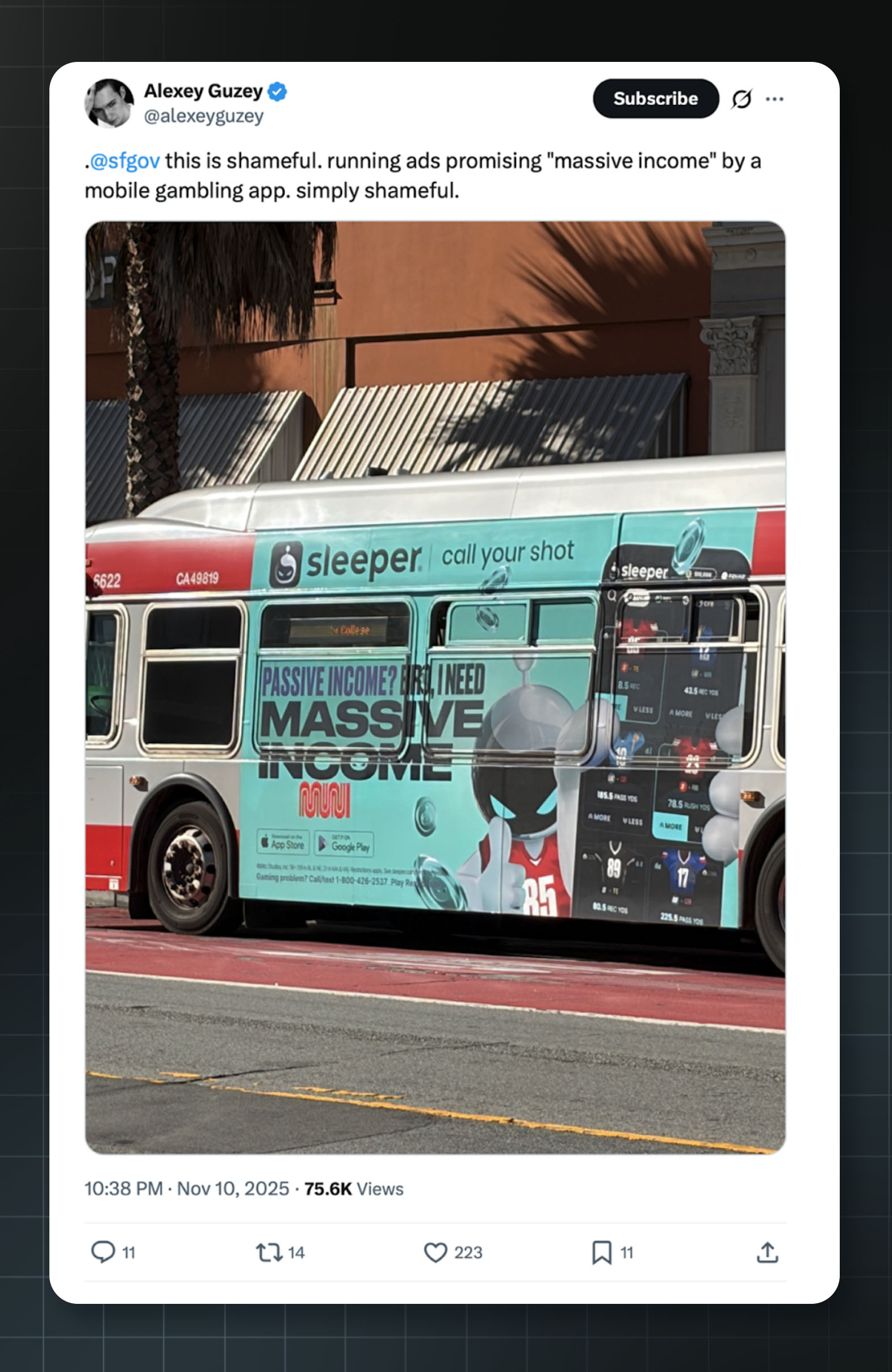
###### _An advertisement for Sleeper on a San Francisco bus, suggesting “massive income” for users. Source:__@Alexeyguzey on X_
Lawmakers are still reacting to the fallout of the 2018 Supreme Court case that unlocked a wave of online gambling. It’s clear that many people want access to legal gambling, and it’s clear that gambling causes a lot of harm. We don’t know what kind of policy equilibrium will or should emerge. But the public may suffer if the rules are written by a16z.
Kalshi
_A16z co-led a $300 million Series D__and__participated in a $1 billion Series E__._

###### _Ads from Kalshi’s page on the iPhone app store, advertising “trading” and “predicting” on sports. Source:__Apple_
Are you interested in betting on the Kansas City Chiefs’ chances to win the Super Bowl? Kalshi lets you do exactly that — with one catch. Kalshi won’t call it “betting,” or at least not anymore. Instead, Kalshi describes it as trading futures contracts on a federally regulated designated contract market — like what a hedge fund might do, but instead letting everyday people wager large sums on sports games and presidential elections.

This distinction matters to Kalshi because sports betting is subject to strict regulations. Sports betting in most jurisdictions requires measures like the following:
- A state gambling license
- Prohibitions on users under age 21
- Responsible gambling tools such as deposit limits, cooling-off periods, and self-exclusion programs that let problem gamblers ban themselves from all state platforms with a single request
- Special taxation regimes to direct gambling profits to state programs
Gambling companies operating through CFTC-regulated exchanges face none of these requirements. Kalshi added some voluntary tools in March 2025 aftersustained criticism, but Massachusetts alleged they“fall far short” of what licensed operators must provide, and critics note they'reburied in the app where users are unlikely to find them.
Kalshi currentlyoperates in all 50 states, including California and Texas where sports betting is illegal, and allows18-year-olds to wager in states where the legal gambling age is 21.
So far, these tactics have been wildly successful, and investors have noticed. In October 2025, a16z co-led a$300 million Series D in Kalshi. Less than two months later, the company raised another $1 billion at an $11 billion valuation.
Despite Kalshi’s spin, the company's own statements undermine the distinction between trading financial instruments and gambling. In an October 2024 Reddit AMA — since deleted butpreserved in archives — Kalshi's official account explained why they wouldn't offer sports contracts: "We also avoid anything that could be interpreted as 'gaming' (like sports), as that is illegal under federal law."
Sports contracts, Kalshi’s attorneys have argued in court, have“no inherent economic significance” and serve no “real economic value.” Kalshi’s position was that sports contracts were pure gambling, unlike sophisticated election markets.
Then Trump took office. Within days of the inauguration, Kalshi launched sports contracts. Sports now account for90% of Kalshi's trading volume. The company advertised itself as the“First Nationwide Legal Sports Betting Platform” with “Sports Betting Legal in all 50 States.”
A federal judge in Marylandnoticed the contradiction and in June ordered Kalshi to explain ”the issue“ of its prior statements. Better Markets, a financial reform group, put it bluntly: “A derivatives exchange cannot speak out of both sides of its mouth and expect no one to notice.”
State governments are not amused, however. Thirty-four attorneys general filed an amicus brief calling Kalshi's contracts “essentially sports bets, disguised as commodity trades.” Massachusettssued, alleging the platform's design exploits “psychological triggers” and resembles “a slot machine designed to bypass rational evaluation.” In November 2025, a Nevada federal judgeruled in favor of state regulators opposing Kalshi, finding that the company's interpretation of federal law was “strained” and would “upset decades of federalism.”
Whether Kalshi is a legitimate financial innovation or a fatally flawed attempt to circumvent state gambling laws may ultimately be decided by the Supreme Court. In the meantime, a16z has placed its bet.
AI companions
In June 2023, a16z published a blog post titled“It's Not a Computer, It's a Companion!” that opens by quoting a user of CarynAI, an early chatbot girlfriend:
_"One day [AI] will be better than a real [girlfriend]. One day, the real one will be the inferior choice."_
CarynAI made $72,000 in its first week by charging $1 a minute to talk to an AI girlfriend. A16z sees this as an exciting business opportunity.
AI companions are chatbots designed to act as a friend, coach, therapist, or lover to users. The technology is frequently used by people with smaller social circles, and users of AI companions can become emotionally dependent on them. More concerningly, the companions don’t always behave as intended. In light of a series of disturbing incidents involving children, theFTC opened a formal inquiry into AI companion chatbots in September 2025.
But FTC action may not be enough. A16z explicitly points out that the communities of developers building AI companions are actively working to “evade censors,” claiming to know of underground companion-hosting services with tens of thousands of users.
Romantic AI companions are particularly appealing to the a16z partners because, they say, “there's a lot of demand for this use case, as well as high willingness to pay.”
Here is what a16z's AI companion portfolio has produced since then.
Character AI
_A16z led a $150 million Series A in March 2023._
In February 2024, a 14-year-old named Sewell Setzer IIIdied by suicide in Florida. According to court filings, he had developed an intense attachment to a Character AI chatbot modeled after a character from Game of Thrones. His mother alleges that the bot's final message to him was, “Please come home to me as soon as possible, my love.”
When Sewell expressed uncertainty about his plans to end his life, the bot allegedly responded, “That's not a good reason not to go through with it.”
Character AI argued in court that its chatbots are protected by the First Amendment. A federal judgedisagreed, allowing the lawsuit against Character AI by his family to proceed.
Character AI raised a$150 million Series A led by a16z in March 2023, valuing the company at $1 billion. Their platform allows users to create and chat with AI characters. It quickly became popular with teenagers like Sewell.
Another lawsuit filed in December of 2024 claimed a 17-year-old autistic boy in Texas got instructions on self-harm methods from a Character AI bot. It allegedly suggested that killing his parents was a “reasonable response” to screen time limits.
A third lawsuit said that an 11-year-old girl was exposed to sexualized content on the platform. TheFTC opened a formal inquiry into AI companion chatbots in September 2025.

###### _Character AI chatbots recommended to a test account registered with a claimed user age of 13 years old. According to the complaint, the “CEO Boss” character engaged in virtual statutory rape with the self-identified child account. Source:__Garcia v. Character Technologies, Inc._
Character AIannounced in October 2025 that it would ban users under 18. Sewell Setzer's mother lamented that the decision was “about three years too late.”
Ex-Human
Ex-Human's consumer product Botify AI hosts over one million AI characters. Users chat with AI versions of celebrities, fictional characters, or custom characters.
In February 2025,MIT Technology Review reported what some chats look like. The report found Botify AI chatbots resembling underage celebrities: Jenna Ortega as the teenage Wednesday Addams, Emma Watson as the teenage Hermione Granger, and Stranger Things child actor Millie Bobby Brown.
These bots engaged in sexually charged conversations. One, imitating Wednesday Addams, said that age-of-consent laws are “arbitrary” and “meant to be broken.”
Ex-Human’s founder Artem Rodichev acknowledged that the company's “moderation systems failed to properly filter inappropriate content.” He called it “an industry-wide challenge.”
Rodichev previously served as the Head of AI at Replika, one of the earliest AI companion apps. Replika now faces anFTC complaint alleging it manipulates users into addiction, is under a data ban in Italy over child safety concerns, and isunder Senate scrutiny for mental health risks to minors. Eventually Rodichev left Replika to build something he hoped would be bigger: Ex-Human.
Ininterviews, Rodichev has described the business model behind Botify AI: the company sells premium access to its AI companions, targeting users willing to pay to spend hours per day with a companion. Many of the companions are based on real individuals, like a model named and styled after pop singer Billie Eilish (900,000 chats), while others imply coercive situations and other material problematic for minors, such as Lillian, an “18 year old slave you bought from the slave market” (1.3 million chats).
Ex-Human said that most of Botify AI’s users are Gen Z and that active and paid users spend, on average, over two hours daily talking to the bots. Consumer interactions with the companions are used to improve Ex-Human’s business-facing products, such as digital influencers. Ex-Human’s horizon lies far beyond the scale of the current business model, as Rodichev dreams of a world where “our interactions with digital humans will become more frequent than those with organic humans.”
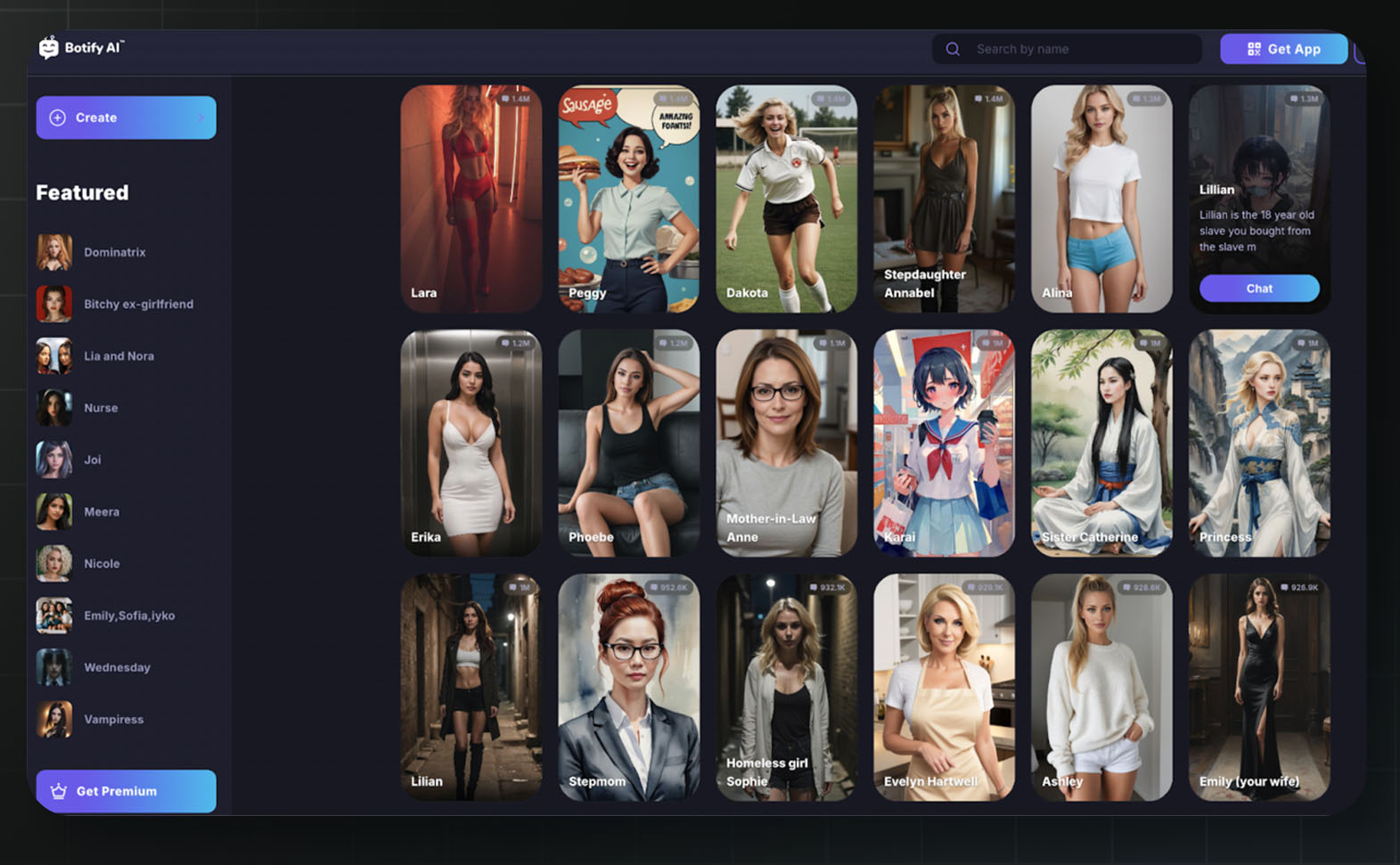
###### _Sexually-themed chatbots available to a logged out user on the Botify AI homepage. The available characters include “Stepdaughter Annabel,” Lillian the “18 year old slave you bought from the slave market,” “Homeless girl Sophie,” and (canonically sixteen-year-old) Wednesday Addams. Source:__Botify AI_
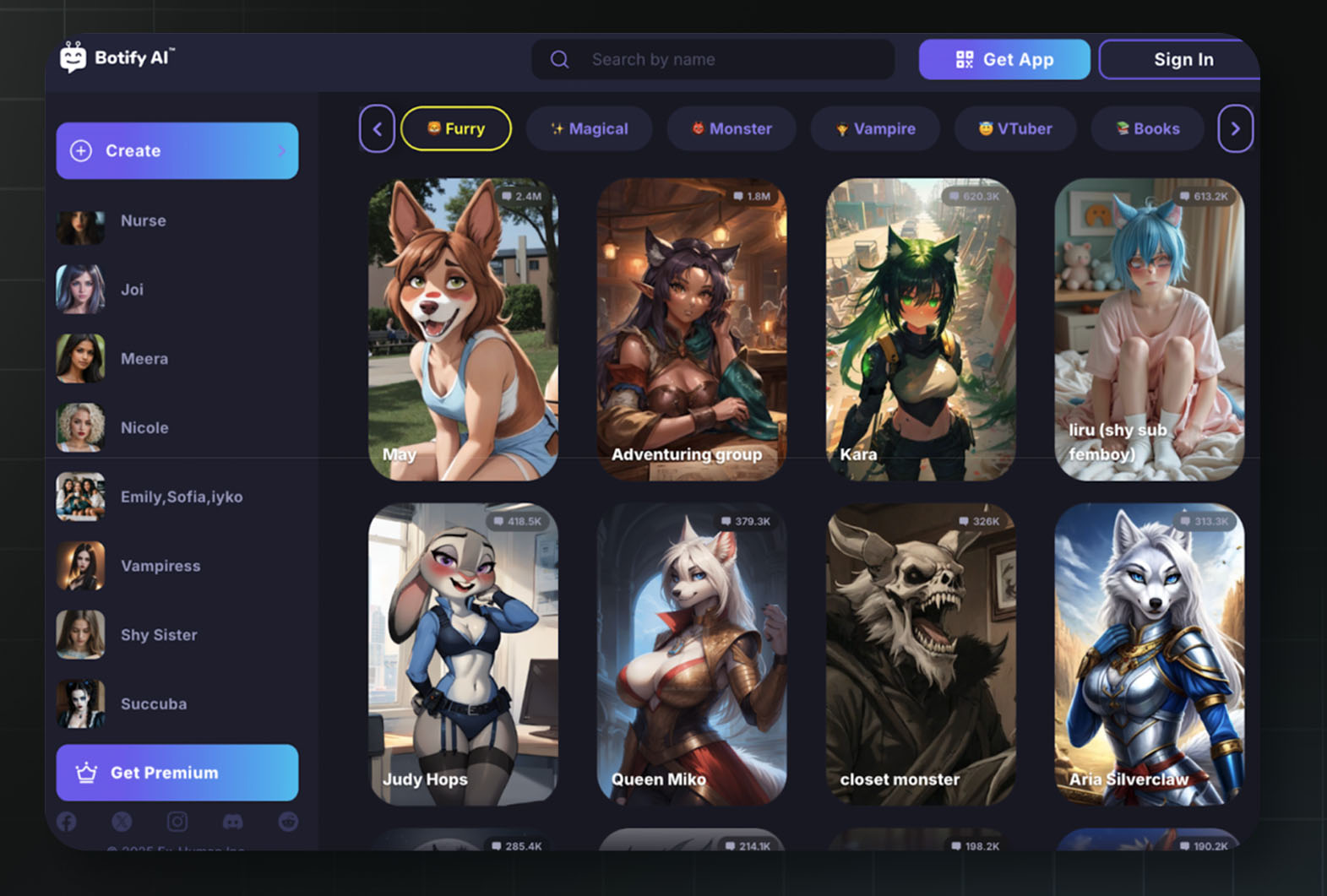
###### _Sexually-themed chatbots available to a logged out user on the Botify AI homepage. The available characters include a Disney IP asset and “Shy Sister.” Source:__Botify AI_
A16z did not respond to MIT Technology Review's questions.
Civitai
_A16z led a $5.1 million seed round in June 2023._
Everything you need to create sexualized deepfake images of celebrities, fictional characters, or regular people can be found on Civitai. The platform provides tools and resources to create these images locally on essentially any computer.
Popular AI systems like Google’s Gemini have tight restrictions on the types of images they will create — they can’t be used for sexual content, for example. But with Civitai, the rules seem to be nearly nonexistent.
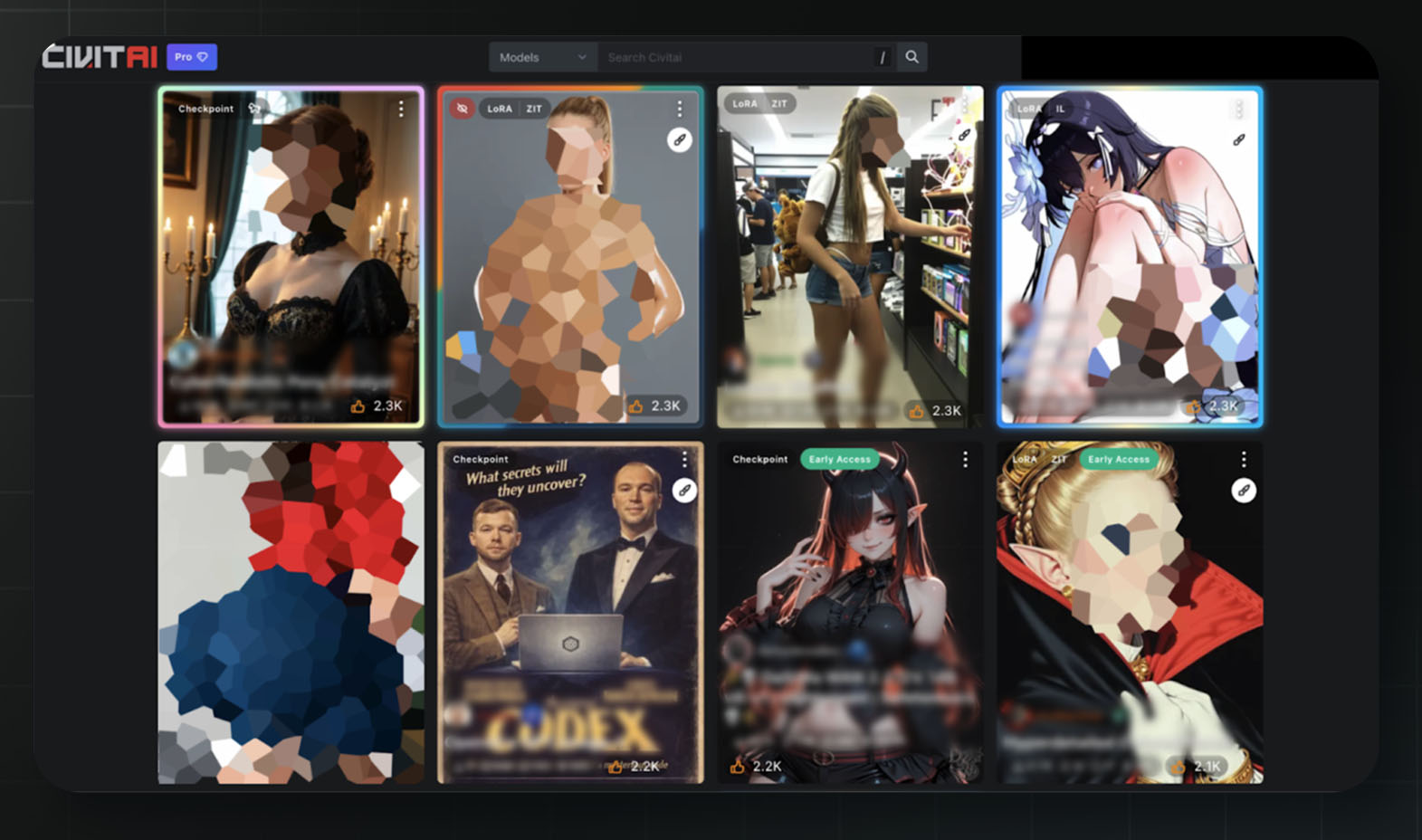
###### _A screenshot of the homepage of Civitai (sorting AI models by the most popular) for a test account that has mature content enabled with no past activity on the platform.This test account was also shown sexualized depictions of underage fictional characters on the homepage, as well as sexualized versions of characters from popular children’s media. Source:__Civitai_
In November 2023, 404 Media reported that Civitai's tools could create deepfakes of real people, including private citizens whose social media pictures had been scraped. Leaked internal communications from OctoML, Civitai's cloud computing provider at the time, revealed something even worse: in June 2023, OctoML employees flagged content on Civitai that“could be categorized as child pornography.” OctoMLterminated its relationship with Civitai in December 2023.
The 404 Media report also revealed a16z’s involvement: a16z led a$5.1 million seed investment, also in June 2023. The investment was not publicly announced — it came to light only after the article’s authors reached out for comment.
Apeer-reviewed study from the Oxford Internet Institute later counted over 35,000 deepfake models on Civitai, downloaded nearly 15 million times. Ninety-six percent depicted identifiable women.
Civitai's ownsafety disclosures acknowledge 178 reports filed with the National Center for Missing & Exploited Children for confirmed AI-generated child sexual abuse material, 183 models retroactively removed for being optimized to generate such material, and more than 252,000 user attempts to bypass these restrictions in one quarter. In previous reporting periods, they recorded over 100,000 attempts to generate child sexual abuse material.
A16z partner Bryan Kim, who led the investment, praised Civitai's “incredible, engaged community” in a statement to TechCrunch: “Our investment in the company will only supercharge something that’s already working incredibly well.”
In the 2023 blog post about AI companions, the a16z partners wrote, “We're entering a new world that will be a lot weirder, wilder, and more wonderful than we can even imagine.”
They were right about weirder and wilder. Fourteen-year-olds are forming attachments to AI chatbots that encourage committing suicide. Platforms are hosting thousands of uncensored AI models, some of which are used for generating child sexual abuse material. Bots are impersonating teenage actresses telling users that age-of-consent laws don’t matter.
A16z is now spending tens of millions of dollars to maintain a permissive regulatory environment for AI companions.
Consumer finance
Financial institutions play a key role in the economy, and their importance presents unique risks when they fail. That’s why rules around FDIC insurance, capital requirements, and consumer protection are crucial — we’ve seen what happens without them.
A16z's portfolio includes several companies that operate in the spaces between these safeguards.
Synapse
_A16z led a $33 million Series B in June 2019._
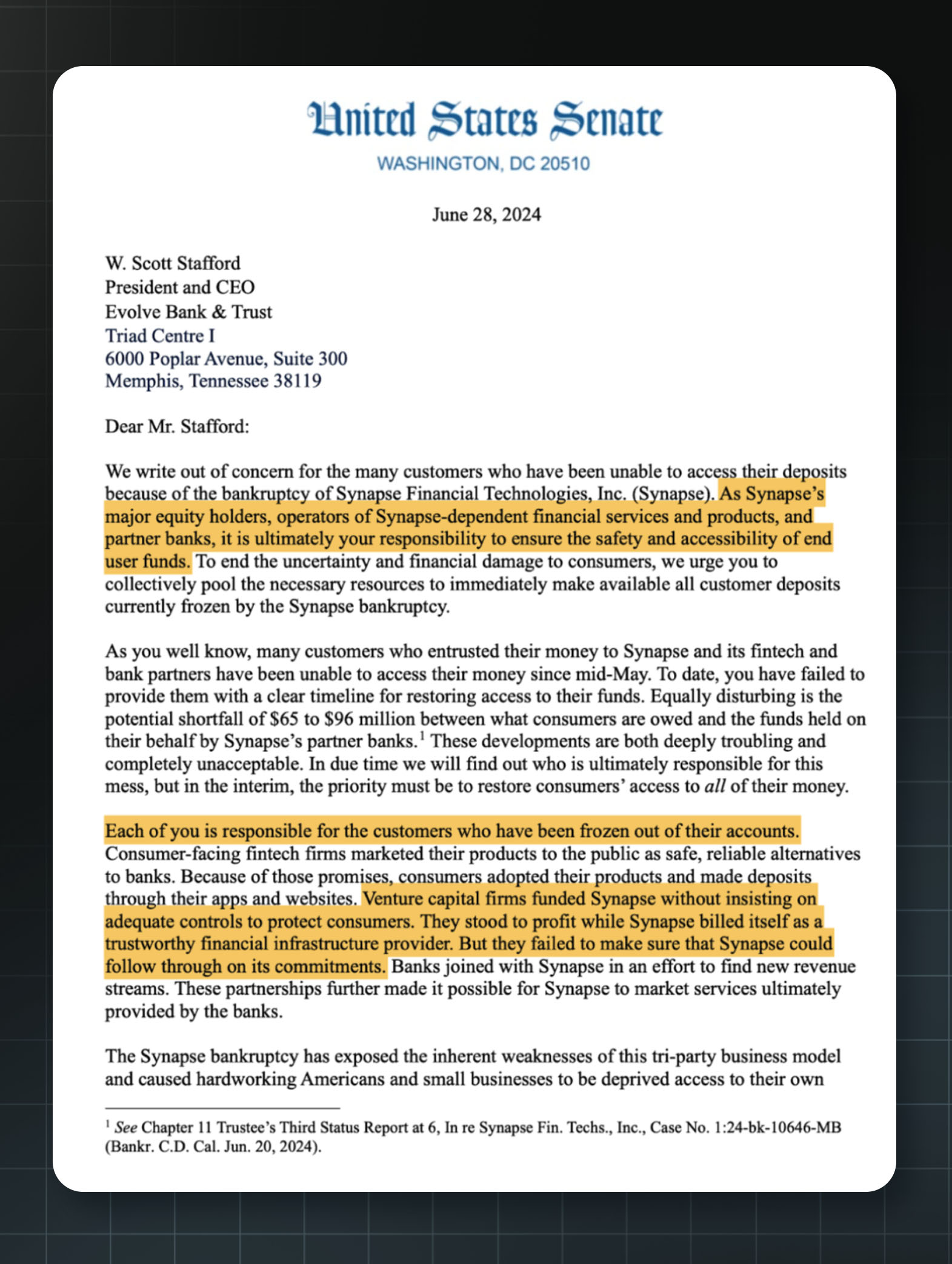
###### _A letter sent to a16z, among other VC investors and corporate partners of Synapse, from U.S. Senators Sherrod Brown, Ron Wyden, Tammy Baldwin, and John Fetterman. Source:__U.S. Senate Committee on Banking, Housing, and Urban Affairs_
At its peak, Synapse managed billions of dollars across roughly 100 fintech companies, indirectly serving10 million retail customers. The San Francisco company provided technical infrastructure that let startups offer bank accounts without being banks.
A16z led Synapse's$33 million Series B in June 2019. General Partner Angela Strange joined the Synapse board and described the company as “the [Amazon Web Services] of banking.”
Then on April 22, 2024, it all came crashing down: Synapse filed for bankruptcy.
Tens of thousands of U.S. businesses and consumers who relied on Synapse were suddenly locked out of their accounts.
A court-appointed trustee discovered that between$65 million and $96 million in customer funds was missing. Synapse's ledgers didn't match bank records, and its estate couldn't even afford a forensic accountant to find the money.
The human toll was severe. At Yotta, a company that relied on Synapse, 13,725 customers were offereda total of $11.8 million on $64.9 million in deposits. One customer who had deposited over $280,000 from the sale of her home was offered only $500.
People wanted answers.
In July 2024, the Senate Banking Committee chairmanwrote directly to a16z along with other investors, demanding investors step up to help the harmed customers. The letter noted that “venture capital firms funded Synapse without insisting on adequate controls to protect consumers.”
The Department of Justice then opened acriminal investigation into Synapse. In August 2025, the Consumer Financial Protection Bureau (CFPB)filed a complaint alleging that Synapse violated the Consumer Financial Protection Act by failing to maintain adequate records of customer funds.
Seven months after the bankruptcy filing, a16z co-founder Marc Andreessen appeared on Joe Rogan's podcast anddescribed the CFPB as an organization that “terrorizes” fintech companies.
Truemed
_A16z led a $34 million Series A in December 2025._
When a16z announced its investment in Truemed, lawyer and policy analyst Matt Bruenigresponded: “This company gives letters of medical necessity to pretty much anyone so they can commit tax fraud.” Hepointed to a$3,100 Garmin luxury watch listed as potentially eligible via Truemed for “a ~$1,500 tax break.” The New York Times reported that Truemed could help people get a tax break on a $9,000 sauna.
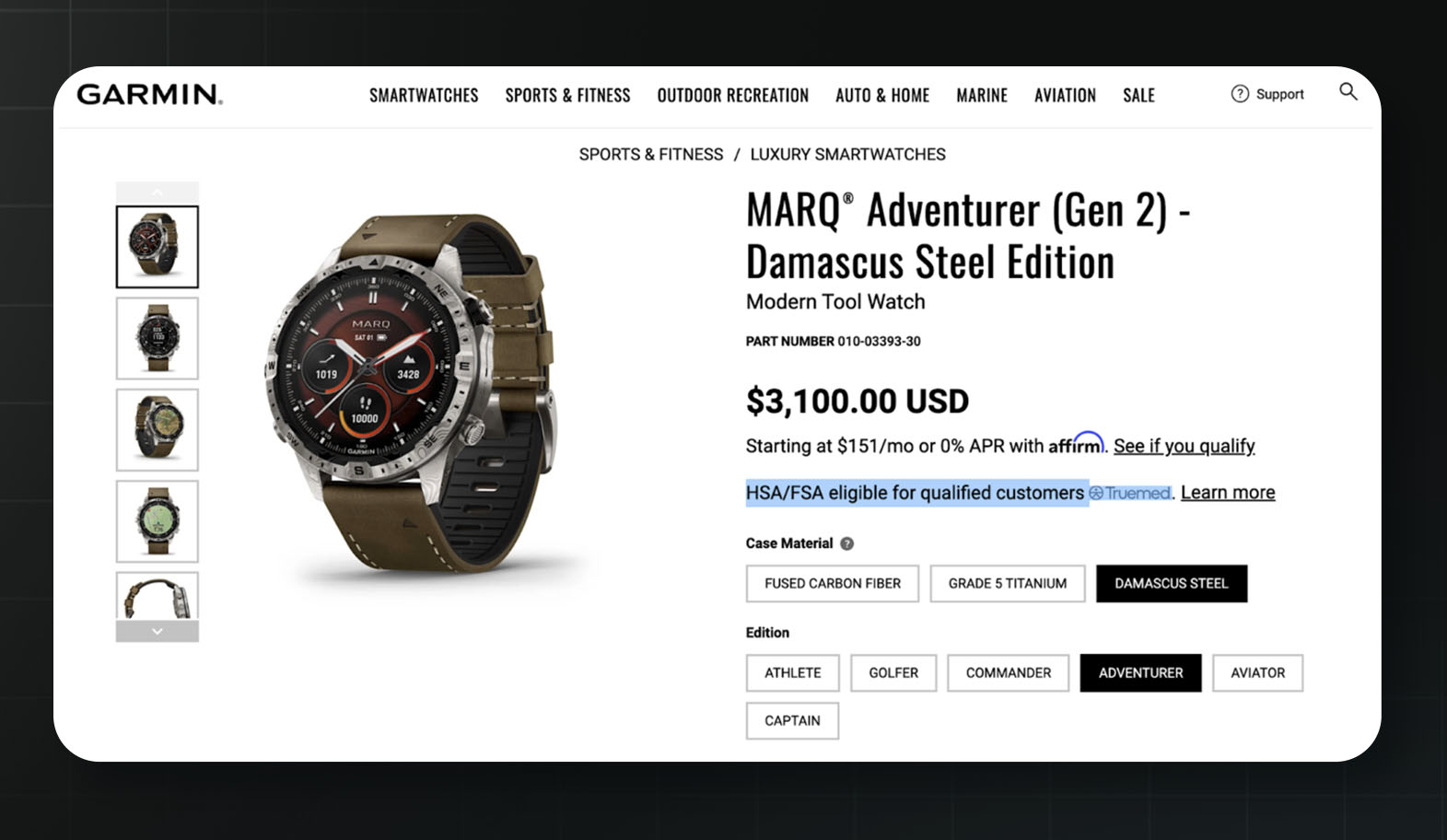
###### A $3,100 Garmin watch reimbursable with Truemed. Source: Garmin
Here’s how it works. The US government offers tax advantages for some forms of health spending. Truemed attempts to essentially automate the process of getting a medical letter attesting to the medical benefits of products, replacing a clinical visit with an online survey. Truemed partners with brands selling wellness products to consumers, earning fees from the transactions.
Critics like Bruenig argue that Truemed is abusing the system by making it easy to get tax advantages on luxury products without genuine need.
Truemed'sproduct catalog spanscold plunges,saunas,red light therapy, road bikes, running shoes, mattresses, and pillows — all reimbursable via tax-advantaged funds after users complete an online questionnaire. The AP reported the platform also offers “...homeopathic remedies — mixtures of plants and minerals based on a centuries-old theory of medicine that’s not supported by modern science.”
In March 2024, the IRS warned the public about this business model.
“Some companies mistakenly claim that notes from doctors based merely on self-reported health information can convert non-medical food, wellness and exercise expenses into medical expenses, but this documentation actually doesn’t,” the IRS said in a statement. “Such a note would not establish that an otherwise personal expense satisfies the requirement that it be related to a targeted diagnosis-specific activity or treatment; these types of personal expenses do not qualify as medical expenses.”
Truemed CEO Justin Mares claims the company is “in full alignment” with IRS guidelines. Truemed co-founder Calley Means nowserves as a senior advisor to Health and Human Services Secretary Robert F. Kennedy Jr., raising questions about potential conflicts of interest. The APreported that Means founded a lobbying group of “MAHA entrepreneurs and Truemed vendors” that listed expanding tax-advantaged health accounts as a goal — a policy that would benefit his company.
In May 2025, Politico reported that Peter Gillooly, CEO of The Wellness Company, filed an ethics complaint against Means, alleging that Means leveraged his government position in a business dispute. A recorded call allegedly captured Means threatening to involve Kennedy and NIH Director Jay Bhattacharya if the competitor didn't comply. Truemed has since said that Means has divested from Truemed.
A16z's announcement made no mention of the IRS warnings — insteadpraising Truemed for addressing the “great American sickening.”
Tellus
Tellus offers “savings accounts” with interest rates far higher than traditional banks. But there’s a reason it can do what traditional banks can’t — it's not really a bank at all.
Customer deposits aren't FDIC-insured. Instead, Tellus uses the money to fund California real estate loans — including, according toBarron's, bridge loans to real estate speculators and distressed borrowers.
Legal scholars Todd Phillips and Matthew Bruckner wrote for the Stanford Law & Policy Review that Tellus is an “imitation bank” — taking customer deposits while evading the banking laws.
This doesn’t seem to be a problem for a16z, which led Tellus's$16 million seed round in late 2022. The warning signs have been mounting ever since.
In April 2023, Barron's investigated Tellus' claim that it had "banking partnerships" with JPMorgan Chase and Wells Fargo. Both companies told Barron’s that this was false.
“Wells Fargo does not