How The World Cup Builds Nations
_Nominal News is an economics newsletter written by a PhD Economist that translates the latest economic research into clear, policy‑relevant insights on current issues. Join 4,000 readers to stay-up-to-date with Nominal News directly in your inbox:_
We’re in the midst of the 2026 World Cup, with the first matches of the round of 32 now being played. As football fans worldwide know, the World Cup is an emotional event, with victories bringing immense joy to countries. I got to experience it first hand on the streets of New York – during a recent Egypt victory, the streets in Astoria erupted with celebrations. But, it turns out that the impact of football games may be more than just short-lived celebratory moments. Winning football matches may help with reducing ethnic tensions and boosting nationhood within countries.
Football has been anecdotally known to unite nations – the qualification of Ivory Coast to the 2006 World Cup is considered to be one of the reasons the First Ivorian Civil War came to an end. Depetris-Chauvin, Durante and Campante (2020) (“**DDC**”) decided to investigate how the performance of national teams in sub-Saharan Africa impacted citizens’ perspectives on ethnicities within their country and how it impacted ethnic violence.
##### Ethnic Perceptions Data
To look at the ethnic perceptions within the sub-Saharan countries, DDC used the Afrobarometer, which is a set of nationally representative surveys covering many African countries. The Afrobarometer is conducted in local languages and includes various questions on attitudes towards democracy, political actors, markets, and civil society. The questions DDC focused on asked about the individual’s identification towards the nation compared to their own ethnic group. To give an example of how attitudes change over time over ethnic vs. national identification, DDC showed the graph below:
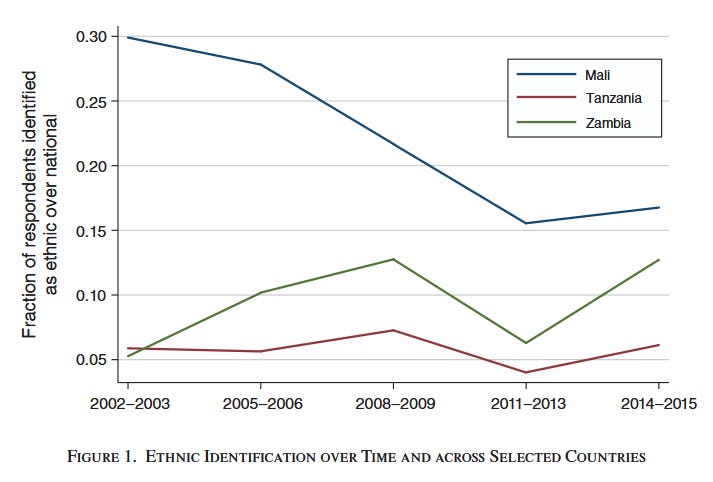
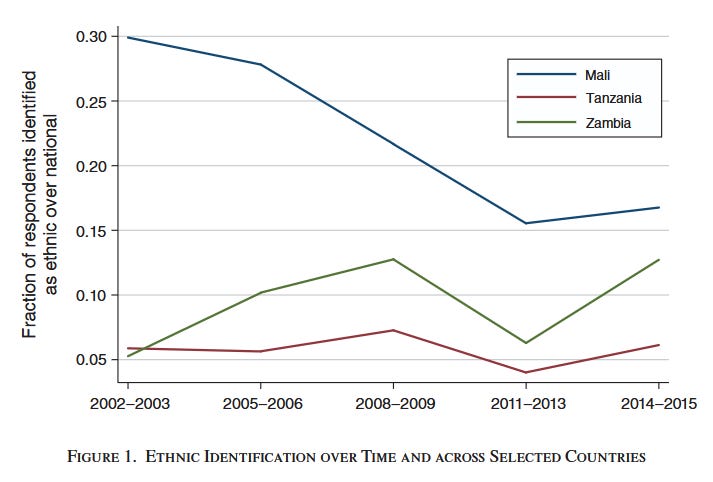
The graph shows the fraction of people that identified more closely with their ethnicity than their nationality. In 2002, 30% of Malians identified themselves based on their ethnicity rather than the Malian nationality. Interestingly, the share dropped in 2013, when Mali achieved their highest finish in the African Cup of Nations (AFCON). Similarly, Zambia saw a drop in ethnic identification when they won the AFCON in 2012.
##### Football Matches Data
The main matches looked at by DDC involved games related to the African Cup of Nations (AFCON), the main African tournament, and the World Cup. To study the impact of matches on people’s identification, DDC looked at situations when the Afrobarometer interviews, by coincidence, were conducted between 15 days before or 15 days after one of these matches.
##### Results
If a person was interviewed after a victory of their national team, **the individual was 5.3 percentage points less likely to state a strong sense of ethnic identity** than a similar person (an individual of the same language group) that was interviewed in the 15 day window before the victory. This is a 37 percent reduction in the average probability of identifying as ethnic rather than as a national. Interestingly, if the national team drew or lost the game, there was no difference in ethnic identification. DDC conducted several other tests with the following results:
- Defeating a ‘traditional’ rival further reduced ethnic identification;
- Whether the match was played at home or away did not matter;
- A victory in a friendly match did not matter;
- Larger victories did not matter;
- The total number of goals in the game did not matter;
- If the composition of the winning national team was more diverse, ethnic identification was reduced.
This last point suggests that team diversity in itself can be an important determinant of national unity.
##### Reduced Interethnic Tensions
The above results focused on self-identification. So how did perceptions of others change? The Afrobarometer asked questions about trust in others within your country. **DDC found that trust in fellow countrymen increased by 6.3 percentage points**after a win of their national team. Even more promisingly, trust in people of other ethnicities in the country goes up by even more – by around 14 percentage points. This is a 30 percent increase in interethnic trust.
##### Hostility to Others?
The above evidence suggests that winning matches has real impacts on national unity, as people view other ethnicities more positively, and self-identify with the nation more than their own ethnicity. But could this positivity be driven by increased hostility to foreigners? Turns out, probably not. The Afrobarometer also asked questions about attitudes towards foreigners and neighboring countries. DDC found that although their estimate suggests an increase in dislike to foreigners, it was not statistically significant.
Does this increased national unity translate into reduced violence? DDC looked at two groups of countries – those that just qualified for AFCON and those that just missed out. Below is an example of such a situation:
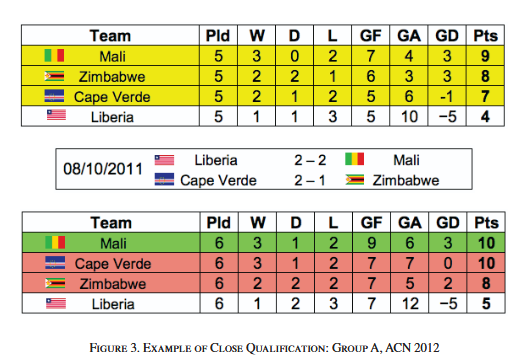
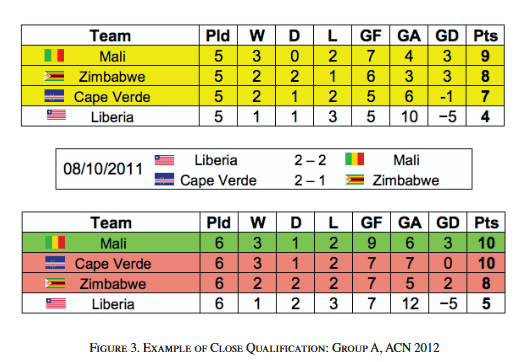
Prior to the final round of games, Mali, Zimbabwe and Cape Verde could qualify. After the final round of games – Mali _just_ qualified, while Zimbabwe did not qualify and Cape Verde _just_ failed to qualify (on goal difference).
The effect of just qualifying is quite sizable – **countries that just qualify for the AFCON experience an 8.6 percent fall in the number of conflict episodes**(any reported civil battles, riots, or killings) compared to countries that just failed to qualify. Moreover, this effect is long lasting – even 25 weeks after the victory, the number of conflicts is lower.
One could argue that these above findings are really just capturing general happiness from a win, and that there is no specific change regarding ethnic and national identity. Using the Afrobarometer, DDC found that football victories did not impact one’s perception of how the country was doing economically, whether one’s life will get better or whether they perceive their current living conditions as better. This suggests that football victories did not make people generally more optimistic.
More importantly, football victories also did not improve people’s perception of their current government. We often hear that sports may be used to build political support, but the work by DDC suggests this is not true.
The research by DDC shows that football victories can increase national unity and reduce ethnic tensions. This is especially true in countries that have weaker ‘state-presence’ (i.e. countries where there is less public infrastructure like roads, hospitals, or public schools). On the other hand, in countries with strong ‘state-presence’, football victories do not impact national unity much (as often, unity is already high).
Investment in sport in low state-presence countries can be a good way to build national unity, especially if the team itself has diverse ethnicities. Football, and sport more broadly, may seem like just entertainment, but the impacts on nationhood are real. With quite a few sub-Saharan teams in this year’s World Cup performing well, we may get to witness some positive spillovers in these countries.
Let me know in the comments below how you view the role of national sports teams. Have you seen changes in ethnic perspectives after sports accomplishments?
I hope that today’s article also shows the breadth of topics studied by economics and how economic methods can be applied to unconventional questions. The idea of looking at already gathered survey responses that overlapped with football matches is quite ingenious. Some might say that this topic is ‘not economics’, but as I have tried to demonstrate, economics is really the study of human behavior and decision making.
_If you would like to support us in reaching our subscriber goal of 7,000 subscribers, please consider sharing this article and pressing the like❤️ button at top or bottom of this article!_
1. Note:
2. Fixed-Rate Mortgages Are Rent Control for Homeowners – Mike Fellman explains how long tenor mortgages are similar to rent-control, which can lead to a distorted housing market. But it is something few are willing to talk about.
3. Kevin Warsh’s Press Conference Collides Into 30 Years of Michael Woodford – Mike Konczal discusses the recent press conference and thoughts of Kevin Warsh, and why his new monetary policy ideas may be a bit contradictory.