Daisugi, the 600-Year-Old Japanese Technique of Growing Trees Out of Other Trees, Creating Perfectly Straight Lumber
[](https://www.openculture.com/)
[](https://www.openculture.com/)
- [Online Courses](https://www.openculture.com/freeonlinecourses "Online Courses")
- [Audio Books](https://www.openculture.com/freeaudiobooks "Audio Books")
- [Movies](https://www.openculture.com/freemoviesonline "Movies")
- [Podcasts](https://www.openculture.com/great-podcasts "Podcasts")
- [K-12](https://www.openculture.com/free_k-12_educational_resources "K-12 Resources")
- [eBooks](https://www.openculture.com/free_ebooks "eBooks")
- [Languages](https://www.openculture.com/freelanguagelessons "Language Lessons")
- [Donate](https://www.openculture.com/help-fund-open-culture "Donate")
*
- [](https://www.openculture.com/contact "Contact Us")
- [](https://www.openculture.com/feed/rss2 "Subscribe to Our RSS Feed")
- [](https://twitter.com/openculture "Follow Open Culture on Twitter")
- [](https://www.facebook.com/openculture "Follow us on Facebook")
*
[Daisugi, the 600-Year-Old Japanese Technique of Growing Trees Out of Other Trees, Creating Perfectly Straight Lumber](https://www.openculture.com/2020/10/daisugi.html "Permanent Link to Daisugi, the 600-Year-Old Japanese Technique of Growing Trees Out of Other Trees, Creating Perfectly Straight Lumber")
in _Architecture, History, Nature_ | October 23rd, 2020 12 Comments
[Bluesky](https://www.openculture.com/#bluesky "Bluesky")[Facebook](https://www.openculture.com/#facebook "Facebook")[Threads](https://www.openculture.com/#threads "Threads")[Mastodon](https://www.openculture.com/#mastodon "Mastodon")[Reddit](https://www.openculture.com/#reddit "Reddit")[Message](https://www.openculture.com/#sms "Message")[Email](https://www.openculture.com/#email "Email")Share
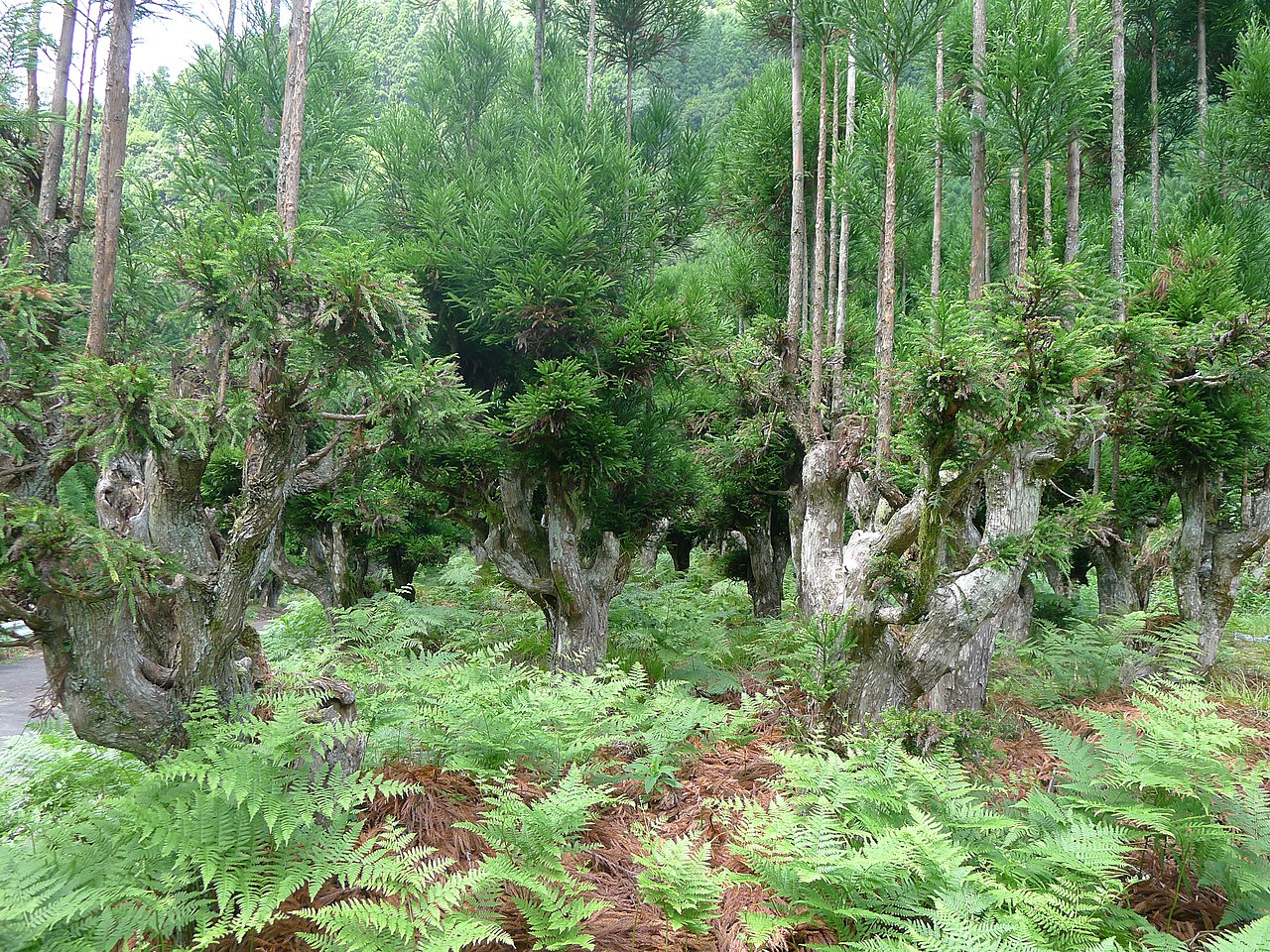
_Image by Indiana Jo, via Wikimedia Commons_

We’ve all admired the elegance of Japan’s traditional styles of architecture. Their development required the kind of dedicated craftsmanship that takes generations to cultivate — but also, more practically speaking, no small amount of wood. By the 15th century, Japan already faced a shortage of seedlings, as well as land on which to properly cultivate the trees in the first place. Necessity being the mother of invention, this led to the creation of an ingenious solution: _daisugi_, the growing of additional trees, in effect, out of existing trees — creating, in other words, a kind of giant bonsai.
“Written as 台杉 and literally meaning _platform cedar_, the technique resulted in a tree that resembled an open palm with multiple trees growing out if it, perfectly vertical,” writes Spoon and Tamago’s Johnny Waldman. “Done right, the technique can prevent deforestation and result in perfectly round and straight timber known as _taruki_, which are used in the roofs of Japanese teahouses.”
These teahouses are still prominent in Kyoto, a city still known for its traditional cultural heritage, and not coincidentally where _daisugi_ first developed. “It’s said that it was Kyoto’s preeminent tea master, Sen-no-rikyu, who demanded perfection in the Kitayama cedar during the 16th century,” writes My Modern Met’s Jessica Stewart.
At the time “a form of very straight and stylized _sukiya-zukuri_ architecture was high fashion, but there simply weren’t nearly enough raw materials to build these homes for every noble or samurai who wanted one,” says a thread by Twitter account Wrath of Gnon, which includes these and other photos of _daisugi_ in action. “Hence this clever solution of using bonsai techniques on trees.” Aesthetics aside — as far aside as they ever get in Japan, at any rate — “the lumber produced in this method is 140% as flexible as standard cedar and 200% as dense/strong,” making it “absolutely perfect for rafters and roof timber.” And not only is _daisugi_’s product straight, slender, and typhoon-resistant, it’s marveled at around the world 600 years later. Of how many forestry techniques can we say the same?
**Related Content:**
The Art & Philosophy of Bonsai
[This 392-Year-Old Bonsai Tree Survived the Hiroshima Atomic Blast & Still Flourishes Today: The Power of Resilience](http://www.openculture.com/2017/02/this-392-year-old-bonsai-tree-survived-the-hiroshima-atomic-blast-still-flourishes-today.html)
[The Social Lives of Trees: Science Reveals How Trees Mysteriously Talk to Each Other, Work Together & Form Nurturing Families](http://www.openculture.com/2017/10/the-social-lives-of-trees.html)
_Based in Seoul,Colin Marshallwrites and broadcasts on cities, language, and culture. His projects include the Substack newsletter_Books on Cities,_the book_ The Stateless City: a Walk through 21st-Century Los Angeles _and the video series_The City in Cinema_. Follow him on Twitter at@colinmarshall, onFacebook, or onInstagram._
[Bluesky](https://www.openculture.com/#bluesky "Bluesky")[Facebook](https://www.openculture.com/#facebook "Facebook")[Threads](https://www.openculture.com/#threads "Threads")[Mastodon](https://www.openculture.com/#mastodon "Mastodon")[Reddit](https://www.openculture.com/#reddit "Reddit")[Message](https://www.openculture.com/#sms "Message")[Email](https://www.openculture.com/#email "Email")Share
by Colin Marshall | [Permalink](https://www.openculture.com/2020/10/daisugi.html "Permalink") | Comments (12) |
**Support Open Culture**
We’re hoping to rely on our loyal readers rather than erratic ads. To support Open Culture’s educational mission, please consider making a donation. We accept PayPal, Venmo (@openculture), Patreon and Crypto! Please find all options here. We thank you! 

##### Comments (12) You can skip to the end and leave a response. Pinging is currently not allowed.
[](https://www.openculture.com/2020/10/daisugi.html)* [](https://www.openculture.com/2020/10/daisugi.html)David Tracey says:[](https://www.openculture.com/2020/10/daisugi.html)October 24, 2020 at 10:55 am Interesting take but I’m not buying.
Yes trees can be pruned to affect future growth, but not to change their genetic dispositions to be tall or straight or whatever. You can keep pruning for some ongoing desired effect, as I suspect the trees in these pics have been to remove all branches up to the highest level of the canopy. I suppose that could help in ensuring a smooth and straight trunk. But calling something a “giant bonsai” is a puzzler. Isn’t that another word for “tree”?
Also it seemed odd to try to grow trees this tall on the weak support of branches as seen in the top picture. Comparing the two pics made me think all the more we’re being fed some guff. Look at the trunks in the two pics to see what I mean.
Anyway, just some random first impressions with zero research so if I’m wrong, sorry. I hope the writer continues to find and report on interesting international tree news — always a worthy topic.
- sdaf says: October 24, 2020 at 10:53 pm
It does seem a little bit too perfect, why would the trees grow straight just because they are on other trees?
- cm83 says: October 27, 2020 at 10:51 am
This require a lot of work. You need to carefully prune them every two years (so you can remove all the knots in the wood) for twenty years.
Here’s your giant bonsai
- Ivo says: October 30, 2020 at 5:56 pm
Also known as ‘coppicing’ in the West, a common practise … it’s not that unusual!
- Tamsin says: August 13, 2021 at 5:27 am
As Ivo says this is a standard woodland management technique, called coppicing in the west, which has been practiced for hundreds of years to do exactly this — produce straight usable pole size timber which can be harvested over and over again, on a 5 — 15 year rotation time scale, without having to fell the original tree from which the ‘poles’ grow.
In my experience its practiced on broadleaf species including commonly hazel, alder, willow, chestnut, ash, and sometimes oak.
It’s fallen out of wide scale use sadly with the rise of destructive industrial scale commercial forestry, but is re-emerging as a good sustainable way of managing woodland.
I’ve never seen it done on a conifer and it looks fascinating.
There’s no magic to ‘buy’! or anything too ‘perfect’ about it — its just what nature does! And its got nothing to do with altering the trees genetics!
Prune an apple tree and see what happens — it throws up water shoots — exactly the same reaction by the tree.
- Sainath Pawar says: March 27, 2022 at 5:39 am
This is great technique . The technique shuuld be impliments in India. Thise type of knowledge should be addded in our school and college syllabus and should implement on it . I am trying my best to implement this technique in my nation INDIA 💯💯
- Sylvia says: March 29, 2022 at 2:19 am
Your comment tells me that you know little about the history of Japan and their well known competition with nature. If you have seen any Bonsai, that is the work of the Japanese. I have been to commercial orchards and often go for the harvest, a have picked an apple weighing 700gramms and had peaches just short of 1kg
Please do more research
https://www.openculture.com/2020/10/daisugi.html
- Ray Theron says: June 13, 2023 at 6:51 pm
Considering that 67% of Japan’s land surface is even today covered by forests and plantations, and given that Hinoki, Sugi and red pine naturally tend to grow straight and tall, there is no need for daisugi. Not only is it unnecessarily time consuming when there are MILLIONS of normally growing trees available, but it will not produce nearly enough timber. I lived in rural Japan and close to my village there were virtually impenetrable hinoki forests used by two sawmills in the village, sawmills that had been in operation for many generations.
As for the notion that the Japanese are “in competition with Nature”, that’s an idea inimical to the Japanese: they live in HARMONY with nature, not in competition with it.
- Margo says:!Image 7 **The Real Person Badge!**Verified as a real person and not a bot. The comment was approved without pre-moderation. Anti-Spam by CleanTalk July 25, 2024 at 4:31 am

You’re an idiot
- Mrs Jane Pye says:!Image 8 **The Real Person Badge!**Verified as a real person and not a bot. The comment was approved without pre-moderation. Anti-Spam by CleanTalk March 24, 2025 at 1:00 am
In Australia the Indigenous semi- nomadic people grew trees in other trees in semi- arid zones — strange but true. Google scartrees. com .au & go to the Trees in Trees archive
- jb says:!Image 9 **The Real Person Badge!**Verified as a real person and not a bot. The comment was approved without pre-moderation. Anti-Spam by CleanTalk June 28, 2026 at 2:38 pm
> with zero research
Making your comments completely worthless.
The new growth are suckers, which grow straight toward the sun.
- Elisa says:!Image 10 **The Real Person Badge!**Verified as a real person and not a bot. The comment was approved without pre-moderation. Anti-Spam by CleanTalk June 29, 2026 at 12:16 am
Daisugi is the ultimate historical example of regenerative design. Instead of clear-cutting forests and waiting decades for a new ecosystem to crawl back, this technique creates a permanent, living timber factory. The fact that the resulting taruki wood is denser, more flexible, and highly typhoon-resistant just proves that ecological harmony doesn’t mean compromising on structural quality. We have so much to relearn from ancestral engineering. houstonmobilemechanic.net
Leave a Reply
Name (required)
Email (required)
Message
- ## Essentials
- 100+ Online Degree & Mini-Degree Programs
- ## Support Us
We're hoping to rely on loyal readers, rather than erratic ads. Please click the Donate button and support Open Culture. You can use Paypal, Venmo, Patreon, even Crypto! We thank you!
 *
Free Courses
- Biology
- Business
- History
- Math
- Physics
- Religion
*
Free Movies
*
Free Language Lessons
- Arabic
- Chinese
- English
- French
- German
- Italian
- Russian
- Spanish
*
Free eBooks
- David Foster Wallace Stories & Essays
- Great Gatsby & Other Fitzgerald Novels
- Gabriel Garcia Marquez Stories
- Chomsky
*
Free Audio Books
- Free Audio Books: Non-Fiction
*
Free Textbooks
- Free Computer Science Textbooks
*
K-12 Resources
*
Free Art & Images
- The Met
- The Tate
- New York Public Library Maps
- Van Gogh
*
Free Music
- 80,000 Classical Music Scores
- 9,000 Grateful Dead Concerts
- Alan Lomax Blues & Folk Archive
*
Writing Tips
*
Archive
*
Personal Finance
- ## Categories
- Apple
- Archives
- Art
- Biology
- Books
- Business
- Comedy
- Dance
- Data
- Deals
- Design
- e-books
- Fashion
- Film
- Finance
- Games
- Gender
- Harvard
- Health
- History
- iPad
- iPhone
- Jazz
- K-12
- Language
- Law
- Letters
- Life
- Maps
- Math
- Media
- MIT
- MOOCs
- Museums
- Music
- Nature
- Opera
- Physics
- Podcasts
- Poetry
- Politics
- Radio
- Random
- Religion
- Sci Fi
- Science
- Software
- Sports
- Stanford
- Theatre
- Travel
- Web/Tech
- Writing
- Yale
- YouTube
- [Bluesky](https://www.openculture.com/#bluesky "Bluesky")[Facebook](https://www.openculture.com/#facebook "Facebook")[Threads](https://www.openculture.com/#threads "Threads")[Mastodon](https://www.openculture.com/#mastodon "Mastodon")[Reddit](https://www.openculture.com/#reddit "Reddit")[Message](https://www.openculture.com/#sms "Message")[Email](https://www.openculture.com/#email "Email")Share
*
- ## Great Lectures
- Walter Kaufmann on Existentialism
- ## About Us
!Image 12 Open Culture scours the web for the best educational media. We find the free courses and audio books you need, the language lessons & educational videos you want, and plenty of enlightenment in between.

Great Recordings
- Patti Smith Reads Virginia Woolf
- Fitzgerald Reads Shakespeare
*
Book Lists By
* *
Syllabi
- WH Auden
- Zadie Smith & Gary Shteyngart
*
Favorite Movies
- Kubrick
- Scorsese
- ## Archives
- May 2026
- May 2025
- May 2024
- May 2023
- May 2022
- May 2021
- May 2020
- May 2019
*