Rest of World faces prospect of shutting down

2:16 PM
Thursday October 29, 2026
!Image 2: Open navigation!Image 3: Close navigation


- Home
- Politics
- Business
- Tech
- Energy
- Gulf
- China
- Africa
- Media
- * Events
- Shows 


- * About
- Careers
- Privacy© 2026 Semafor Inc.


- Home
- Politics
- Business
- Tech
- Energy
- Gulf
- China
- Africa
- Media
- EventsEmail BriefingsShows 
Privacy© 2026 Semafor Inc.
- D.C.
- BXL
- Lagos
- Riyadh
- Beijing
- SG
Intelligence for the New World Economy
- D.C.
- BXL
- Lagos


- Riyadh
- Beijing
- SG
2:16 PM
Thursday October 29, 2026
Intelligence for the New World Economy
!Image 16: Open navigation!Image 17: Close navigation
- Home
- Politics
- Business
- Tech
- Energy
- Gulf
- China
- Africa
- Media
- * Events
- Shows 
- * About
- Careers
- Privacy© 2026 Semafor Inc.

- * *
HomePoliticsBusinessTechEnergyGulfChinaAfricaHealthcareMediaCEO SignalSemafor World Economy
- * *
Rest of World faces prospect of shutting down

Media Editor, Semafor
Oct 25, 2026, 9:32pm UTC
Copy link

Screenshot/Rest of World
**Sign up for Semafor Media:**Media’s essential read.Read it now.
Email address Sign Up

The News
The globally-minded tech news startup Rest of World is scrambling to find a new home — or faces the prospect of shutting down.
The six-year-old digital publication has seen the social and web search traffic on which it depends evaporate. This sharp decline has prompted the organization’s founder and primary financial backer, Sophie Schmidt, to explore other options for its future.
In recent months, Schmidt has held conversations with what one person familiar with the situation described as several large institutions about potentially absorbing Rest of World. But while conversations with potential partners are ongoing, the organization is also preparing for a grimmer outcome. Two people familiar with the plans told Semafor that the organization has selected a wind-down date for the publication in late January, a contingency intended to ensure employees receive exit packages and to give them a chance to look for new jobs if they so choose.
Schmidt wrote in an email to donors, in anticipation of this report, that Rest of World will “cease publishing as a standalone entity” at the end of January, according to The New York Times.
Schmidt declined to comment. One person familiar with her thinking told Semafor that while Schmidt is proud of the organization’s staff and journalism, she has privately conceded that the decline in audience has lessened Rest of World’s impact.
AD
Rest of World launched in 2020 with an ambitious goal: to shift Western perspectives by telling global stories about technology often ignored by the mainstream US news outlets. A few months into its launch, Schmidt described the outlet as her “life’s project,” and told The Wall Street Journal that she would commit $60 million to it.
The outlet — initially organized as a nonprofit and funded at first largely by Schmidt, rather than advertising or subscriptions — hired dozens of journalists and built out a fast network of freelancers. Rest of World received some critical acclaim and broke several stories that prompted global policy changes, including its reporting on Uber Eats in South Africa and on mapping in rural Borneo.
But over the last 18 months, its fortunes began to shift.
Around the beginning of the second Trump administration, Rest of World saw a sharp decline in online web traffic, prompting concern from its leadership and a scramble to hold onto its audiences. The organization reprioritized Western readers in an attempt to sharpen its connection with the audience most likely to read its content, and chose to focus coverage on regions it believed remained true to its mission but would more easily appeal to American readers, like China. It began requiring visitors to register with the site in order to read articles.
AD
None of the moves seemed to stop the publication from hemorrhaging readership.
Insiders cited broad industry-wide online traffic problems plaguing numerous online publishers, including Meta’s decision to deprioritize links to news articles and the rise of chatbots and AI summaries, which have decimated search traffic. It also wasn’t positioned to take advantage of increases in media attention tied to Trump and US politics.
But the organization’s leaders also attributed the decline to a deeper cultural shift to the right within the tech community. One senior leader at the organization said they believe tech news readers who previously expressed liberal values and an appetite for consuming global journalism have grown disillusioned with the news media, and now prefer an information diet of inward-looking podcasts, YouTube shows, and chatbot outputs.

Max’s view
Rest of World’s audience struggles are not unique. Media companies that previously largely produced written content have found themselves scrambling to adapt to a world dominated by short- and long-form video consumption. Many have reacted by retreating, focusing on cultivating niche audiences.
Nowhere is this audience fragmentation clearer than in tech media, which is increasingly dominated by largely sycophantic media outlets owned by the decisionmakers themselves. A new generation of tech news consumers have turned their backs on the likes of Wired and The Verge in favor of self-congratulatory or friendly podcasts, newsletters, and X accounts.
Outlets like Rest of World, that rely on expensive-to-produce stories published somewhat infrequently, have struggled. It is, however, darkly ironic that the news organization launched by the scion of the former Google CEO has fallen victim to the changes Big Tech brought to the internet.
AD
Top Stories
[European Central Bank chief Christine Lagarde to step down !Image 28: European Central Bank Christine Lagarde with shortlisted designs for future euro banknotes. Heiko Becker/Reuters](https://www.semafor.com/article/10/29/2026/european-central-bank-chief-christine-lagarde-to-step-down)
Trump weighs post-midterms Iran operations 
[Upcoming elections put US-Venezuela oil deal at risk !Image 30: Trump speaks at a rally beside the oil tanker that transported Venezuelan crude to Texas. Kevin Lamarque/Reuters](https://www.semafor.com/article/10/29/2026/upcoming-elections-put-us-venezuela-oil-deal-at-risk)
AFL-CIO drafting ‘gold-standard’ AI legislation 
Voters in key states want AI safety measures, poll finds 
Some BP board members favor breakup of $129 billion oil giant 
[Volkswagen reports its worst results in a decade !Image 34: Volkswagen employee at the company’s EV factory in Zwickau, Germany. Lisi Niesner/Reuters](https://www.semafor.com/article/10/29/2026/volkswagen-reports-its-worst-results-in-a-decade)
2028 candidates: What’s your GLP-1 plan? 
The World
at a Glance
Updated 11:08am UTC

European Central Bank chief Christine Lagarde to step down
Updated Oct 29, 2026, 11:07am UTC
Copy link

Heiko Becker/Reuters
The European Central Bank announced on Wednesday that President Christine Lagarde will step down from the job in February, eight months before her tenure was set to end, formalizing a move that had been rumored since the beginning of this year.
The decision sets up a leadership contest at the bank as Europe faces major inflationary pressures, largely sparked by the war in Iran. The ECB is likely to hold interest rates steady today, though a rate hike is expected as early as December.
Lagarde is widely rumored to leave the bank to lead the World Economic Forum — Reuters reported that she could be officially confirmed as early as next month — and has batted away suggestions that she could run for the French presidency.
The bank itself, meanwhile, faces potential pressure from a continent-wide surge in far-right parties: European officials are widely reported to want to appoint her successor and fill other key vacancies before France’s presidential election in April next year, a vote the far-right is expected to win.
AI disillusionment puts regulation at forefront ahead of midterms
Updated Oct 29, 2026, 11:05am UTC
Copy link
!Image 38: ‘AI Regulation’ words and a keyboard in this illustration taken October 19, 2026

Dado Ruvic/Reuters
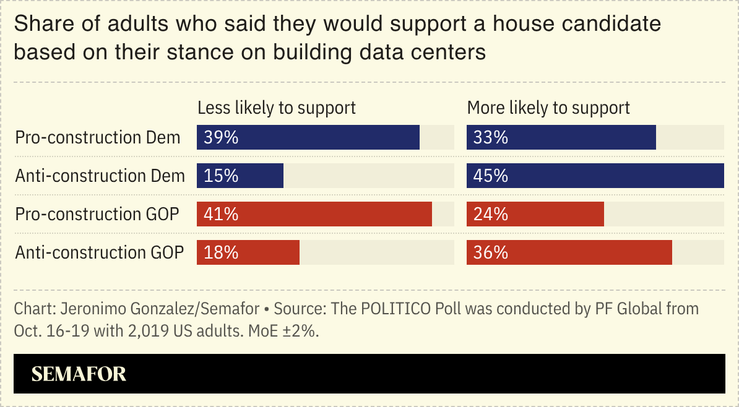
Growing voter disillusionment with AI is driving a regulatory push in the US ahead of midterm elections, though the White House has so far shown little interest. Polling shared first with Semafor found voters preferred “reasonable” safeguards, even if such rules hurt US competitiveness. The Trump administration has so far pursued a laissez-faire approach to AI, despite warnings from some industry leaders that the technology poses an existential risk to humanity.
A regulatory push is nevertheless gathering pace in response to voter frustration: Though support for AI data center construction has recovered somewhat among Republicans, the public writ large remains highly opposed, a recent Heatmap poll found. “The backlash is far-reaching,” a former tech executive told The Wall Street Journal.
!Image 39: A chart showing polling on AI in the US.
AD
US, Gulf states launch fresh diplomatic push to end Iran war
Updated Oct 29, 2026, 11:06am UTC
Copy link
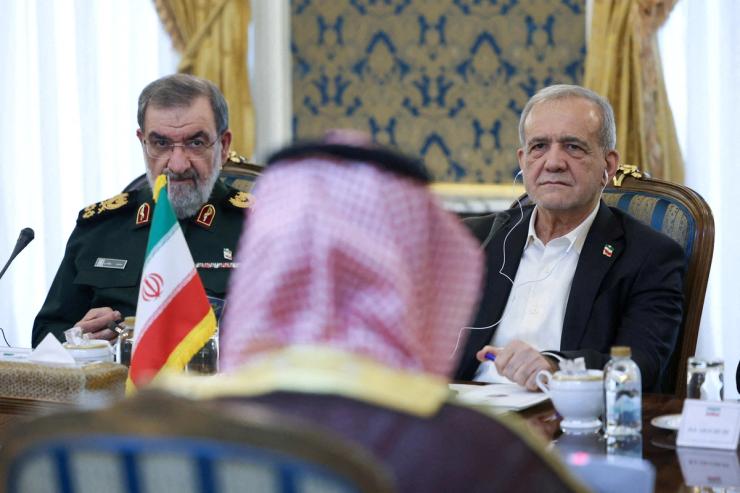
Iranian President Masoud Pezeshkian meets officials from the Mecca Defense Pact. Iran’s Presidential website/WANA/Reuters.
The US and Gulf states launched a renewed diplomatic effort to ward off a resumption of conflict with Iran, though officials cautioned that the push remained fraught with challenges.
The US vice president reportedly wrote to the head of Iran’s top security body to restart truce talks, Gulf states are driving a deal to fully reopen the Strait of Hormuz, and Iran’s foreign minister said Tehran would “give diplomacy a chance.”
Oil prices fell on the news, though they remain far above pre-war levels, and a Trump administration official warned that Washington would resume fighting if negotiations failed: While several members of the White House are skeptical of further strikes, the president is “the one most open,” the official told Semafor.
Russia’s influence in Africa wanes as Moscow summit falls short
Updated Oct 29, 2026, 11:03am UTC
Copy link
!Image 41: Russian President Vladimir Putin alongside African leaders at the Russia-Africa Summit.

Anastasia Barashkova/Reuters
Russian President Vladimir Putin’s efforts to expand his country’s influence in Africa, where China and the US have been vying for power, appear to be falling short. Though the Kremlin agreed to several deals at a summit with African leaders in Moscow — including selling fighter jets to Ethiopia and creating a geological map of Mali — barely 20 leaders attended the meeting out of more than 50 sub-Saharan nations, a sign of how Moscow’s forced recruitment of Africans to fight in its war against Ukraine has damaged its reputation.
Failed defense partnerships with countries in the Sahel have also weakened its regional standing. “Public sentiment toward Russia has begun to sour across many African countries,” Foreign Policy wrote.
!Image 42: A map of Russian influence campaigns in Africa.

AD
Volkswagen reports its worst results in a decade
Updated Oct 29, 2026, 11:11am UTC
Copy link
!Image 43: Volkswagen employee at the company’s EV factory in Zwickau, Germany.

Lisi Niesner/Reuters
Volkswagen reported a bigger-than-expected third-quarter loss, the latest major legacy automaker to be hammered by competition with Chinese rivals both at home and abroad. The disappointing results — its worst in a decade — come after fellow German carmaking giants Mercedes-Benz and BMW cut their earnings outlooks on worsening consumption in China.
Chinese automakers are also grappling with brutal domestic competition and plummeting sales in the world’s second-biggest economy, and as a result are expanding an overseas sales push that is piling further pressure on Western firms. The shifts underline broader global frustration with China’s twin-track economy, with policymakers and executives accusing Chinese firms of hollowing out economies elsewhere. “China is no longer a growth engine,” VW’s China CEO told Handelsblatt.
Fed holds rates steady despite dissents
Updated Oct 28, 2026, 10:07pm UTC
Copy link

Kylie Cooper/Reuters
The Federal Reserve voted to leave interest rates unchanged today as officials seek more information to decide whether additional hikes would be necessary to tame inflation.
Two officials broke from their colleagues, both arguing that the central bank should raise rates by a quarter of a percentage point: Cleveland Fed President Beth Hammack plus Fed Gov. Lisa Cook, who had not previously dissented in a Fed vote.
Chair Kevin Warsh reprised his typically hawkish tone after the announcement, telling reporters that “if you think that we’re tolerating some inflation target somewhere [above 2%], let us disabuse you of it.” He also revealed that the Fed will take one less vote a year beginning in 2027, so officials can “reserve time and space, as an intellectually diverse group, for strategic deliberations.”
The dissents reinforce investor expectations that the Fed will hike rates in December. The Iran war has continued to drive up energy costs, even as other economic indicators paint a more positive picture.
The Trump administration had warned the central bank against hiking rates before next week’s midterm elections. Warsh told reporters Wednesday that “politics played no role in the decision” to hold rates steady. “I just spent two days with my colleagues upstairs; I didn’t hear an utterance about politics,” Warsh said.
Trump recently resurrected his attempt to fire Cook, reviving his allegations she committed mortgage fraud as he continues to lobby for lower rates.
The White House has asked Cook to testify on the mortgage fraud allegations at an unusual private hearing next week. Warsh said, to his knowledge, neither he nor the Fed would be involved in those proceedings.
In response to a question from Semafor, Warsh said the task forces he created may not wrap up their work by the end of the year as promised — and that he would attend a hearing next month by the Fed task force focused on AI.
In a speech last month, Cook highlighted how the AI buildout is fueling inflation but indicated it was mostly contained to the tech industry. At Wednesday’s press conference, Warsh indicated higher interest rates are having a cooling effect on the AI boom as investors push back on tech borrowers.
“What are the implications for the dual mandate?” Warsh said he hoped the AI task force hearing would answer. “Is this going to make it harder or easier for us to achieve price stability over the next several years?”
Google stock falls after earnings miss
Updated Oct 28, 2026, 10:13pm UTC
Copy link

Carlos Jasso/File Photo/Reuters
Alphabet’s stock fell 7% in after-hours trading Wednesday after the company missed profit projections and increased its AI spending past $50 billion in the third quarter.
The resulting cash burn stoked investors’ fears that hyperscalers aren’t generating enough revenue to justify their debt-fueled infrastructure investments.
Meanwhile, Microsoft shares jumped after the company’s cloud revenue beat estimates, bolstering confidence in the tech giant’s AI play.
“The companies that can show they are producing cash for shareholders are more in the driver’s seat in this market than companies that aren’t,” a portfolio manager told Bloomberg.
“The fear gauge is clearly on high alert about all this spending,” and Microsoft “is getting a benefit because it has an eye toward that discipline.”
Netanyahu becomes prediction markets’ favorite to be next Israeli PM
Updated Oct 28, 2026, 10:21pm UTC
Copy link
!Image 46: Israeli Prime Minister Benjamin Netanyahu

Ronen Zvulun/Reuters
Benjamin Netanyahu is now oddsmakers’ favorite to stay on as Israel’s prime minister in its next government, which could take weeks or months to form, as the broader region braced for a period of prolonged uncertainty.
Neither Netanyahu’s nor his main challenger’s bloc are poised to form a majority, but Israel’s ultimate political survivor retains broad powers to wage war against Iran, even in a caretaker capacity.
A new government sans Netanyahu could “create some diplomatic space” for Gulf engagement, Chatham House’s Middle East director told Semafor before Tuesday’s vote.
“A Netanyahu defeat would be welcomed by most Gulf capitals,” he added, while his victory would mean Saudi normalization remains out of reach.
Investors eye Brazilian equities after election selloff
Updated Oct 28, 2026, 10:24pm UTC
Copy link
!Image 47: Flávio Bolsonaro disembarks a plane in Miami, US

Flávio Bolsonaro arrives in Miami. Eva Marie Uzcategui/Reuters
Brazil’s main stock index sold off further on Wednesday amid mounting fears over the country’s fiscal picture following the surprise election defeat of Flávio Bolsonaro, who then fled to the US.
This week’s selloff was “much more about the positions the market had adopted in recent days” than “a reaction to fundamentals,” Brazil’s finance minister said, pointing to investors unwinding pre-runoff bets on Bolsonaro; some analysts suggested the “overdone” reaction makes Brazilian equities more attractive.
The election upset showed the shortcomings of prediction markets, which “helped fuel a political narrative that briefly created around $130 billion in stock market wealth, which subsequently vanished,” a Bloomberg columnist argued. “If it happens again around the US elections, the havoc would reach a whole new level.”
Some BP board members favor breakup of $129 billion oil giant
Updated Oct 28, 2026, 10:08pm UTC
Copy link

Lee Smith/Reuters
Some board members of global oil-and-gas giant BP are in favor of breakup of the company, according to people familiar with the matter, following years of smaller spinoffs that have failed to assuage pressure from investors to boost returns.
No decision has been made, and CEO Meg O’Neill appears to be opposed to the move, one of the people said. The $129 billion company could ultimately choose not to move forward with any plans, these people said. The full board has not formally discussed the possibility of a breakup, the people said.
A BP spokesperson said: “This is categorically false.” The company is slated to report earnings on Friday.
The company —one of Britain’s largest public companies and an anchor of a London Stock Exchange that has lost a series of key listings to the US —has already contemplated slimming down its retail exposure. The company has also recently divested or considered divesting from a number of other assets, including stakes in US pipelines and onshore wind farms, North Sea oil and gas production, and startups in its venture capital portfolio, in pursuit of what O’Neill has called a “simpler, stronger, more valuable BP.”
!Image 49: Share price performance, one year

The move could dramatically reshape the industry and prompt a rush for assets among the other oil majors. It could also elicit a backlash from the UK government, if a breakup prompts BP to relist the company in the US and the continued outflow of FTSE companies from Britain.
Also unknown: the response of big shareholders, including Elliott. The activist has pushed for relistings or relocations at other companies before, including dual-listed BHP. But it has refrained from such a push at BP, choosing instead to urge the company to boost its free cash flow, divest its renewables business, and improve capital returns.
HP shifts production back to China as costs soar
Updated Oct 28, 2026, 10:26pm UTC
Copy link

Donna Carson/Reuters
Leading PC makers are shifting some production back to China as costs bite. Firms including US-based HP — which had planned to shift more than half of its production out of the country in a “China+1” strategy — are moving some manufacturing back to offset surging memory and storage chip prices fueled by AI demand.
Despite the risk of rising Western protectionism, experts believe more companies will return: “China’s supply chain retains a distinct advantage,” an analyst said.
Tech giants like Apple have sought to create alternative supply chains in India, which has spent billions to attract high-tech manufacturing. But “paying its suppliers ever-larger subsidies in the hope of recreating China is unlikely to be a winning trade,” a Bloomberg columnist argued.
— Jeronimo Gonzalez and Tasneem Nashrulla
Netanyahu’s coalition draws ahead in Israel’s tight election race
Updated Oct 28, 2026, 10:49am UTC
Copy link
!Image 51: Israeli Prime Minister Benjamin Netanyahu speaks at Likud’s election headquarters.

Ammar Awad/Reuters
Israeli Prime Minister Benjamin Netanyahu’s coalition took a slight lead in a tight election race, defying exit poll projections, though he remained short of the numbers required to form another government.
Critics argued the results signaled voter disillusionment with Netanyahu’s leadership, but it was not clear the opposition bloc would be able to muster the support necessary to take power either.
Arab parties won a record number of seats and looked set to play the role of kingmaker, but both main alliances appeared reluctant to take the unprecedented step of working with them.
As a result, one longtime chronicler of Netanyahu argued, “the increasingly likely outcome is just another election.” Israel’s currency and benchmark stock index fell on the uncertainty.
Defeated presidential candidate Bolsonaro flees Brazil
Updated Oct 28, 2026, 10:57am UTC
Copy link
!Image 52: Brazilian presidential candidate Flavio Bolsonaro.

Agustin Marcarian/Reuters
Defeated presidential candidate Flávio Bolsonaro reportedly fled Brazil for the US following his election loss, sowing doubt over the future of the right in the country and South America more broadly. Bolsonaro — who faces a corruption investigation but lost his legal immunity after resigning as a lawmaker to run for president — looked set to join the new right that has risen to power across the region in recent years.
But while much of the continent remains under the grip of conservatives, voters are beginning to sour on them: Almost two-thirds of Argentinians disapprove of President Javier Milei’s government as growth cools, while Ecuador’s leader saw his approval ratings freefall over a security crisis.
!Image 53: A map showing the political divides in South America.

Yemen’s Houthis attack Saudi Arabia’s largest oil refinery
Updated Oct 28, 2026, 10:48am UTC
Copy link
!Image 54: Houthi activists stand on a platform against a banner depicting Houthi missiles.

Houthi supporters at an anti-Saudi rally. Khaled Abdullah/Reuters.
Yemen’s Iran-backed Houthis said they struck Saudi Arabia’s largest refinery while the US and Israel were reportedly preparing for a new round of combat with Tehran, driving oil higher on fears of fresh escalation in the Middle East.
Though crude flows out of the region have risen to near prewar levels, prices remain elevated as investors expect further disruption to supplies: One leading commentator warned that the oil market “should brace for a forever stalemate in Iran,” while the head of the International Energy Agency said markets were unlikely to return to pre-conflict norms even next year and urged governments to treat “energy security as a number one priority.”
!Image 55: A chart showing Middle East crude oil flows

Tanzania finds first new gas field in more than a decade
Updated Oct 28, 2026, 10:47am UTC
Copy link
Emmanuel Herman/Reuters
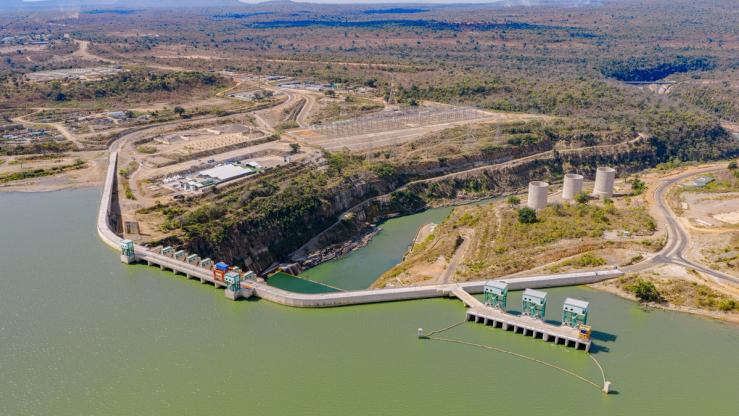
Tanzania announced its first gas discovery in more than a decade, a finding that comes